
The relationship between the church (especially evangelicals) and the political class has long been marred by images of politicians spewing vitriol from pulpits, and church leaders calling press conferences to uphold whatever vile machinations the government of the day has devised against its citizens. There’s the now-viral photo of President Trump seated, surrounded by church leaders laying hands on him in prayer, as if he didn’t just start an unjustified war. The church is often supplicant to whoever sits in power. Religion no longer speaks for the ordinary, the lowly, and the downtrodden. But then one might ask: when has it ever? Religion has upheld and, countless times, even spoken for almost every atrocity humanity has inflicted on itself. From the crusades to the slave trade, colonialism to genocide, someone has always carried a Bible and claimed vindication.
However, Fifth Wall Production’s play, Followers, staged from 27 to 29 March at Braeside Lavington, does something the church can’t or won’t do: speak truth to power.
Stay ahead of Kenya & East Africa’s film and TV.
Get our stories in your inbox — Subscribe to our newsletter now.
In an industry where liturgical theatre has consistently bared its teeth and demonstrated its ability to stretch beyond Biblical pages to engage with the cultural and political realities of today, Followers takes to the stage with a subversiveness and provocation that would almost be blasphemous if it weren’t actually aligned with the teachings of the Bible.
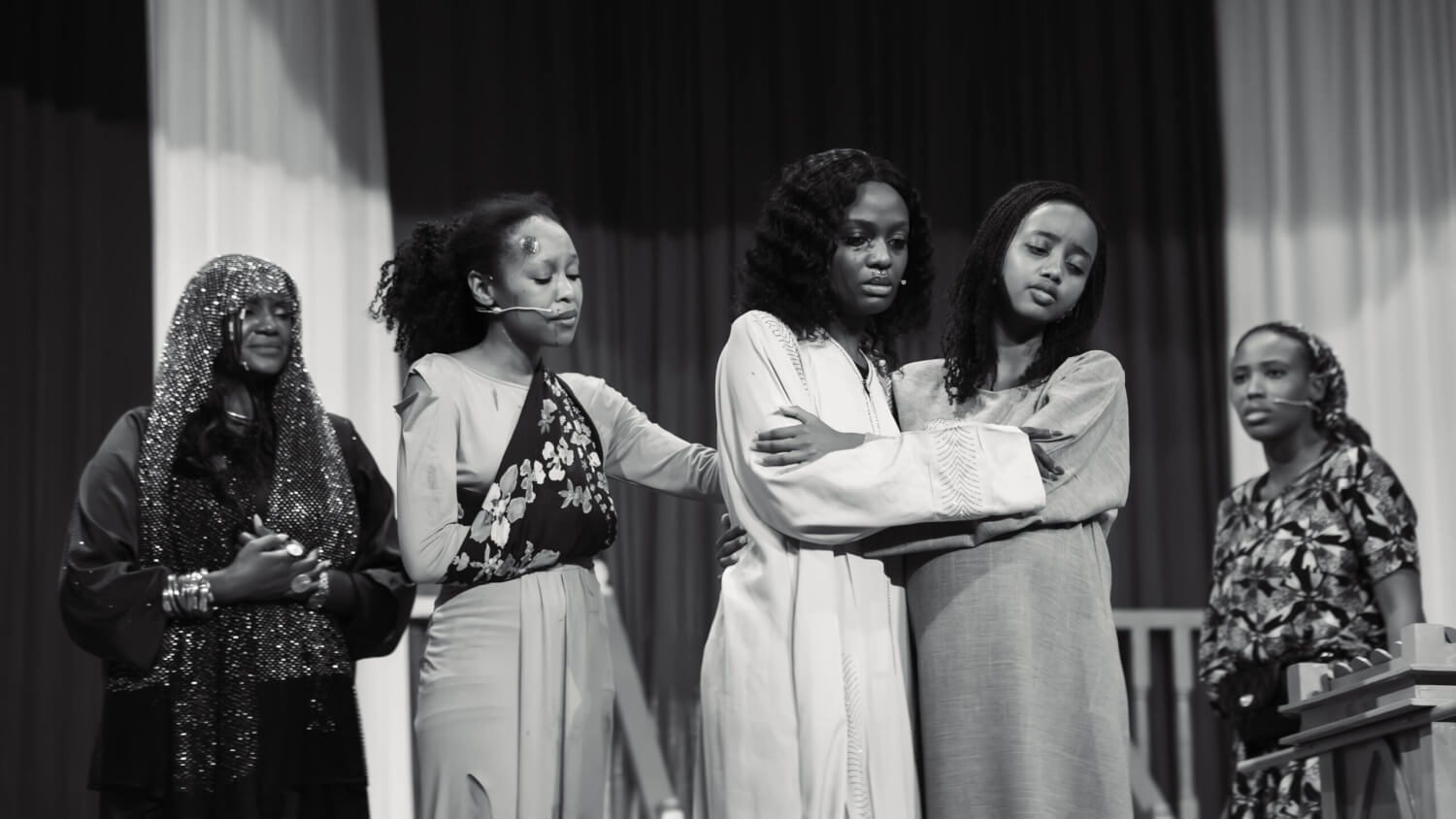
Written by Mercy Mutisya and Eunice Mwabe, and directed by Agnes Kola, Followers is a Biblical reimagining with a strong political and feminist lens. The play is a tense, three-hour drama set during the arrest of Jesus, told through the eyes of five women hiding within the temple’s forbidden inner courts. As unrest brews outside and the threat of both Roman force and religious punishment closes in, the women—each carrying their own beliefs, doubts, and pasts—are forced into difficult moral choices about loyalty, faith and survival. Confined together, their conversations unravel questions of power, silence and resistance, ultimately asking what it truly means to be a follower when standing by your convictions could cost you everything. The story unfolds over one night, almost in real time, giving it a sense of urgency and high stakes.
The play is driven by conversation and confrontation rather than action, meaning the performances rely on subtle shifts in tone, pauses, interruptions and vulnerability rather than theatrical projection. The characters talk, circle each other, confess, deflect, joke and unravel.
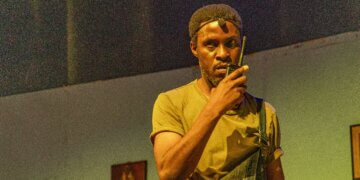
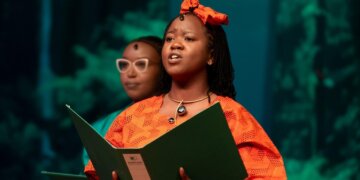
The cast overflows with talent. The five-person ensemble features Nyokabi Macharia (Mama Simon), Lorna Lemi (Mary Magdalene), Foi Wambui (Anna), Eunice Mwabe (Esther), and Marianne Nungo (Claudia), with Faiz Ouma, Will Mwangi, Sage Chemutai, Esther Kazungu and Bril Kenneth in supporting roles. The cast eschews big monologues and showy acting, opting instead for a tightly held, ensemble-driven tension in which each actor feels as though they are thinking and deciding in real time. The performances are deeply interdependent, with the actors constantly bouncing off one another and shaping each other’s energy.
Mutisya and Mwabe’s writing is nuanced, alive, and colourful, and strikingly un-theatrical, which fascinated and excited me in equal measure. It feels almost like improv, or something written for television. The writing feels like it is thinking out loud rather than presenting a finished thesis. I’m a sucker for genuine-sounding dialogue that feels both dialectal and dialectical. Every character in Followers sounds like a fully realised human being. The dialogue is intelligent; the characters don’t simply exchange information, they debate ideas.
For instance, in one scene, the play interrogates women’s complicity in the injustices perpetrated by the men around them. Macharia’s Mama Simon asks Claudia (played by Nungo), Pilate’s wife, why she does nothing as her husband rains terror upon the Jews. Claudia responds: “Power is like a current. Even the people who build the dams cannot stop the water.” That line carries both content and style. The content is the relationship between women and power; the style is analytical, layered with analogy, metaphor and hypothesis. This is what great dialogue looks like. In the hands of lesser writers, the response would have been something like, “I may be close to power, but I’m powerless,” or another unimaginative derivative.
The writers even go as far as to interrogate the very beliefs the play (being religious and all) is supposed to uphold. Followers questions the ineffectiveness of faith in the face of prevailing difficulties, but does so with enough tact that even hardline Christians would hardly take offence. Belief, the play tells us, becomes a question of survival, not just spirituality.
The writing balances the Biblical world of its setting and the contemporary world it seeks to comment on. The shift between the two is nuanced, organic and story-driven. The play succeeds in commenting on the present without pulling us out of its world. The language is contemporary both in syntax and tone, with characters moving fluidly between English and Kiswahili, grounding the dialogue in local texture.
The ruthless Roman officers in charge of Jesus’ arrest are juxtaposed with Kenya’s violent police. That chaotic night is juxtaposed with present-day government crackdowns. The public’s decision to release Barrabas, a known criminal, over Jesus, in a not-so-subtle way, is juxtaposed with our political climate today. Barrabas, hilariously portrayed by Faiz Ouma (who also takes on multiple roles), declares: “I burnt people in churches, I grabbed land, I stole money, and they still chose me, why?” Another character responds: “They chose you because you’re all they know.” Come on! This is what intelligent writing looks like. We know exactly who this Barrabas represents in Kenya’s political landscape.
Mwabe’s creative direction is strikingly fresh and arresting in its unconventionality. The first 30 minutes unfold offstage, among the audience, and in the space between the seating area and the stage. But the play is neither immersive nor does it attempt to be; the characters do not engage the audience directly or break the fourth wall. During this time, the stage – which is a character in its own right – remains dark, while the audience space is lit.
This offstage opening immediately destabilises expectation. You arrive prepared to watch, but instead find yourself sitting inside the atmosphere of the play before it formally begins. That alone isn’t new; many productions experiment with pre-show action or audience proximity. What makes this choice compelling is its refusal to become immersive theatre. The audience is caught in a strange position: physically implicated, yet dramatically ignored.
There’s also a lot of singing, even though the play is not quite a musical (for once, somebody allowed Nyokabi Macharia to sing on stage!). The entire ensemble sings, even Foi Wambui (who knew she could sing?). Unlike in a traditional musical, the characters in Followers don’t break into song to advance the story. Instead, they slip into it: a moment of fear turns into a hymn, a shared silence fills with something half-sung. And just as quickly, it falls apart or gets cut off. The music here doesn’t resolve tension, but it exposes it. It also doesn’t create spectacle. There’s no sense of choreography to it, no build toward applause. When the characters sing, it’s less about expression and more about grasping for something steady when language alone isn’t enough.
EDITOR’S NOTE:
All reporting, interviews, and reviews on Sinema Focus are protected under international copyright law and the Kenya Copyright Act, 2001. No part of this publication may be reproduced, rewritten, republished, or redistributed in any form by media outlets without prior written consent. For reprint or syndication inquiries, contact editorial@sinemafocus.com.
©️ 2026 Sinema Focus / African Film Press. All rights reserved.
Never miss a moment.
Get the latest stories from Sinema Focus delivered straight to your inbox. Subscribe to our newsletter now.