
About 20 minutes after I had settled into my seat at the Jain Bhavan auditorium, as the lights went up on stage and a gifted ensemble conjured the spirit of Africa’s first woman Nobel Laureate, Wangari Maathai, to walk amongst us once again, I remember thinking, “Finally, we have successfully created a uniquely Kenyan theatrical genre.” And I thought we might call this new genre mbaka, a Luo word inaccurately translated as “conversation” but actually without an English equivalent, and which, in practice, looks very similar to the performance Too Early for Birds (TEFB) staged in its latest biopic play, Wangari Maathai.
Mbaka has its performer(s), jambaka, build an entire world from the ground up, using whatever the moment demands: gripping narration, reenactment, bursts of dramatisation, movement and song. The result is something that feels total, self-contained. But “immersive” doesn’t quite capture what mbaka is. That word suggests a blurring between performer and audience. Mbaka goes further; it unsettles the boundary between performer and character. Jambaka is always having a conversation not just with their audience but also with whatever character they are inhabiting in the moment, sometimes even at odds with it. It’s not unusual, in mbaka, to watch a character turn back and mock the very performer bringing them to life.
Stay ahead of Kenya & East Africa’s film and TV.
Get our stories in your inbox — Subscribe to our newsletter now.
And what a great mbaka we had with Wangari Maathai as a people, as a culture, as a society, constantly in a state of yearning. We learned so much about ourselves, where we come from and where we are now through the life of this towering woman, whose roots of rebellion we were reminded never to stop watering. The play, reaching back in time to gather words long immortalised in history, admonishes us: “In the course of history, there comes a time when humanity is called to shift to a new level of consciousness, to reach a higher moral ground. A time when we have to shed our fear and give hope to each other. That time is now.”
Wangari Maathai is the ultimate refinement of a hybrid immersive-narrative theatrical form that TEFB has been running for a while now. The original technique, as seen in Tom Mboya and Baddassery, was quite simple, really; a historical biopic material with a contemporary political angle, comprehensive research, lyrical narrative-driven writing, and a deceptively simple stage design. This worked just well enough because, one, like most biopics in cinema and theatre, the audience, already familiar with the subject, has an embedded interest in the lives of these larger-than-life personalities. Add actors charismatic enough to distract the audience from the fact that this is, at its core, a scarcely dramatic three-hour-long history lecture, and you have a sold-out show.
But this technique was missing something that they finally figured out with Wangari Maathai: verisimilitude – giving the appearance of truth. The most successful biopics must dramatise actuality, possibly even elevate their subjects into the pantheon of cultural mythology, and show why they belong there. So, as you can probably tell, a narrative-heavy production, no matter how charming the actors and lofty the writing, would just be three very long hours of historical lecture. And at the end of the day, most people aren’t very appreciative of long lectures. Verisimilitude demands that the audience believe the actor portraying a given historical figure is that figure.
Tom Mboya (as well as Baddassery) had all the flair and the feels, but the play in itself failed to fully dramatise the actuality of the life of its eponymous historical figure, denying the audience the illusion of authentic intimacy with the real person. For the most part, Tom Mboya was a narration of the life of Tom Mboya, with dramatisation kept to a minimum.
Wangari Maathai does both narration and dramatisation equally and seamlessly, and that’s what earns it a place as one of the finest productions ever staged in Kenya. Here, we meet the real Wangari Maathai. We see her look like Wangari; we hear her talk like Wangari; and for three and a half hours, this magnificent woman, who was everything but life itself, is alive before us.
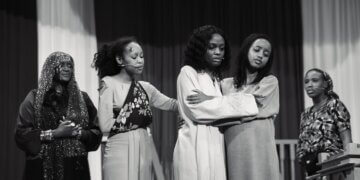
The play traces the life of Wangari Maathai from her rural upbringing to her emergence as a fearless environmental and political activist, weaving together moments of personal conviction, public resistance and national history. Through a fluid ensemble that is sometimes specific figures, other times composite characters representing broader systems, the play explores Maathai’s role in founding the Green Belt Movement, her clashes with state power, and her unwavering belief in the connection between environmental conservation, democracy and women’s rights. Rather than a straightforward biography, it unfolds as a collective retelling, alive with music, humour, and contemporary political commentary.
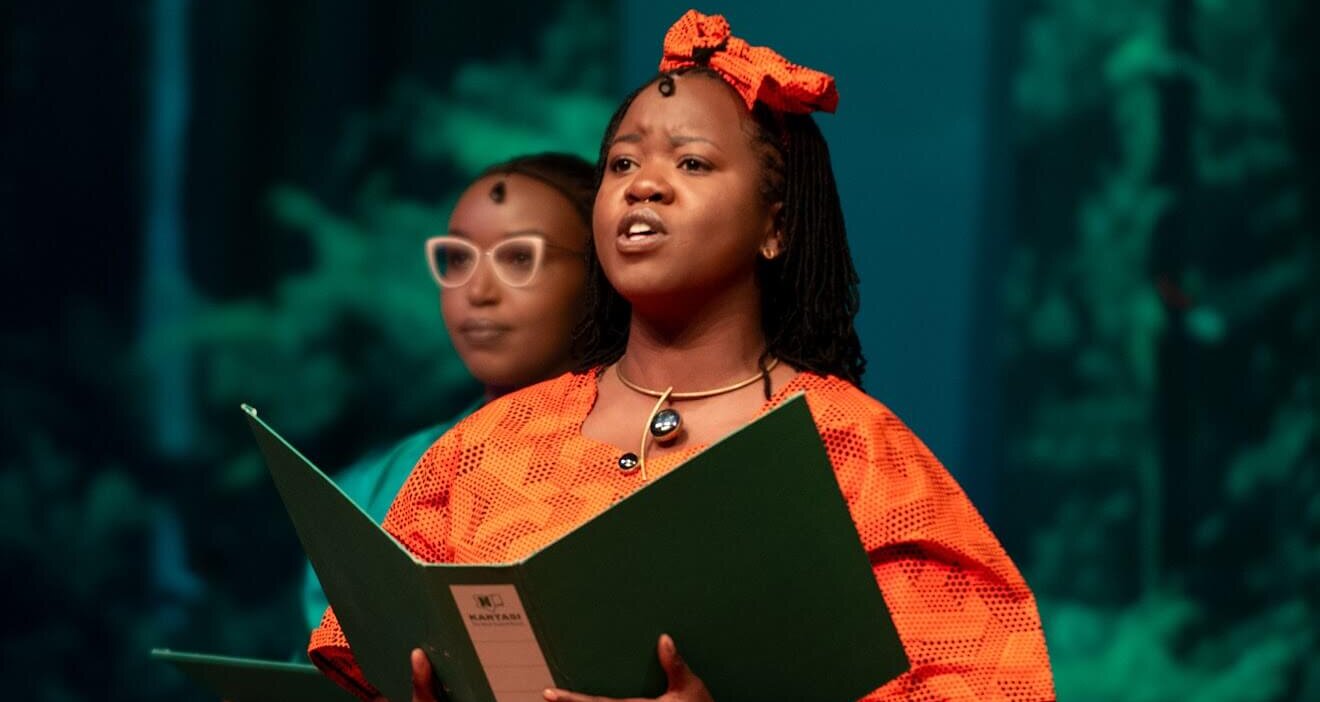
Director Martin Kigondu, as expected of a TEFB play, assembles an ensemble of charisma and gravitas: Akinyi Oluoch, Shiviske Shivisi, Joe Kinyua, Faith Wangare, Charles Gachanja, Sam Arlcons, Diya Vaya, Red Brenda and Karimi Rimbui.
The cast shifts between multiple characters, narrators, and historical figures, helping build the world around Maathai, played by Red Brenda as a curious girl and by Akinyi Oluoch as an adult. The ensemble moves with the elasticity, slipping between roles without ceremony, as though history were less a sequence of events than a set of arguments still in progress.
As the adult Wangari Maathai, Akinyi Oluoch’s likeness is uncanny. It feels as though history is passing through her body in real time. It’s amazing how she captures the physical and vocal essence of Maathai without tipping into caricature. At points, the production introduces recorded voices of Wangari Maathai, and it becomes difficult to tell whether what we are hearing is the real Wangari Maathai or Akinyi Oluoch as Wangari Maathai.
Structurally, the play works in that in-between space where history is told and lived at the same time, never fully settling into either. On one hand, the play leans into retelling: the ensemble acts as narrators, historians, even gossipers of the past. They summarise, jump across time, question events, and sometimes undercut the very story they’re telling. This keeps the audience aware that what they’re watching is a reconstruction, a version of Wangari Maathai’s life being assembled in real time, rather than a fixed, authoritative account.
There’s also a subtle dramaturgical trick: the play often lets others tell Wangari Maathai’s story before she steps into it. They describe her, debate her, even mythologise her, then she appears and complicates that image. This creates a sense that Wangarĩ exists both as a person in the moment and a figure being remembered and constructed. What’s striking is how fluidly the play moves between these modes. It doesn’t signal the shift with lighting cues or formal transitions; it simply moves, as fluidly as the characters breathe.
The kind of trust Kigondu has with his cast is rare, if it exists, because he does something I’ve never seen any director do: he allows his cast to design the stage to suit their performance in real time. In a typical theatre, actors adjust themselves to fit the stage. But not in Wangari Maathai, where we watch the actors build the world as they go. Chairs become a home, then a court, then parliament, then a prison, all controlled by the actors in full character under the glare of the lights. Of course, these movements must have been thoroughly blocked and rehearsed, but it still feels like the actors were making spatial decisions in real time.
The play also takes breaking the fourth wall to the next level. Here, the wall isn’t only broken between the proscenium and the audience; it’s dismantled between the actors and their characters. Characters refer to themselves and each other by their real names, even referencing their lives outside the play. At one point, a character complains about Joe Kinyua’s prima donna attitude because he is a big star in the popular TV show Njoro wa Uba.
The writing, led by Abigail Arunga, is just as inventive and playful, packed with sharp wit, self-deprecating mockery, high satire, and bare-knuckled political urgency. It demonstrates an acute understanding of who we are as a people: what we believe, what moves us, how we speak. This is a culture where a word or phrase can mean whatever the culture decides it means. Panda mti could be what Wangari Maathai is best known for, or it could be how babies are made. And the writing leans fully into this rhythm. It mocks us, the audience; it mocks the production (its length, its composition-like dialogue); it mocks the actors; and it mocks the government.
EDITOR’S NOTE:
All reporting, interviews, and reviews on Sinema Focus are protected under international copyright law and the Kenya Copyright Act, 2001. No part of this publication may be reproduced, rewritten, republished, or redistributed in any form by media outlets without prior written consent. For reprint or syndication inquiries, contact editorial@sinemafocus.com.
©️ 2026 Sinema Focus / African Film Press. All rights reserved.
Never miss a moment.
Get the latest stories from Sinema Focus delivered straight to your inbox. Subscribe to our newsletter now.