

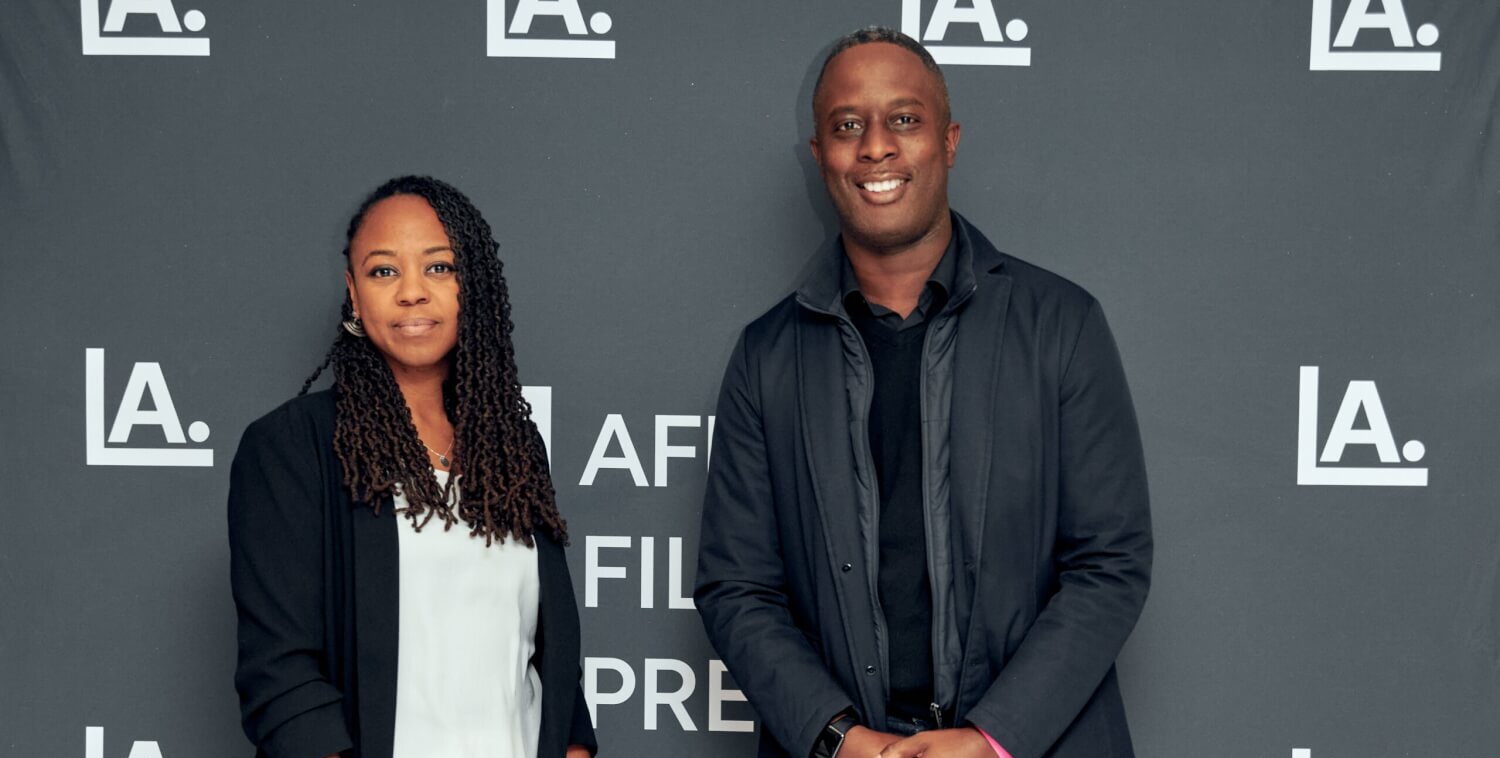
A scroll through Okada Media’s Instagram page reveals a catalogue of African films landing distribution deals across a diverse mix of outlets, from major players like Netflix, Amazon Prime Video and Canal+, to less common platforms such as Tubi, Allblk and Mansa.
This, in a nutshell, captures Okada Media’s core strategy in film distribution: expanding beyond mainstream channels and opening African stories up to platforms that filmmakers on the continent rarely consider, both within Africa and the diaspora.
Stay ahead of Kenya & East Africa’s film and TV.
Get our stories in your inbox — Subscribe to our newsletter now.
“The idea is not to create a dependency on just one platform,” Okada Media co-founder Nadira Shakur says.
Shakur co-founded Okada Media with her partner Serge Noukoue in 2019 to expand distribution opportunities for African filmmakers and increase access to their work globally.
Over the last six years, they’ve acquired a library of over 30 African titles that now includes Nigerian romantic drama and Berlinale-premiered All the Colours of the World Are Between Black and White; Cameroon’s L’axe Lourd (The Highway), widely promoted as the country’s first action thriller; Ugandan mystery-thriller The Girl in the Yellow Jumper; Tanzanian drama Binti and Kenya’s 2023 Oscars entry Mvera.
More than half of the titles in this library have landed on Netflix, including Uganda’s first film on the platform The Girl in the Yellow Jumper, as well as Tanzania’s first Binti. Therefore, in the last few years, for many filmmakers in East Africa, Okada Media has been perceived as a bridge between Netflix and the industry, so much so that Noukoue notes that some believe they’re an “agency for Netflix.”
“We’re an international distribution company. We’re not an aggregator for Netflix,” Noukoue clarifies. “We work with a lot of different platforms in different territories.” It’s very important for him to clear this misconception, especially as they continue to build a distribution model that looks beyond a single streamer like Netflix.
Netflix’s entry into Africa in 2016 was met with much excitement and widely seen as a watershed moment for the continent’s film and television industries. This optimism was reinforced as Netflix commissioned one African Original after another, investing $175 million in content and the local creative ecosystems in South Africa, Kenya and Nigeria between 2016 and 2022, according to its 2023 Socio-Economic Impact report.
A lot has happened since then, and that early momentum has given way to something closer to caution as reality began to set in. One reality is that Amazon Prime Video exited Africa in January 2024, leaving Netflix as the only major global player on the continent, before Canal+’s 2025 acquisition of MultiChoice of course.
The second reality is that in that same year, if you were paying closer attention, you started noticing a pattern with Netflix: the streamer had slowed down its acquisition of originals and licensed titles in Nigeria – its second most active market after South Africa – and in Kenya, its third most active market in Sub-Saharan Africa. South Africa remains its most active market, albeit with a more controlled output.
The third reality is that there are more players out there other than just Netflix, but for many Kenyan and African filmmakers, Netflix has always been the end goal, viewed as the peak of success, a symbol of “finally making it.”
“Most filmmakers see being on Netflix as a badge of honour,” says Shakur.
Granted, with a presence in over 190 countries and more than 300 million subscribers globally, Netflix offers an unrivalled reach. Some African titles, like Blood & Water and The Black Book, have managed to unlock this reach with impressive viewership across territories, but only one has reached the pinnacle – South African film Heart of the Hunter which became the first (and, to date, the only)) African title to debut at no. 1 globally on Netflix with 11,000,000 views in its first week. Who wouldn’t want their work watched by audiences across the world, in places whose names we’ve never even heard of?
However, as aforementioned, Netflix’s Africa strategy has shifted in the last two years. Other than reduced investment, more titles are now geo-locked to African territories, cutting global reach tremendously.
In this ever-changing and uncertain landscape, Noukoue and Shakur stress that diversification is the answer. “Depending on one platform is like putting all your eggs in one basket,” Shakur cautions. “We’ve seen what happens with global streamers like Amazon and Netflix, and then you have to suddenly scramble to find a plan B or C.”
But make no mistake, this approach is not reactionary for Okada, their strategy has always prioritised diversification for this simple reason: “The more places you can put your work as a filmmaker, the more revenue you can bring in,” says Shakur. “The whole point of a distributor is that we’re here to fight for eyeballs in revenue for all the projects we are representing. We take the agreement we sign with a filmmaker very seriously so it’s important for us to try as hard as we can to maximise the potential from any title we acquire and not just let it sit in our library.”
Beyond distribution on VOD platforms, Okada Media has also worked with broadcasters such as Canal+, MultiChoice’s M-Net, France Television, Ivory Coast’s RTI and NCI, Bénin TV and Australia’s Special Broadcasting Service (SBS).
In the last few years, the company has been expanding into cinema distribution, beginning in 2024 with the Tanzanian-Kenyan collaboration The Christmas Run. In 2025, Okada Media handled local distribution for the Kenyan-Swedish crime noir The Dog, which screened in Nairobi, Kisumu and Mombasa soon after its premiere at the NBO Film Festival. Most recently, the company entered a partnership with Pathé Touch Studios to release its films in East Africa.
The right term for it, Noukoue explains, is “building back” cinema culture in the territories they operate in. “The culture did exist at some point but now people are really not going to the cinemas. We’re sitting on a goldmine here, just waiting to be unlocked,” he says.
Shakur doesn’t mince her words, adding: “Cinema can be the biggest gamechanger for film industries across the continent, more than being number one for one week on Netflix.”
The company has also tapped into one of the most overlooked routes for African films: inflight distribution. As with cinema, the opportunity here is ripe for the taking, Noukoue notes. “People are travelling more and more, and airlines are competing to entertain passengers by offering them more options than ever before.”
But despite the potential, the African catalogue is still smaller even on African carriers. “There’s a lot more opportunity in the space, but there’s still a mismatch between the potential and reality,” says Noukoue. “But we want to increase representation of African films and make a difference in that space.”
In September 2025, Okada Media signed a deal with Nigeria-based Nemsia Studios to bring Nollywood stories to global airline audiences. Nemsia is known for projects such as Breath of Life, After 30, Ms. Kanyin and Suky, through its deal with Amazon Prime Video.
Through this collaboration, Okada Media is distributing 13 of Nemsia’s signature titles across international airlines. “We are showcasing the depth, diversity, and sophistication of Nollywood to audiences who may be experiencing it for the first time. It’s an opportunity to expand global perceptions of African cinema, one flight at a time,” Noukoue said of the partnership at the time.
It’s also about getting better deals for African filmmakers as Shakur says. “With airlines, the contracts are shorter, and so are the release windows. The turnaround time for paying licensing fee to filmmakers is also quicker than VOD platforms, so it’s even more lucrative.”
Noukoue explains that inflight distribution is also not tied to exclusivity as most streaming deals usually are, giving filmmakers a chance to explore as many options as possible. “It’s a bit of a sweet spot because it doesn’t affect any other releases you may have. It’s really additional income for filmmakers,” he says. “Also consider the fact that there are a variety of airlines, and you’re not restricted to Africa in the same way as a VOD or linear platform.”
But Okada Media’s approach to distribution does not exist in isolation. Long before its existence, Noukoue and Shakur founded Nollywood Week Film Festival in 2013 as a platform to showcase Nigerian cinema to global audiences in Paris, while fostering networking and industry dialogue. While still rooted in Nollywood, the festival has in recent years expanded to represent more territories in Africa and the African diaspora, in what Noukoue describes as a “deliberate strategy” to create more opportunities for African filmmakers.
Does the festival retain its name despite its growing pan-African approach? “You shouldn’t look at the name ‘NollywoodWeek’ as a barrier or obstacle to non-Nigerian filmmakers,” Noukoue clarifies. “The name really is about branding, like afrobeats which started in Nigeria and now is everywhere.”
NollywoodWeek, he stresses, is a festival “for the people, by the people”, a platform prioritising audience-facing projects that are not just “elitist” or “festival” films.
The line-up for the 2026 edition, which runs from 6 to 10 May, includes Mothers of Chibok (Joel Kachi Benson, Nigeria), When Nigeria Happens (Ema Edosio, Nigeria), The Fisherman (Zoey Martinson, Ghana), Memory of Princess Mumbi (Damien Hauser, Kenya), Goat (Judy Kibinge, Kenya), and Batwing Unmasked: An African Superhero (France).
“We don’t just want to increase representation, but also create opportunities for co-productions and cross-border collaborations within the continent,” says Noukoue. “NollywoodWeek offers a neutral platform in the middle of Paris where the diaspora, Francophone filmmakers and African audiences can converge. There’s a lot of ideation in a space like that and we really want to reinforce that.”
For Noukoue, a number of festivals adopt the pan-African label but have failed to generate any meaningful collaborations for African filmmakers and its audiences. “For a long time, African filmmakers have been trapped within their regions and language blocks, and we want to break that with the festival,” he says.
This emphasis on cross-border collaboration extends into Okada Media’s own work, including Tanzanian-Kenyan co-productions Married to Work (2023) and The Christmas Run (2024), where Noukoue and Shakur served as executive producers.
In Paris in May, under the 2026 theme “Voyage”, NollywoodWeek will open and close with East West Love (a Nigerian-Kenyan collaboration helmed by Tanzanian director Seko Shamte) and Ogene (a Nigerian-Japanese collaboration) respectively.
But creating pathways for collaboration and for African films to travel is only one part of Okada Media’s work. The other, Shakur reveals, is helping filmmakers understand the systems that shape that movement in the first place. “You cannot build without creating systems, and without education,” she says.
Beyond distribution and NollywoodWeek, the company also engages filmmakers on the business side of the industry, from licensing structures to intellectual property rights and the mechanics of deal-making. This education, Shakur explains, becomes even more crucial in Africa, where most film industries still lack the structures to adequately protect creators.
“The only way to understand if you’re being treated fairly, or the only way for someone to cheat you is when you don’t understand how things work or have something to compare to,” she says. “We’ve noticed that this is a huge issue across the continent.”
Noukoue describes it as “working against the tide” or “fighting so many battles at once”, an effort they are intent on doubling down on. “We try to do as many webinars as we can, but we want to do more of these lessons. We’re hopeful, and we think that the future is great.”
EDITOR’S NOTE:
All reporting, interviews, and reviews on Sinema Focus are protected under international copyright law and the Kenya Copyright Act, 2001. No part of this publication may be reproduced, rewritten, republished, or redistributed in any form by media outlets without prior written consent. For reprint or syndication inquiries, contact editorial@sinemafocus.com.
©️ 2026 Sinema Focus / African Film Press. All rights reserved.
Never miss a moment.
Get the latest stories from Sinema Focus delivered straight to your inbox. Subscribe to our newsletter now.