

“Tell me about a complicated man. Muse, tell me how he wandered and was lost when he had wrecked the holy town of Troy.”
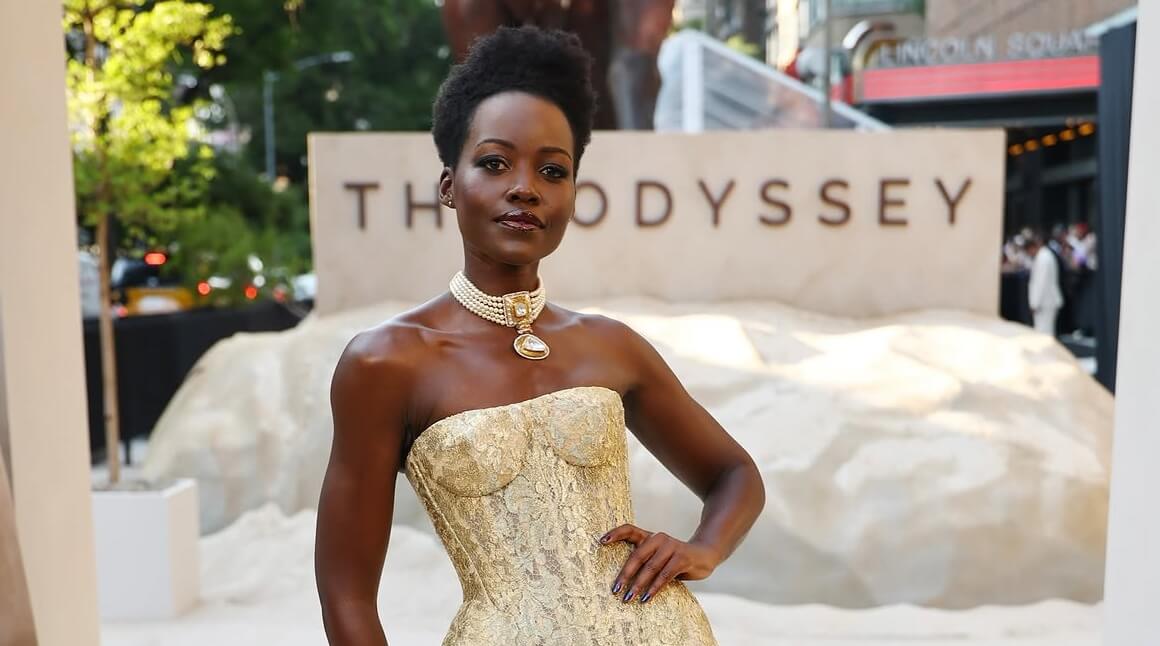
When it was announced that Lupita Nyong’o would be the latest actor to play Helen of Troy – the woman whose abduction supposedly launched a decade-long war – Elon Musk, the richest man in the world, and many of his followers responded in disbelief. Their objections could be distilled into a single question: who would ever go to war for her? Poetically, life imitated art, and the internet has been at war over the Kenyan Academy Award-winning star ever since. To understand why, however, it helps to start at the beginning.
Stay ahead of Kenya & East Africa’s film and TV.
Get our stories in your inbox — Subscribe to our newsletter now.
The Odyssey outperformed expectations in previews and during its opening weekend, grossing an estimated $264.1 million globally. Believe it or not, some people were genuinely surprised that the film opened so strongly. For better or worse, there is a faction of audiences that can only see Christopher Nolan’s adaptation as an explicitly Western story. In Europe and the United States, many on the political left celebrate it as a cornerstone of Western civilisation, arguing that its enduring appeal lies in its emphasis on moral agency, perseverance and redemption rather than ethnicity.
Their conservative counterparts, meanwhile, want it to remain the story of a Western man who will stop at nothing to protect his Western family from threats abroad and at home. That is usually the point at which words you’d be hard-pressed to hear in everyday conversation begin flying around: “virtue signalling,” “forced diversity” and “diversity hire.”
These readings, regardless of where they fall on the political spectrum, tend to divorce Western achievements from human achievements. The wheel is a human achievement. So are the pyramids, paper and fire. Meanwhile, space travel, the internet, the automobile and filmmaking are often treated as exclusively Western achievements. In this worldview, credit is only given when it’s Western; otherwise, it’s shared by all of humanity.
History is simple according to these readings. The good guys did the right thing. And when they did overstep, they regretted it to such cosmic proportions that it made them better men. The bad guys died at the end. And, preferably, Helen of Troy had blonde hair and blue eyes. When she didn’t, it became a testament to how much progress Western civilisation had made over the years.
But for reasons many seem to have misunderstood, Nolan chose none other than Nyong’o to play the pivotal – albeit brief – role. I’d say it’s a blink-and-you’ll-miss-it performance, but the entire final sequence of Odysseus’ (Matt Damon) homecoming, doesn’t work without the context of Helen’s own complicated return to Sparta after a war that tore her family apart in more ways than one.
Nyong’o is no stranger to controversy. In the years since her Academy Award win, she has been selective but effective in the roles she has chosen, and her calling card has become Jordan Peele’s doppelgänger horror film Us. While the film explores how poor people and the underclass are just like “us,” in the years since its release, it has been co-opted by the xenophobic Black American group known as the Foundational Black Americans (FBA).
The FBA took the film to signify that African immigrants to the United States seek to replace them in the economic opportunities the country offers, or, as they call it, a “destiny swap.” Nyong’o has become the obvious poster child for the movement’s grievances because of her African roots. And with every major magazine cover or high-profile press run she does, commentary about where her identity belongs inevitably follows – both abroad and right here at home.
In the lead-up to the release of The Odyssey, popular Kenyan podcaster Mwafreeka appeared on Coffee Pump, hosted by Sajid Vajani, where the two briefly discussed Nolan’s casting as misguided. “As a Kenyan, I’m happy,” Mwafreeka said, “but that will end up being the Achilles’ heel of the movie.” He added, “The movie might end up performing badly because of that.”
The Odyssey has now become the biggest opening of Nolan’s career, eclipsing his 2012 film The Dark Knight Rises.
Throughout all this, Nyong’o has never directly addressed criticism of her identity. Instead, she’s responded to concerns about her casting by saying, “You can’t perform beauty. My thought was, well, there’s nothing I can do about that. It’s either people think I’m beautiful or I’m not… and so who is Helen beyond that?”
Also Read: Edi Gathegi Doesn’t Need a Breakout. In ‘Superman’, He’s That Guy – and It’s His Universe Now
Helen has been many things to many different people. To certain podcasters and trillionaire tech magnates, she is the definition of a beautiful white woman. To Paris, the prince of Troy, she was an irresistible seductress. For Menelaus (played by Jon Bernthal in The Odyssey), she was property. And when someone takes your property, you fight to get it back.
Nolan, however, characterises Helen as something entirely unique. Across the many adaptations and reimaginings of Homer’s works, the debate has long raged over whether Helen left Sparta for Troy of her own accord. As time passed and the agency of every character came under greater scrutiny, it became widely accepted that Helen left willingly. That interpretation suited contemporary Western culture better than the early 20th-century understanding that she was kidnapped and eventually came to love Troy. Which is fine; after all, Fyodor Dostoevsky once wrote, “There is no subject so old that something new cannot be said about it.”
For Nolan, the arc of his career since Dunkirk has bent toward a more political meditation on war and its collateral damage.
In Nolan’s adaptation, war is ugly, pointless and devoid of glory. Most importantly, it turns heroes into villains. Odysseus is so guilt-ridden that he spends 10 years raiding and pillaging various islands because, deep down, he doesn’t want to go home. He doesn’t feel he deserves to.
Damon doesn’t play Odysseus as physically lost; he plays him as spiritually lost. He knows he has sinned. Zeus’s Law is brought up incessantly throughout the film. It demands that all Greeks treat strangers as though they were Zeus in disguise, whether beggar or traveller. In those days, Zeus was believed to walk among men, testing who deserved his blessings and who deserved his curses. With the Trojan Horse, Odysseus knows he has broken Zeus’s Law.
If Zeus could look like anyone, and if Odysseus could look like a beggar – and all of this is in the text – Nolan asks us: who could look like Helen?
Ultimately, Nolan’s point with The Odyssey is that, first and foremost, it’s a global story. The mockery surrounding the casting of Nyong’o, Himesh Patel, John Leguizamo, Zendaya, Wil Yun Lee and Elliot Page comes from people who struggle to understand that ancient Greece is not just a pillar of Western civilisation, but of global civilisation. The casting is meant to feel just as natural as it would have if the cast had been entirely American.
In Homer’s Iliad, which explores the Trojan War in greater depth, Ethiopia is mentioned as a land where the blameless Aithiopes (“burnt-faced people”) hold feasts. With that context, it is not especially inconceivable for a bard who looks like Travis Scott to sing about the Trojan War before every feast.
That being said, it’s only people unfamiliar with Homer’s work who found Nolan’s interpretation unsatisfying. Emily Wilson – the author of the very translation of The Odyssey Nolan adapted – said she kept looking in vain for an Odysseus who was glory-hunting, like the one in the book she had just translated, but all she found was his shame.
I would disagree with that slightly because, when Odysseus is finally shown fighting, it’s perhaps the most glorious I’ve seen a man in battle this entire year.
We can thank 88-year-old author Joyce Carol Oates for Musk’s fixation on this film. At one point, she got tired of Musk’s antics on X and went viral after dressing him down, writing, “So curious that such a wealthy man never posts anything that indicates that he enjoys or is even aware of what virtually everyone appreciates – scenes from nature, pet dog or cat, praise for a movie, music, a book (but doubt that he reads); pride in a friend’s or relative’s accomplishment; condolences for someone who has died; pleasure in sports, acclaim for a favorite team; references to history.”
Oates added, “In fact he seems totally uneducated, uncultured. The poorest persons on Twitter may have access to more beauty & meaning in life than the ‘most wealthy person in the world.'”
From that point on, Musk and many of his online mentees began focusing on films and what they should look like. After The Odyssey performed well at the box office – and because this is a group that values the fruits of capitalism as the ultimate evidence of success – they pivoted to calling on Musk to fund an adaptation of his own, preferably directed by a reformed Mel Gibson.
Musk, who is perpetually preoccupied with his various tech companies, saw an opportunity and has now promised his followers an AI adaptation of The Odyssey by the end of the year.
Nolan adapted The Odyssey to answer a simple question: does Homer still have something to say in 2026? His film suggests that he does. Homer can still tell us that wars – whether cultural or actual – are fought on behalf of people who have little say in them, leaving ordinary men traumatised, ashamed and spiritually lost.
If that’s the story Nolan wanted to tell, then it’s difficult to imagine a more fitting Helen than Lupita Nyong’o: a woman whose own identity has become a battlefield for arguments that were never really about her.
EDITOR’S NOTE:
All reporting, interviews, and reviews on Sinema Focus are protected under international copyright law and the Kenya Copyright Act, 2001. No part of this publication may be reproduced, rewritten, republished, or redistributed in any form by media outlets without prior written consent. For reprint or syndication inquiries, contact editorial@sinemafocus.com.
©️ 2026 Sinema Focus / African Film Press. All rights reserved.
Never miss a moment.
Get the latest stories from Sinema Focus delivered straight to your inbox. Subscribe to our newsletter now.