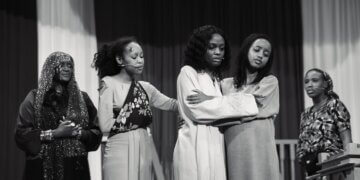

While all art forms can make us feel and think, theatre offers something more immediate: the ability to see and hear, live and in front of us, the experiences of other human beings. That is what makes theatre such a powerful medium for social change, particularly when it comes to challenging stigmatising attitudes towards mental illness and the people living with mental health conditions. Live performance allows for a shared human connection as we witness a portrayal of human life unfolding in real time, deepening our ability to empathise with the characters on stage. And it is through empathy that complex issues such as mental illness can be humanised.
Now art, in any form, at its highest expression, is religious. And I don’t necessarily mean that in the spiritual sense, but in the way great art does what humanity itself aspires to do: bring us closer to absolute truth.
Stay ahead of Kenya & East Africa’s film and TV.
Get our stories in your inbox — Subscribe to our newsletter now.
In the Seashell Hum, staged at the Kenya National Theatre from 15 to 17 May, and marketed as a mental health play, sheds no new light on this weighty subject. Still, through its poetry and the electric performance of its cast, it brings us closer to absolute truth as words, images, and ideas possibly could.
For two hours, we sat frozen as we journeyed through grief, melancholy, despair, anxiety, paranoia, spikes of levity, fear, and other emotions that wouldn’t fit our limited human vocabulary. Until we didn’t. When the play ended, I felt rejuvenated, like I had stepped beyond some invisible barrier. Like there was a before In the Seashell Hum, and an after. And I wondered: how did this play that offers no fresh perspective or insight on mental health beyond the same old truths of “love, support, and care conquer all” unburden me thus?
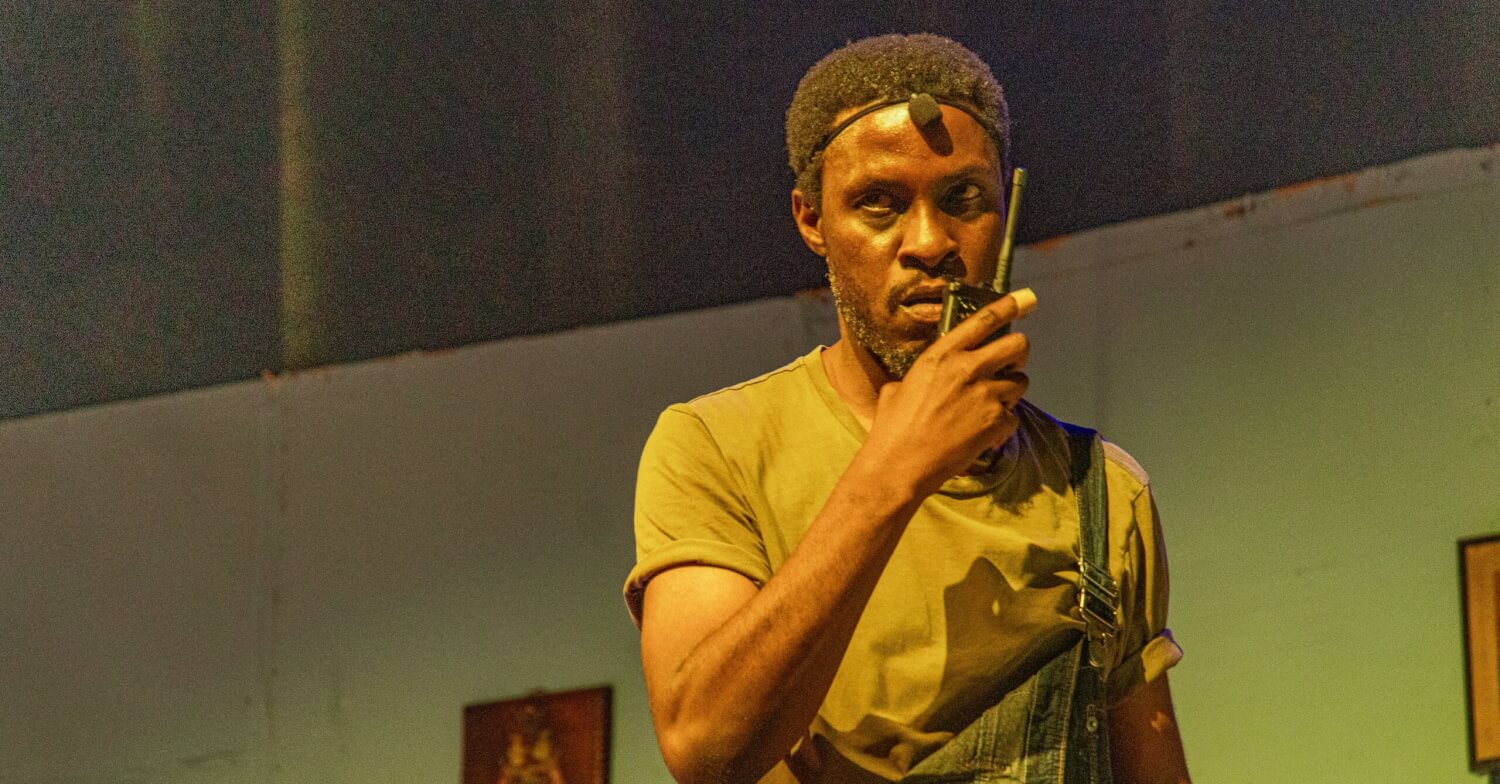
Written by Adipo Sidang (Parliament of Owls) and directed by Victor Gatonye (40 Sticks), the play is a haunting, psychologically charged drama centred on Baraka (played by Nick Ndeda), a brilliant, creative young man battling severe mental illness. While eloquent and gifted, Baraka is trapped inside a violent storm of hallucinations, paranoia, fractured memories, and intrusive voices. The play follows his gradual psychological unravelling as the people around him, including us in the audience, struggle to understand whether they are witnessing genius, trauma, or a complete psychiatric collapse. Around him are characters trying, and often failing, to reach him emotionally, each revealing different social attitudes toward masculinity, care and stigma.
Baraka’s arc is almost political because the play postulates him as the symbol of the modern boy child taught to endure suffering quietly until the mind turns against itself.
Ndeda plays this character with a fury that feels pulled from the bowels of Earth. He taps into such energy and clarity that makes Sidang’s lyrical language sing and sting at will, and never, for a second, loses control. Opposite him, Foi Wambui, as Baraka’s girlfriend, delivers probably the best stage performance of her career. She darts across the stage like a ball of light: restless, wounded, sly and funny all at once. Against Ndeda, she becomes the sail to his wind. Angela Mwandanda’s calmer performance seems to bend the emotional atmosphere of the stage, while Gitura Kamau attacks his role with astonishing velocity, firing off language with wit and desperation, as though words themselves are keeping the character alive. And Benson Ojuwa’s voice, on and off the stage, rolls through the theatre like a mighty storm.
Under Gatonye’s direction, the production leans heavily into poetic surrealism, soundscapes and emotional fragmentation, with ominous music and sonic design by Eric Musyoka, amplifying the feeling that Baraka is drowning inside his own consciousness.
As I said before, Sidang isn’t really looking to add a new voice to the mental health discourse, nor does the play strive for universality of ideas. Instead, the production leans heavily into ambiguity to achieve profundity. What’s real and what’s not? In the Seashell Hum robs the conventional interpretations of reality of their relevance and power. Baraka’s identity as a “former soldier”, for instance, is deliberately unstable. The audience is never given enough certainty to cleanly separate lived history from psychological fragmentation.
At times, Baraka speaks and carries himself with the specificity of someone deeply marked by violence and militarised trauma; at other moments, the play strongly suggests that parts of his biography may be self-authored myth, delusion or symbolic projection emerging from his deteriorating mental state.
So the question becomes less “Was he really a soldier?” and more “What does the soldier represent inside Baraka’s mind?” This ambiguity is reinforced through fractured transitions, sound design, and surreal tonal shifts, making the audience inhabit Baraka’s unstable consciousness rather than observe it objectively. Is he suffering from PTSD or something he inherited from his mom, who the play informs also suffered from mental health challenges that resulted in her suicide? Does Baraka’s art save him or torment him? Does his art give him a sense of identity or strip it away?
The play refuses to resolve the ambiguity because certainty would weaken its emotional core. Baraka is a man at war, whether with memory, society, masculinity, or his own mind, and the audience is left suspended between reality and hallucination the same way he is. And yet I felt that with this ending, the play released me from myself, left me with the feeling of acceptance. I do not have to name my inner demons and learn where they come from. I do not even have to fight them. I just have to find a way to coexist with them peacefully. For Baraka, that turns out to be his art and the love of those around him.
In the Seashell Hum is not optimistic, but it’s compassionate. Rather than descending into a didactic, modern mental-health chest-thumping manifesto, it leans into catharsis. It grasps for meaning in the darkness and transcends it. And in doing so, the play becomes religious.
EDITOR’S NOTE:
All reporting, interviews, and reviews on Sinema Focus are protected under international copyright law and the Kenya Copyright Act, 2001. No part of this publication may be reproduced, rewritten, republished, or redistributed in any form by media outlets without prior written consent. For reprint or syndication inquiries, contact editorial@sinemafocus.com.
©️ 2026 Sinema Focus / African Film Press. All rights reserved.
Never miss a moment.
Get the latest stories from Sinema Focus delivered straight to your inbox. Subscribe to our newsletter now.