
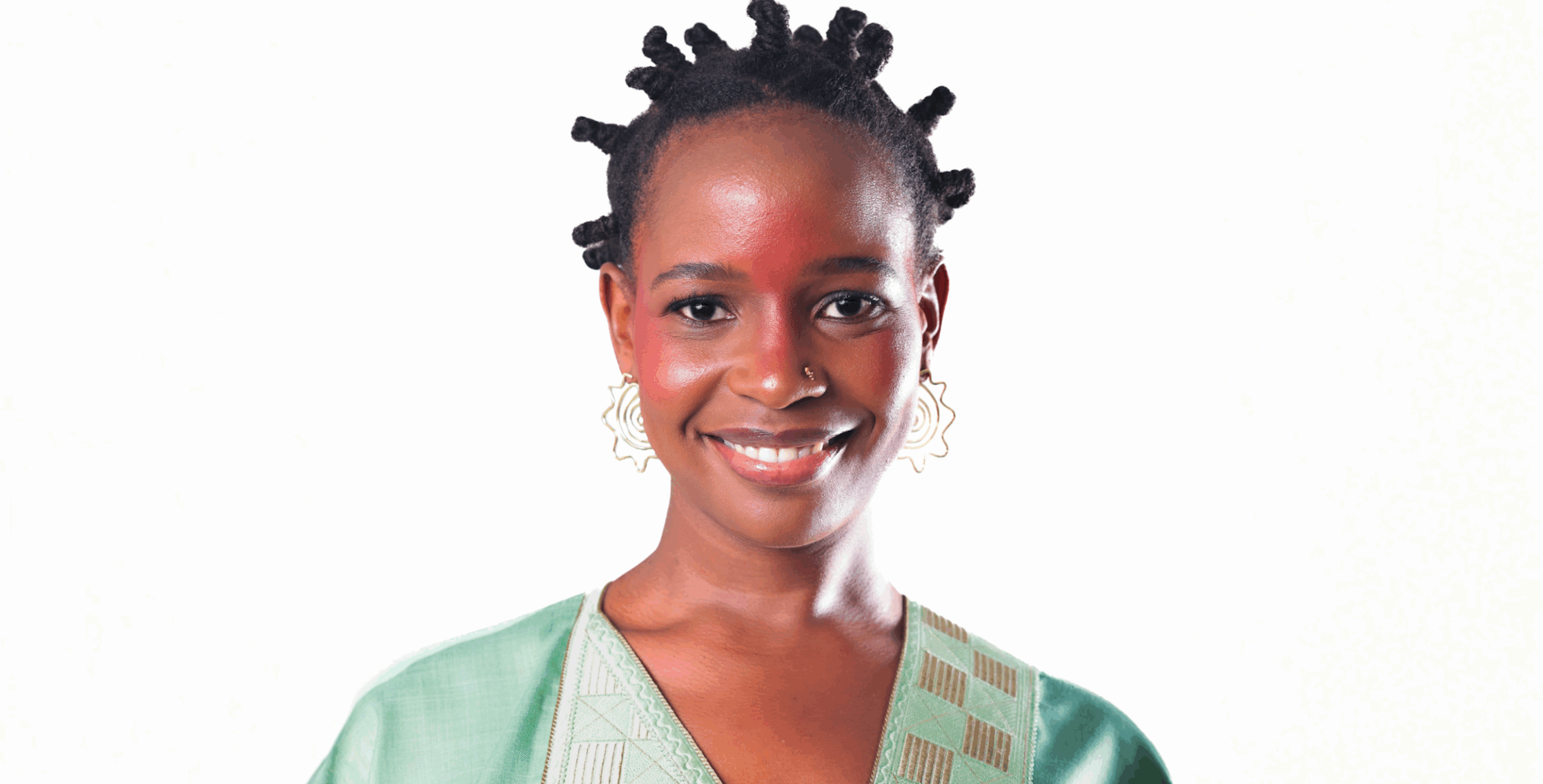
For a long time, documentary film in Africa was yoked to the burden of instruction: it was supposed to teach, to testify, to wring tears on cue. The result, too often, was cinema that felt embalmed in its own moral duty. But the best of it today across the continent is far from dutiful. It is sensual, contradictory, sometimes even messy – because life itself is messy. Right now, the form has never been more electric: rougher, more intimate, less impressed with its own virtue. A new generation of African documentary filmmakers is wriggling free. Nyasha Kadandara is one of the jailbreakers, belonging to this new, unruly strain, and embodies that voltage.
Perhaps that is why I felt compelled to sit down for a conversation with her, one she would begin by indirectly prompting me to observe something striking. Kadandara doesn’t rush to define herself. When she speaks of her work, her sentences take the long way around, as though she is circling an image, waiting until it reveals its fullest dimension. She brings the same patience in her filmmaking. Before she lifts her camera, she prefers to sit, to watch, to understand. Once, before filming, she attended a church service with a subject – no camera, no equipment, just her presence – because reverence, for her, has to be earned. That instinct is the heart of who Kadandara is: an award-winning pan-African director and cinematographer whose art is inseparable from her humility, and whose stories carry both beauty and value for her subjects.
Stay ahead of Kenya & East Africa’s film and TV.
Get our stories in your inbox — Subscribe to our newsletter now.
Born in Zimbabwe and currently residing in Nairobi, Kadandara has lived outside her home country since the age of 18, navigating the shifting coordinates of the diaspora. It makes sense, then, that her art refuses to stay put in one medium. She drifts between virtual reality, podcasts, fiction, and nonfiction with the same unsettled curiosity that keeps her moving across borders, always in pursuit of one question: how do African lives appear on screen, not just represented but fully seen? Her films are attempts to answer that question, wrestling with visibility in all its emotional and political dimensions. She insists that her urgency as a filmmaker is not merely to archive, but to honour, and to help herself and her communities feel present in moving images.
As a filmmaker who moves between worlds – Zimbabwean, pan-African, global – Kadandara admits this state is a curious, shifting gift. “It is always an interesting place to be in, which I really love,” she says. She occupies that space many diasporic Africans know well: insider and outsider, familiar yet foreign, belonging everywhere and nowhere at once.
And then, there’s the matter of the camera, and what it means to hold one as an “African” filmmaker.
As an African female cinematographer, still a rare sight on most sets, her very presence disrupts expectations. “You just don’t see people like me very often, sadly,” she says. A woman walking through unfamiliar cities with a camera slung over her shoulder tends to draw attention. “But I think as a woman, I am less threatening. And I try my best to connect with people.”
That connection often starts with shared details, small but resonating: the way childhood games echo across borders, or how a dish prepared in one village reminds her of home. “We can be very different as Africans,” she says, “but we can also be so similar.”
This ethos took its most elaborate form in Matabeleland, her seven-year odyssey of a documentary that premiered at the Copenhagen International Documentary Film Festival (CPH:DOX) in 2025. The story follows Chris Nyathi, a Zimbabwean truck driver living in Botswana, whose resilience carries the weight of a violent history – Robert Mugabe’s Gukurahundi massacres, which claimed his father’s life.
With Matabeleland, Kadandara was documenting something charged and painful. On Gukurahundi, she admits she knew there were no simple answers – only a series of decisions, each heavy with consequences. “It’s a very hard one,” she admits. “And it’s a fine line.”
The line she refers to is the one between ethical responsibility and emotional harm: the filmmaker’s duty to bear witness versus the risk of retraumatizing communities still navigating the silences of a wound that has never closed.
That balancing act shaped nearly every creative and editorial choice. “We tried to be very deliberate when we talked about what happened,” she says. Notably, the documentary does not open with the violence. There is no archival voiceover setting the stage. Instead, Kadandara leads with character, not chronology. “We really thought about the audience journey, and what you needed to know about Chris and when you needed to know it,” she says.
The duality of being close but not entirely of a place shapes her. “In making a film like Matabeleland, it was still an insider-outsider experience,” she says. “I was an insider as a Zimbabwean, but I was an outsider as a Shona making a film about a tragedy that happened amongst the Ndebele community.” The historical divide could have been a barrier, but instead it became something she chose to acknowledge openly.
“I do not pretend to be something I am not,” she says. Her honesty, paired with the fact that she was born in the region, allowed people to let her in.
Kadandara has learned that on the continent, hospitality often meets humility. “People are actually much more welcoming than you think,” she says. “They are more excited that you came from wherever you came from, rather than someone they are used to seeing from far away.” And when the questions come – about differences, about home, about how she sees them – she responds with something simple, something grounding: “We are all human beings.”
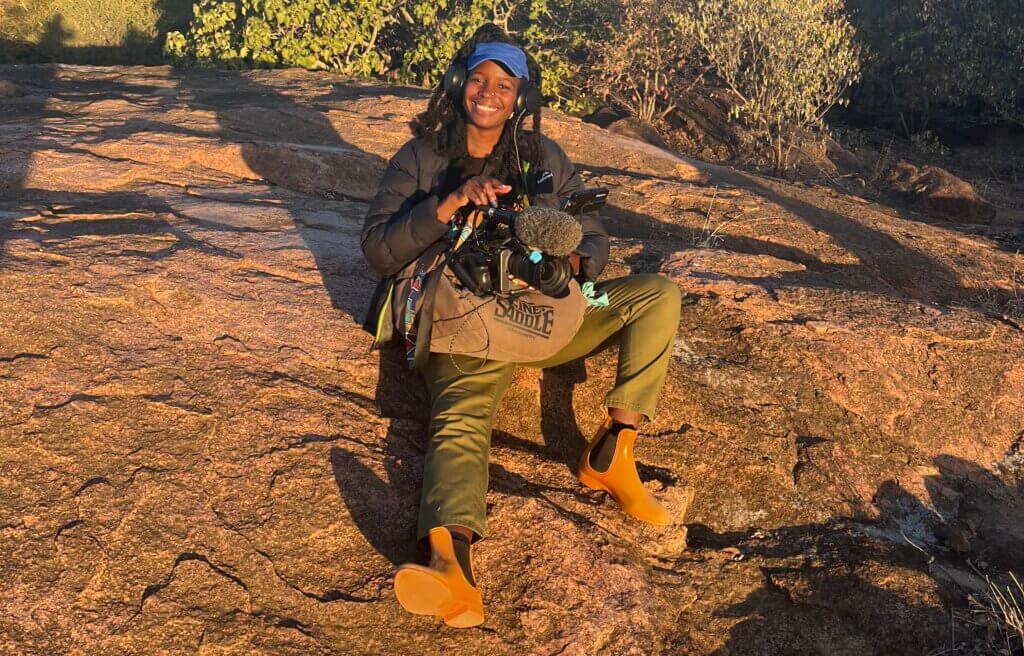
Matabeleland is only one chapter in her growing body of work. What the film most clearly demonstrates is her method: patience, ethical exactness, and a visual style attuned to intimacy. As much a cinematographer as director, she prefers to hold the camera herself so she can catch the play of light, the breath before confession, the rhythm of a prayer under the open sky. Her closeness to her subjects allows immersion without intrusion; her lens is careful, precise, but never domineering. “It’s how I prefer to work,” she says. “I like to work with the camera.”
She has long moved fluidly between the two roles in her practice, and the dual responsibility has come to feel natural. Still, Kadandara is also keenly aware of the tightrope that dual-role filmmakers walk: the risk of overcomposing a shot at the expense of the story. “You can spend so much time on the visuals you forget what the story is,” she says. Her challenge, and eventual triumph, is in holding both.
Collaboration, too, is central to her practice. Partnering with Kenyan producer Sam Soko (Softie, No Simple Way Home) on some projects, has confirmed her belief that African cinema must be built on solidarity rather than rivalry. She met Soko during the release of Softie, the 2020 acclaimed Kenyan documentary film about political activist Boniface Mwangi.
“Sam and I both feel that we, as Africans, are in a different game compared to other filmmakers,” she says. “And we are only going to make it if we work together.”
Kadandara has hard-won insights on the present state of African filmmaking, and also the broader future of the African documentary. She knows that progress will not come from external validation or streaming deals alone. “There’s multiple things that need to happen,” she says, cutting straight to the core of a fractured ecosystem. “We are spreading resources across borders, and there’s just not enough money to go around.”
A sustainable model, in her view, begins with making it easier for African filmmakers to work with each other. That doesn’t just mean collaborating on passion projects, it means governments implementing co-production treaties, streamlining tax systems, reducing bureaucratic obstacles like restrictive work permits. “This thing where you must get a work permit, and pay endless taxes, you are just restricting business. It is basic economics,” she says.
But the structural side is only one part of the puzzle. The deeper challenge, and the more radical one, is changing the culture around film consumption itself.
“For instance, step one is get Kenyans to watch a Kenyan film,” she says. If even a fraction of Africa’s billion-plus people paid a dollar to see a film from their own region, the model begins to shift.
“Right now, the appetite, and the habit, often is not there. We have a culture where people go to the cinema and only want to watch Marvel,” says Kadandara. “Then tomorrow, you are the same person who complains ‘Ah, nobody makes films for us.’”
She isn’t condemning viewers’ love for Hollywood blockbusters, “Shout out to Ryan Coogler,” she laughs, but she’s making a serious point: “We also need coins too.”
Part of the work ahead is audience education on African films and their value. Not every film will be glossy or escapist. Some will be slow, intimate, and provocative. “You need to watch all the different types of films we’re making, the documentaries as well.” she says.
The global documentary industry is in flux, as platforms are shift priorities, festivals redefine scope, and funding grows ever more competitive.
But for Kadandara, funding is not the fuel, conviction is. “Funding or not, I’m going to make these films, these documentaries,” she says plainly. “That is just the truth.” It’s a vow from a filmmaker whose work has been witnessed to be persistence, even when the odds were uneven.
Her next projects reflect her widening scope. She’s collaborating with LBx Africa on a nonfiction project that takes her into the world of African sports, specifically, the Zambian women’s national football team. “We are looking at what it takes to compete on the world stage,” she says.
She is also preparing a return to fiction, a space she has long been drawn, with bolder stories. One is a short film titled Time set in Kenya, a meditation on friendship in the midst of chemotherapy. Another, Noughts and Crosses, is still under wraps. There’s also Come Sunrise We Shall Rule, a historical adventure set against the backdrop of Zimbabwe’s liberation.
Whether it is the sports doc, or the period drama, one thing ties Kadandara’s body of work together: an unflinching belief that African stories deserve to be told on their own terms. She doesn’t make films to reassure you. Her films, those already released and those still forthcoming, do not seem to educate politely; they ambush. They are restless, uncooperative, and more alive than the tidy moral exhibits so many audiences expect. That is her gamble, and her triumph – that truth doesn’t have to arrive gift-wrapped to matter. And if you’re unsettled, if you walk away still arguing with what you have seen, then she has done her job. If African documentary has often treated as an obligation, her work arrives like a dare: watch closely, stay uncomfortable, because the story won’t wait for you to catch up.
Matabeleland is screening at the 2025 NBO Film Festival that runs from 16-26 October.
EDITOR’S NOTE:
All reporting, interviews, and reviews on Sinema Focus are protected under international copyright law and the Kenya Copyright Act, 2001. No part of this publication may be reproduced, rewritten, republished, or redistributed in any form by media outlets without prior written consent. For reprint or syndication inquiries, contact editorial@sinemafocus.com.
©️ 2026 Sinema Focus / African Film Press. All rights reserved.
Never miss a moment.
Get the latest stories from Sinema Focus delivered straight to your inbox. Subscribe to our newsletter now.