


In September 2024, Philit Productions set out to do what had never been done before: attract an audience of 6,000 and host the biggest single venue premiere in Kenya for its film Makosa ni Yangu. “This is not just about entertainment. This is us as a collective putting Kenya on the map,” they announced on their Instagram page.
Three months later, on 7 December, they premiered Makosa ni Yangu at Sarit Centre to an audience of 5,700 – just a few hundred shy of their goal, but no less monumental, especially in a country like Kenya, still struggling to build a strong and steady cinema culture. It was history in the making.
Stay ahead of Kenya & East Africa’s film and TV.
Get our stories in your inbox — Subscribe to our newsletter now.
To put this into broader context, even for African countries that may enjoy considerable box office success, like Nigeria and South Africa, pulling such a crowd at a single event is rare. According to Nigerian Box Office (the independent organisation that tallies box office numbers), Funke Akindele’s Everybody Loves Jenifa – Nollywood’s highest-grossing title of all time at ₦1.8 billion – drew 9,409 admissions when it premiered in 2024. This was the biggest opening day for a Nollywood film yet. But unlike Makosa ni Yangu, this number was across multiple screenings in multiple locations.
Down South, the Afrikaans film Die Kwiksilwers admitted 7,306 movie goers during its opening weekend in May 2025, described as the “best opening weekend for an Afrikaans film since theatres opened after Covid” by distributor Filmfinity, according to TV With Thinus.
So how did Philit Productions pull off such a rare feat? For one, Makosa ni Yangu wasn’t just any other movie premiere. It was a three-in-one bonanza labelled the Trinity Experience that included a live storytelling segment by Philit’s co-founder Abel Mutua, a live concert, and the film’s screening.
When we spoke to Philip Karanja – the other co-founder and CEO – two days after the record-breaking premiere, they were still collecting data, and reeling from what is now by far Kenya’s biggest premiere. “We’re still tallying stuff but so far we’ve confirmed that at least 5,700 people were at Sarit Centre for The Trinity Experience,” Karanja said at the time. By our estimates, those numbers translate to around Ksh 15 million in ticket sales at the premiere.
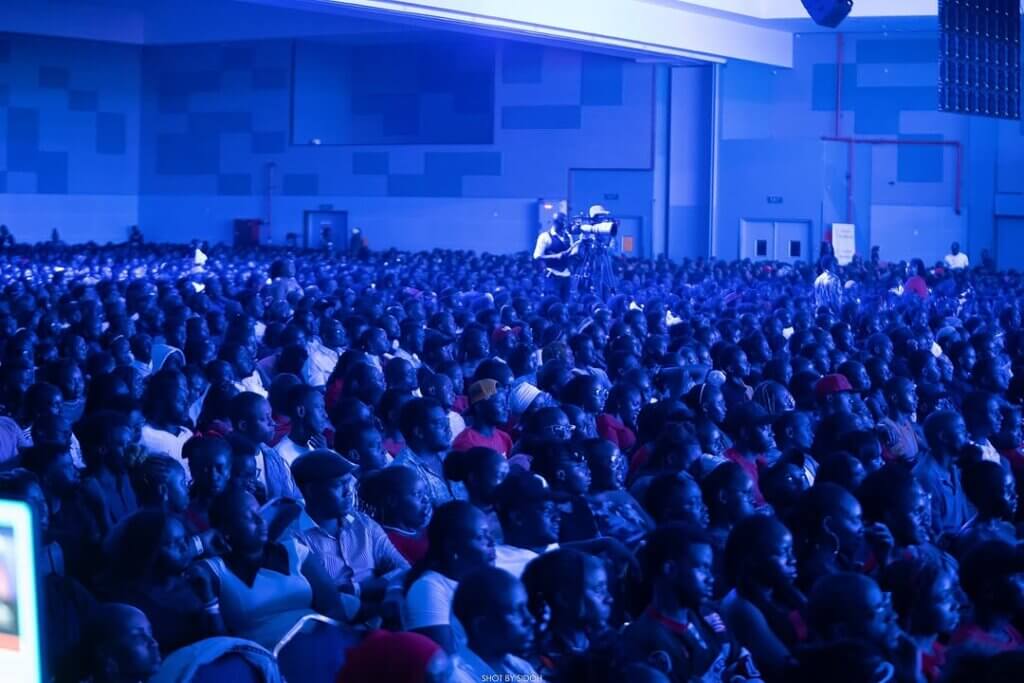
Karanja had spoken about this before, manifested it even. So why six thousand in particular? We ask when we chat again for this interview. “Because that’s the maximum capacity of the venue: the Sarit Expo Center,” he says. A pragmatic answer from a very pragmatic visionary, because here is proof that it can, in fact, be done. This wasn’t just a high-profile, adrenaline-rush moment for them; Philit has created a blueprint of success that could benefit filmmakers in Kenya in years to come.
This did not happen overnight. Over the years, Karanja and his team have been very strategic about what they wanted to sell, how they wanted to sell it, and to whom they wanted to sell it to.
“We’ve been building a fanbase for twenty years since the days of Tahidi High,” he says. “And for the last four or five years, we’ve been intentionally and actively building a community on social media.”
They endearingly call this community of loyal fans #PhilmAmbassadors or “wakurugenzi”, drawn from Abel Mutua’s “Mkurugenzi” nickname, a Swahili word that means “director” or “manager.”
“The power belongs to the people,” Karanja says.
It’s the kind of thinking that has shaped their content, so much so that when fans loved Mutua’s narration about a young footballer whose life is upended by crime – an episode of his popular YouTube series Young & Stupid – they made a movie out of it. The movie, Click Click Bang, reached another milestone in 2022 during its opening weekend: premiering to an audience of 2,500 at a single venue and making Ksh 2.5 million in those two days.
Even Makosa ni Yangu, which takes a more serious tone compared to their two previous films, was made out of a need to address a prevalent societal need – femicide – which was at an all-time high in 2024, according to a report by Odipo Dev and Africa Uncensored.
“This is not just a movie, it’s a reflection of our society,” Mutua, who penned the script, said when the film was first announced.
On 14 February this year, almost as an extension of Makosa ni Yangu and following a viral question he posed about men’s culpability and silence, Mutua hosted the first-ever Men’s Conference tackling femicide and GBV. What had long existed as a social media joke – a fictional event where men supposedly escape the emotional demands of Valentine’s Day – was transformed into something tangible and urgent.
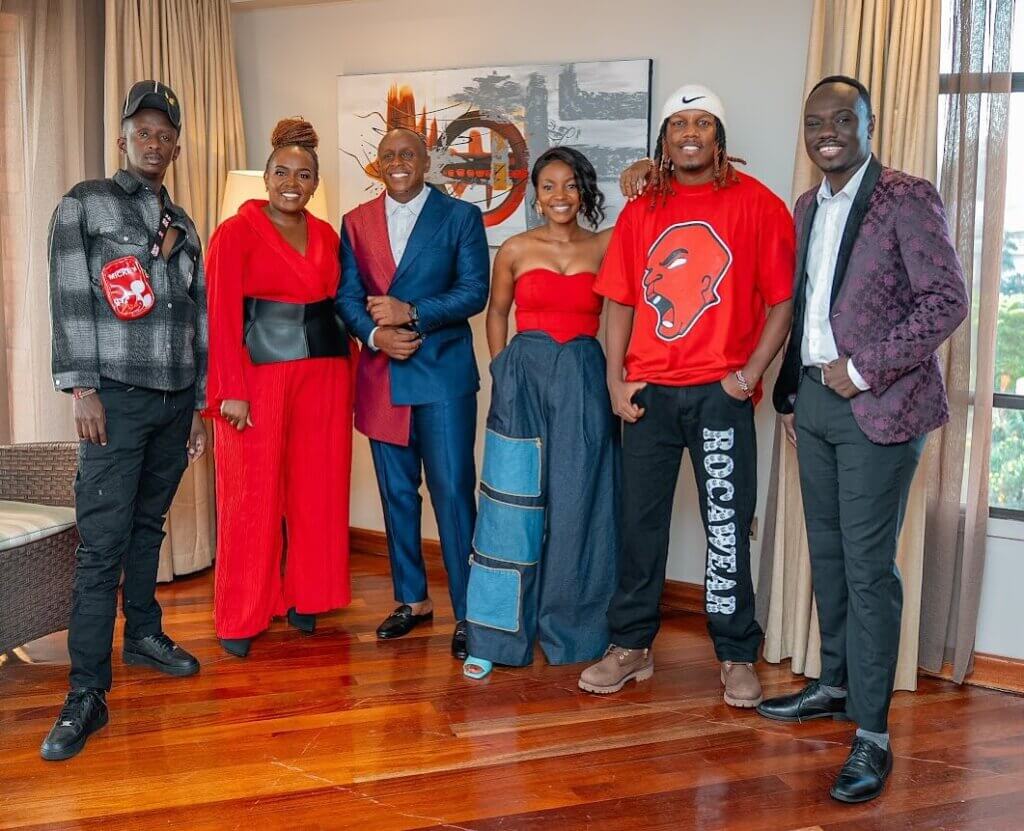
Their love for community has also influenced how they move within their inner circles, leveraging their power as a very intentional group of creatives driven by the simplest marketing economics: there’s strength in numbers. Karanja and Mutua work very closely with Mutua’s wife Judy Nyawira, comedian Timothy Ndegwa Kimani (popularly known by his stage name Njugush) and his spouse Celestine Ndinda, and comedian Butita. While they’re all strong brands individually, with a cumulative follower count of over 6 million followers on Instagram alone, they’re an unstoppable force, or “the Big Six” as their fans now call them.
“Initially, there was no plan of making it like a group, we were just creatives who were friends,” says Karanja. “But every time we got together, more people were excited about it, and so we started supporting each other’s individual projects.”
After talking about it, they decided to make “the Big Six” a reality, not just through individual projects but also collective projects, showing their support anywhere they’re needed. “That’s the thing, everything we do really starts from our audience, our community, even the Big Six, because we’re always engaging with them and learning from them,” he says.
Their biggest drive: they don’t have a plan B. “We exist in the creative world – in the arts, in film and television. It’s the only thing we know how to do, and so we have to make it work.”
And so, Karanja and his team have been learning, adopting and adapting, unafraid to think outside the box. And with every release or project, they dream bigger than the last.
In 2021, while promoting their debut feature A Grand Little Lie, they went viral when they hit the streets of Nairobi with eye-catching placards on major roads, essentially to “hawk” the film to the masses. “I came up with the idea for the placards,” says Karanja. “I had seen it from this guy on social media called Dude with a Sign.”
Leveraging the film’s title, the placards promised that the movie would “cure stress, relationship troubles, money troubles etc” – echoing the kinds of signs and exaggerated promises seen on walls and poles in Nairobi every day. “Kenyans still fall for these signs, and we wanted to use that. We were going for humour but also for the shock value. We needed it to go viral.”
This guerrilla marketing tactic was ridiculed by some. “The idea of Abel and I on the streets was shocking. Some people called us crazy, but then again, they’ve always known we’re a bit crazy,” Karanja says. It all paid off when A Grand Little Lie premiered to a sold-out audience at Nairobi Cinema. According to a past interview by Mutua, it also made over Ksh 4 million in its first week through viewing link sales.
The trick, Karanja says, is to never stop talking about your product and to never stop selling. A quick scroll through Philit’s recent Instagram feed reveals behind-the-scenes interviews with the cast of Untying Kantai, the Showmax’s comedy-drama that ended in July 2024. “We used money to produce these projects, and we will go to great lengths to sell them,” says Karanja. “Even for Makosa ni Yangu, we’re still selling. If you asked me today to stand in front of KICC and scream about our work, I would.”
Karanja compares their model to Funke Akindele’s record-breaking strategy in Nigeria, from audience building to leveraging personal brands to relatable mass-appeal storytelling to marketing strategies that have turned her films into Nollywood blockbusters. “She’s using the same model as we are, and that started with building a strong community,” says Karanja. “That’s why it’s easy for her to break records and become the undisputed king of box office in Nigeria.”
Much like Karanja and Mutua with Tahidi High, Akindele’s claim to fame started with Jenifa, a 2008 comedy-drama that won her Best Actress at the Africa Movie Academy Awards and kicked off the Jenifa franchise. Her stories have been described as deeply rooted in Nigerian everyday life – capturing the hustle, the chaos and the resilience of the common Nigerian.
For Karanja, Nigeria and Akindele serve as a case study for Kenyan filmmakers. “We made fun of Nigerian films for years because most of us were watching them through the Hollywood lens we were exposed to. But they kept to their stories, and because of that, they developed naturally with their audience,” Karanja says.
Among other things, Akindele’s robust marketing has been bolstered by strategic partnerships and corporate sponsorships. For Kenyan filmmakers like Karanja – with “too many crazy ideas”, as he puts it – corporate sponsorships could unlock a world of possibilities. “It’s the capital that slows us down. We’d be able to scale up, in marketing and distribution, upskilling our crew, investing in equipment,” he says. “But we’re not yet at a stage where corporates are investing in us, so how do we convince them?” His answer: filmmakers need to put in the work. “Corporates will go where the numbers are. And honestly, we still don’t have the numbers as an industry.”
Even with the limitations compared to Akindele’s big Nollywood play, Philit’s strategy is just as ambitious, and grounded in their core goal: to capture the audience first and build a strong film culture. “Because once you have a community, you can create anything with them, a business, a school, anything you want,” Karanja says.
Every success story – even though Karanja admits they’re not quite there yet – starts somewhere. Mubi founder Efe Cakarel built the now $1 billion streaming platform after failing to find In the Mood for Love online while on vacation in Tokyo. Issa Rae created and starred in Awkward Black Girl, which became HBO’s hit series Insecure, because black women like her weren’t being represented on screen. Philit’s own journey began at the Kenya Institute of Mass Communication in 2005, with two friends writing roles for themselves because there weren’t enough to go around.
“I’ve known Abel for 20 years now,” says Karanja. “When we joined the drama club, there were no roles for us, so we wrote our own scripts and cast ourselves just to prove to others that we were capable.”
It was here that Karanja and Mutua were discovered by the makers of the popular high school drama Tahidi High – the series that would launch them into the limelight. “They called us up after we won Best Actor and Best Runners-Up.”
In 2012, while still appearing on Tahidi High, they founded Philit Productions, with Mutua as the writer and Karanja as the director. Over time, the two have evolved from just creatives into businessmen, working to grow the company into something more than just a production house.
It’s with this business mindset that they created their own VOD platform PhilitTV, where most of their independent content is currently housed. Viewers access titles by purchasing unique viewing links delivered via SMS or email.

After its historic premiere at Sarit Centre, Makosa ni Yangu went straight to PhiliTV where its currently available to watch at Ksh. 250. It was a necessary move but one that Karanja wishes they didn’t have to make. “I believe film should be experienced in the cinema. That’s why we invest so much in good picture and good sound,” he says. “I know Makosa ni Yangu would have done really well with a cinema run.”
With a strong start, topical relevance, a popular and lovable lead in Pascal Tokodi, and the backing of Philit’s loyal fans, Makosa ni Yangu was primed for theatrical success. In a review by Kelvin Kariuki for Sinema Foucs, the film was praised for “sparing no detail in depicting the psychological and physical toll of abuse.” But Karanja skipped cinemas entirely – even its premiere was held at an exhibition centre rather than a traditional cinema hall – opting instead to sell the movie link directly to viewers through their platform. The reason: an unfavourable cinema model.
In this current model, there’s a fixed 50/50 revenue split between exhibitors and distributors (even for filmmakers who choose to self-distribute), along with limited screening windows and the added burden of filmmakers having to cover their own marketing and distribution costs.
“This doesn’t really benefit us filmmakers,” says Karanja. “As a businessman, there’s more return on investment for me on my platform.”
When we spoke a few months after Makosa ni Yangu landed on PhilitTV, Karanja didn’t disclose specific numbers but said the movie was performing well on the platform even though they hadn’t yet broken even. “I can see it will definitely surpass our first two films, and that for us is growth,” he said.
Despite betting on his platform and its growth, Karanja isn’t giving up on theatrical just yet. He’s planning to bring cinema operators, filmmakers, distributors and marketers to the table. “The idea is to really understand each other’s pain points and create a model that works for all of us, one that is practical for a country like Kenya,” he says.
For PhilitTV, he’s playing the long game, slowly building it into a bigger and more accessible platform. “Filmmakers should think of it more like YouTube, not Netflix or Showmax,” says Karanja. “Right now, we’re just learning how to do things, what works and what doesn’t. By the time we get to our tenth film, we’d like the platform to be profitable.”
Part of that strategy involves expanding their content offering beyond Philit’s own releases to include projects from other filmmakers like Vincent Mbaya’s comedy Sketchy Africans, Fakii Liwali’s 2Asunder and John Jumbi’s It’s a Free Country – all currently available on the platform. “We’re happy that a lot of filmmakers are beginning to see what we’re trying to build, and they’re buying into it,” says Karanja. “A lot of investment in Kenya’s film industry is from foreign countries, and it’s time we start building our own solutions.”
EDITOR’S NOTE:
All reporting, interviews, and reviews on Sinema Focus are protected under international copyright law and the Kenya Copyright Act, 2001. No part of this publication may be reproduced, rewritten, republished, or redistributed in any form by media outlets without prior written consent. For reprint or syndication inquiries, contact editorial@sinemafocus.com.
©️ 2026 Sinema Focus / African Film Press. All rights reserved.
Never miss a moment.
Get the latest stories from Sinema Focus delivered straight to your inbox. Subscribe to our newsletter now.