
On one night in April 2014, 276 girls were abducted from their school in Chibok, in northeastern Nigeria, by the Islamic militant group Boko Haram. For the next few weeks, the hashtag #BringBackOurGirls connected the world in a collective cry for justice, a rallying call amplified by global figures like former U.S First Lady Michelle Obama. The hashtag trended across timelines, politicians made statements, and protests filled streets, a new movement was born. Then, as so often happens with even the most potent of international headlines, the outrage slowly faded from attention. Boko Haram became another name in the global lexicon of terrorism, with not enough discussions of their heinous crimes after.
Ten years later, filmmaker Joel Kachi Benson returns to Chibok in his quietly searing 2024 documentary Mothers of Chibok, turning his piercing lens on the women who never left the frontlines of that grief.
Stay ahead of Kenya & East Africa’s film and TV.
Get our stories in your inbox — Subscribe to our newsletter now.
Benson, who previously directed the VR short Daughters of Chibok, expands his earlier vision into a grounded, human-scale portrait of the aftermath. He introduces us to Lydia, Ladi, and Yana, mothers whose lives now orbit around one shared mission: earning enough from each harvest to educate the next generation. It’s a cruel irony that these women fight for the same right that once cost their community a generation of girls. The film reminds us that Boko Haram, translated from Hausa, means “Western education is forbidden.”
Benson’s camera follows the women of this ravaged community through a season of their agricultural cycle – planting, praying, persevering – against the uncertainty that hangs like the rain clouds above them. In silently watching and listening to their daily conversations and routines, Mothers of Chibok transforms each act of farming and nurturing the next generation into more than survival; it becomes defiance. Every gesture is a continuation of hope in the face of despair and grief that fogs their moments of inactivity. In the mentions of the girls robbed from them and the memories they hold for those who still remember them, the film unfolds as a meditation on motherhood, resilience bolstered by faith – both Christian and Islam – and the haunting persistence of hope in a world that has no other option but to move on.
Druing the course of this eighth year after the kidnapping of the girls, the film stirs every morning with roosters and community, the haggles for every transaction, the lessons, routines, and laughter of women and children in their element on the farms, and the importance all these women individually still hold in the education of their kids, a startling reminder that, even bearing the scars of being so close to an ideology that condemns learning, their lives insists on carrying courageously forward.
Over the course of a year, the film stirs every morning with roosters and the rhythms and routine of community life – the haggling in the market, the laughter of women and children working tirelessly in the farms, and the importance all these women still hold in educating their children. It’s a startling reminder that even in the shadow of an ideology that condemns learning, these women persist, carrying forward courageously.
We meet Lydia, who still holds out hope for her sister Aisha’s return, and Yana, who clings to the memory of her daughter Rifkatu. One of the mothers, Mariam, is a rescued survivor who returns with a son she loves despite the stigma surrounding his origins. Her struggle to pursue her own education while being uncertain of her child’s, raised away from her, reveals a poignant paradox of survival. Where many might see a living reminder of trauma, Mariam sees a blessing and fortunately, Benson’s camera does too.
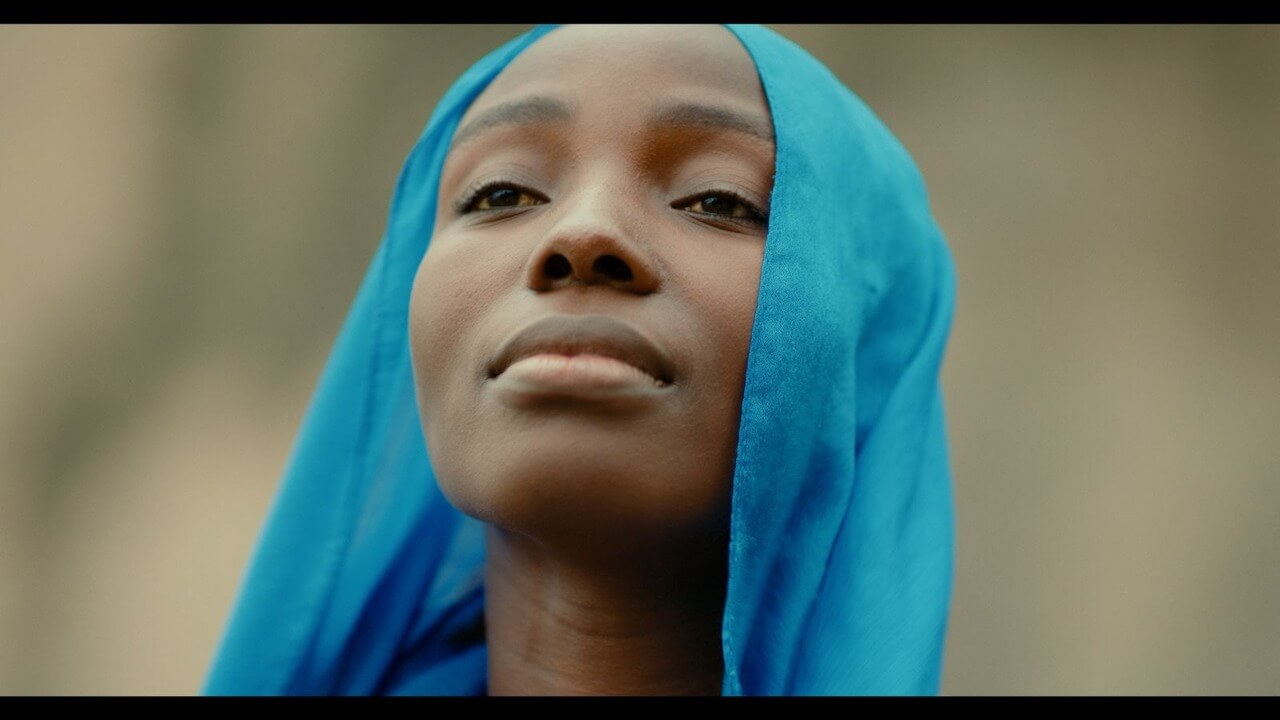
Visually, Benson’s cinematography captures the region’s rugged beauty as a love letter to the sunlit hues of the African landscape. Sweeping aerial shots of farmland dissolve into intimate portraits of faces marked by endurance. His use of silhouette and stillness gives Mothers of Chibok a meditative rhythm, with scenes unfolding like whispered prayers between furrows of soil and the ghosts of those absent. The editing resists melodrama, preferring the texture of real time, and while it might be slow, it revels in the waiting, the working, and the silences heavy with unspoken grief. When the rains come, filmed with breathtaking tenderness as children run out to play and the women rejoice, the film punctuates its undercurrent of loss with grace and bountiful harvest of answered prayers.
Yet beneath its serene visual language lies a quiet fury. Immersed entirely in the lives of women, the film silently confronts the gendered imbalance of labor and burden in Nigerian society. In the daily lives of these women who sow, build, and endure, the full scale of a day’s work is laid bare, while men lounge in the shade playing board games, their absence unassuming. These women, despite being the direct nucleus of terror’s cruelty, are not victims. They are not frozen in mourning; they are alive. Their laughter, strength, smarts, leadership, and resolve resonate just as vividly as their sorrow.
Mothers of Chibok may not be for everyone, as it offers so much room for contemplative silence that the attention of some viewers may drift. But for the patient viewer, it serves as a testimony that extends beyond the political, spiritual, and the news cycle. It’s a testimony to faith, community, and the defiance of women who continue to sow hope in soil stained by loss.
Mothers of Chibok screened at the 2025 NBO Film Festival that ran from 16-26 October.
Check out our full coverage of the 2025 NBO Film Festival here.
EDITOR’S NOTE:
All reporting, interviews, and reviews on Sinema Focus are protected under international copyright law and the Kenya Copyright Act, 2001. No part of this publication may be reproduced, rewritten, republished, or redistributed in any form by media outlets without prior written consent. For reprint or syndication inquiries, contact editorial@sinemafocus.com.
©️ 2026 Sinema Focus / African Film Press. All rights reserved.
Never miss a moment.
Get the latest stories from Sinema Focus delivered straight to your inbox. Subscribe to our newsletter now.