
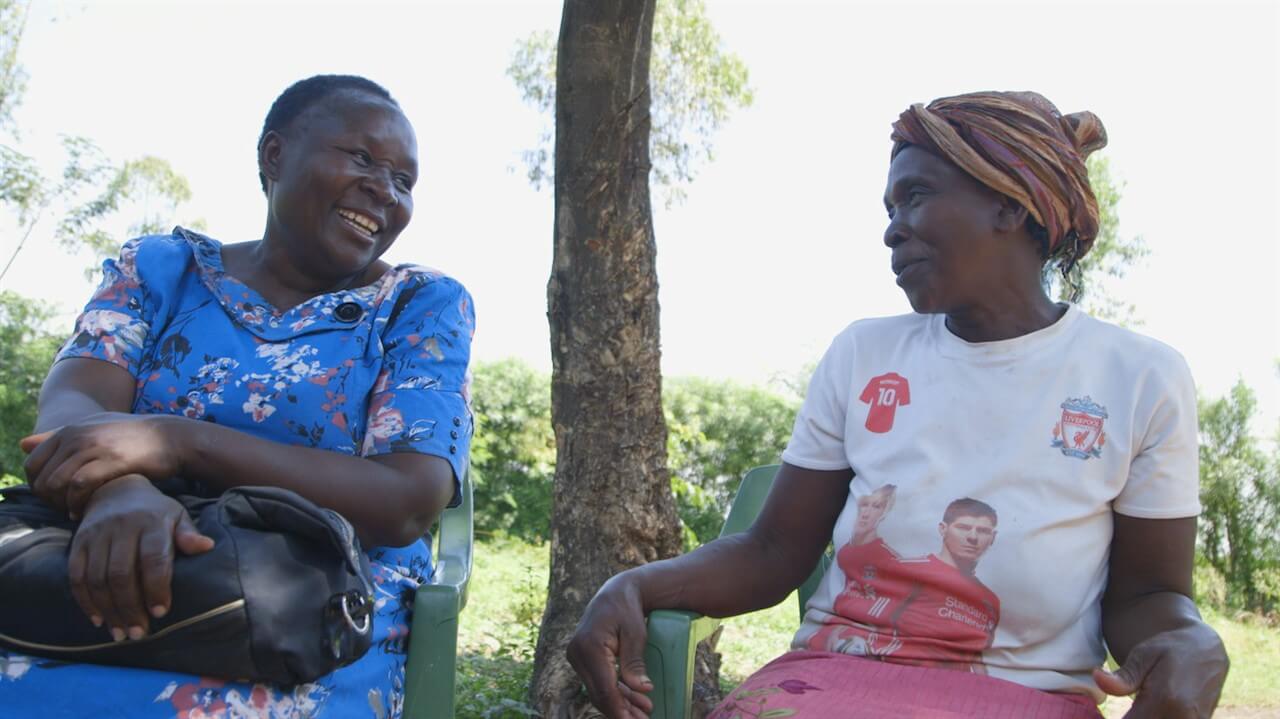
Zippy Kimundu’s sophomore feature Widow Champion, following Our Land, Our Freedom, is a powerfully grounded documentary that is less a documentary and more a weary glance into the emotional labour, social strategy, and quiet strength behind Rodah Wekesa’s journey as both a victim and advocate for widows against the very traditions and community of family.
Set in Kisumu County, Kenya, the film follows Rodah, who, having lost her home when her in-laws demolished it after her husband’s death, spent years fighting for her land and the dignity that comes with it. Her advocacy extends beyond her own struggles, as she holds up the many widows entangled in the same inherited chains of patriarchal conditioning.
Stay ahead of Kenya & East Africa’s film and TV.
Get our stories in your inbox — Subscribe to our newsletter now.
The film focuses on two of Rodah’s clients, Mary and Theresa, both battling in-laws who exploit community inheritance customs to push them off their late husbands’ land. Within the voices of a few families, generations of conflicting values – shaped by gender norms, tribal biases, HIV stigma, and economic dependency- reverberate through mediated meetings and long-held silences. These mediations, often the only recourse, take centre stage in the film as Rodah, working with the Luo Council of Elders and the NGO KELIN, facilitates conversations that meander in their resolution yet remain poignant in their justifications, with results that are more persuasive suggestions than binding legal outcomes.
Aimed at capturing the day-to-day struggle for survival of the women it documents, Widow Champion commits to emotional and visual honesty. Kimundu’s camera stays close – on Rodah’s worn shoes, her quiet resilience, the tense silences between words – with little to no dramatic score or editorial manipulation, that, if not for the visceral nature of its subject matter, would feel rather unremarkable. Instead, it bets on the power from the real stakes and the long, slow mediation scenes where community values and gendered power are negotiated in real time, often with tenuous conclusions.
Perhaps the film’s most endearing quality is the clear constraints it chooses to exist within. It is easy to sensationalise Rodah’s work in the language of modern progressive ideals. Yet for Rodah, her world is shaped by the whims and dictates of a past that would seem fictional if meddled with. The documentary avoids easy villains, though some family members are clearly cruel or opportunistic. It is Rodah’s mediation – asking women to forgive and families to treat each other as kin – that makes resolutions possible. However frustrating this may be for those seeking legal vindication or catharsis, the filmreflects the real limitations and cultural dynamics of restorative justice. Singing and prayer often close meetings, even when the outcomes of their fight feel fragile or bittersweet.
Widow Champion, in its simple and intimate filmmaking, achieves a resonant universality. If stomached through the first few scenes that drag in introducing its subjects, it rewards with moments of emotional levity and gravity. Though rooted in Kenyan customs, its themes echo global issues: widowhood as economic peril, misogyny hidden in tradition, and legal systems that fail the most vulnerable – issues that resonate with those both within and beyond these contexts. The film is a constant reminder that the suppression of women’s property rights is neither distant history nor culture-specific; it persists everywhere, merely shaped by local context. Following a woman who is both inspiration and cautionary tale – still without her title deed even as she helps others – is a sobering reminder of the realities of cultural inequality faced by women and the slow, fragile nature of justice.
While not flashy or fast-paced, the film is patient, precise, and piercing. Through Rodah, a story of the duality of resistance and hope comes to light – not because justice is guaranteed, but because community action, however flawed, is still possible. With empathy, restraint, and deep insight, Widow Champion honours the pain and power of the women at its centre and brings to light conversations that urgently need to be amplified.
Widow Champion made its world premiere at the 2025 Tribeca Film Festival. For its Kenyan premiere, Widow Champion screened at the 2025 NBO Film Festival that ran from 16-26 October.
EDITOR’S NOTE:
All reporting, interviews, and reviews on Sinema Focus are protected under international copyright law and the Kenya Copyright Act, 2001. No part of this publication may be reproduced, rewritten, republished, or redistributed in any form by media outlets without prior written consent. For reprint or syndication inquiries, contact editorial@sinemafocus.com.
©️ 2026 Sinema Focus / African Film Press. All rights reserved.
Never miss a moment.
Get the latest stories from Sinema Focus delivered straight to your inbox. Subscribe to our newsletter now.