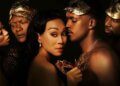


Imagine a chessboard. The pieces are ideas on identity, language, colonialism, class relations, image reproduction, privilege, stereotypes, race, history. Three players are moving these pieces through the squares, that on this wild, subversive chessboard are bizarre dialogue, satire, surreal situations, spectacle, grotesque humour, frenzied and absurd reenactments, poetry and music. And every rule you know about chess is turned on its head. So watching these three players in action becomes an exercise in bewilderment and anxiety – a confrontation with the unsettling human condition, an encounter with opposing truths, a grapple with the questions, “Why are we the way we are?” and “How do we see each other?”
But this is not a game of chess. This is This Plot is Not for Sale, an absurd, multilingual, mind-swirling theatre production. An international collaboration between Gisemba Ursula (Kenya), Theresa Seraphin (Germany), and Denijen Pauljević (former Yugoslavia), the play staged at Nairobi’s Goethe Institute on 26 and 27 September. It’s a journey through a bright, sometimes sensorily overwhelming world that suddenly, and without warning, dives into the intimate, the gravitas, even the philosophical. “Reality is a mistake, and I can correct it with every frame,” a velvety voice tells us for an introduction, and the lighting flicks from red to pink.
Stay ahead of Kenya & East Africa’s film and TV.
Get our stories in your inbox — Subscribe to our newsletter now.
The setting is a surreal photo studio run by Pauljević’s Stevan (who, because name pronunciation is very important in this play, insists on the accent on the V). He’s an unimpassioned former Yugoslavian, who, for the most part, wears the personality of his vintage camera: aloof, apathetic, a bystander just observing. He sets up the camera as he sings an old Serbian folk song, then breaks the fourth wall to welcome us to his “photo room.” It’s a deliberate and impressive artistic achievement how the play breaks the fourth wall. It doesn’t happen as we’re accustomed to, with the performance basically saying, “hey, here we are now crossing the divide to reach out to you to make you feel like part of the story.” This Plot is Not for Sale bursts out of the proscenium, into the audience section, so that the theatrical world envelops us, rather than being contained. Watching these three actors, I get the feeling that they are handling their characters less as alter egos and more as mascots costumes they put on and off as they choose. Even a greater artistic distinction, though, is the blurred line between where the actor ends and the character begins.
Stevan launches into a stream of dispassionate monologue in Serbian, which I don’t understand because the supertitle falters (the supertitle proved unreliable throughout the performance), but I nevertheless surmise that he’s talking about photography. From the onset, the production tells us that even language, as culturally intrinsic as it is, can be universal.
Gisemba’s Petronilah ‘Pete’ Bochaberi waltzes into the studio in a suit and a perfect bob fringe wig. Nimble, quirky, and buoyant, she’s the antithesis of Stevan’s mellowness. Her diction is precise as she attempts to present her true self to this camera that can only capture the perfect photo when the subject reveals their true selves.
What follows is a profound exploration of identity as a Western-educated, middle-class Kenyan. As she digs deeper into who she thinks she really is, adopting absurd reenactments and bouncing between English to German to Ekegusii, we see how colonial narratives persist in our self-perception. The use of multiple languages underscores the idea that identity, voice, and perspective are really fragmented. In Ekegusii and Kenyan-accented English, she’s Petronilah Bochaberi, who bemoans her colonial upbringing that insisted she shed everything authentic about herself for a ‘polished, westernised’ identity. How she has to change and her name, her accent, her dressing just to belong, to be more palatable in “the place without the sun” where she’s still treated as a subhuman. She quotes Achille Mbembe’s Critique of Black Reason and reminds us that colonial relics persist when she says that the way she’s treated in the West today mirrors how her father was treated by the colonial era missionaries: “I can hear it just like the missionaries called my father boy.”
Absurdist theatre demands patience; the audience must sit with dissonance, interpret symbolism. The pacing must be even, the poetic sections cannot be too slow, the re-enactments cannot be too repetitive. The arrival of Seraphin’s Katharina ‘Kathy’ – a Bavarian wide-eyed heiress – works wonders for the pacing and firmly grasps our attention. Opposite Gisemba, the two are balls of pure energy, revolving around each other like binary stars. Seraphin, wearing cornrows and a floral flowing dress, brings out the humour and the pathos as a privileged white woman, and the naiveté that comes with it. Privilege allows her the liberty to chase ideals. Together, the two manifest ‘utopic’ visions like “Afritecture” and “making Africa great again” and “bringing back communal culture” and building “Giraiffel Tower”, and turning the continent into a “Paris in the Savannah.”
This fantasy unravels when the cracks in their identity appear, and the conflicting lenses the two see each other flare up. Turns out Kathy sees Pete as a Black opportunist and Pete sees Kathy as the guilt-ridden white saviour. For Pete, it was never about “making Africa great again”, but about survival, and climbing up the middle class, and the white, rich and naive Kathy is the golden ticket. “Why should I let go of a system that has made me king?” she poses. For Kathy, it’s all about absolving herself of her guilt of privilege by saving the “poor Africans.” “Your poverty makes you a happier person,” she tells Pete. It’s in this chasm that the universality of the human experience comes to light. We get to reflect how the way we frame each other dictates our differences, and the kind future we can build. In this space, This Plot Is Not for Sale is able to make political points without slipping into didacticism – interrogating us rather than delivering a lecture.
The performers, Gisemba, Pauljević and Seraphin, who also co-wrote and directed the play, resist neat reconciliation into a single, consoling narrative. Rather than offering solutions, they choose to dramatise the persistent, systemic nature of the issues the play lays bare.
EDITOR’S NOTE:
All reporting, interviews, and reviews on Sinema Focus are protected under international copyright law and the Kenya Copyright Act, 2001. No part of this publication may be reproduced, rewritten, republished, or redistributed in any form by media outlets without prior written consent. For reprint or syndication inquiries, contact editorial@sinemafocus.com.
©️ 2026 Sinema Focus / African Film Press. All rights reserved.
Never miss a moment.
Get the latest stories from Sinema Focus delivered straight to your inbox. Subscribe to our newsletter now.