
I don’t care what part of the country you are in, I will bet you my ancestral land that out of the ten Kenyans you meet, nine of them would know exactly who Mtemi Bokono is. Say to a random dozen people, “Mimi ndiye macho na masikio ya Butangi”, and at least half will respond with “Na pia kisu chake cha kuchinjia watu!” Even those who were never in high school between 2006 and 2012, when the now cult-classic play, Kifo Kisimani, authored by Prof. Kithaka wa Mberia, was studied as a set book. I wasn’t in high school until 2013, but by then, I could already recite the scenes between Mtemi Bokono and his wife, Nyalwe, word for word – my scanty Kiswahili notwithstanding.
Kifo Kisimani has transcended the literary and theatrical confines to become a canonical cultural force, as much ingrained in the Kenyan popular culture as anything else that defines us as a people.
Stay ahead of Kenya & East Africa’s film and TV.
Get our stories in your inbox — Subscribe to our newsletter now.
Somewhere in the academic circles, Kifo Kisimani was once described as “a beautiful and dangerous play, admired for its poetry, feared for its politics.”
Even before the play was published as a book in 2001, it had already occupied the conscience of the nation since its first staging in the early 90s, at the height of the multiparty struggle. The ideas of resistance, truth versus power, the death of conscience, repression and fear, societal complicity and betrayal, were as profound then – to a people living under Moi’s dictatorial rule, marked by state violence and political intolerance – as they are now.
It’s under similar circumstances that on the first weekend of August, Kenyans gather at Loresho’s Jain Bhavan Auditorium to watch the long-awaited revival of Kifo Kisimani, helmed by Martin Kigondu, with the blessings of the author himself, Professor wa Mberia.
Kigondu’s highest directorial score is his cast, most of them seasoned histrionics. My friend, Gisemba Ursula, herself a thespian, stage writer, and director, commented on the performance: “The cast didn’t just fit, they sounded, moved, and behaved as individuals.” I couldn’t have agreed more. For such a massive ensemble, each character felt singular, explored, and alive. Each of them, a masterful showman, handling overlapping dialogue, comedic timing, and emotional tension with expertise.
Stylistically, Kifo Kisimani is a political allegory and philosophical tragedy. Artistically, it’s a humorous free verse, where the dialogue is a poetic repartee, the language heavily laced with sarcasm. You need energy and clarity to make the play work – to make the language sing and balance the sarcastic humour with the philosophical gravitas.
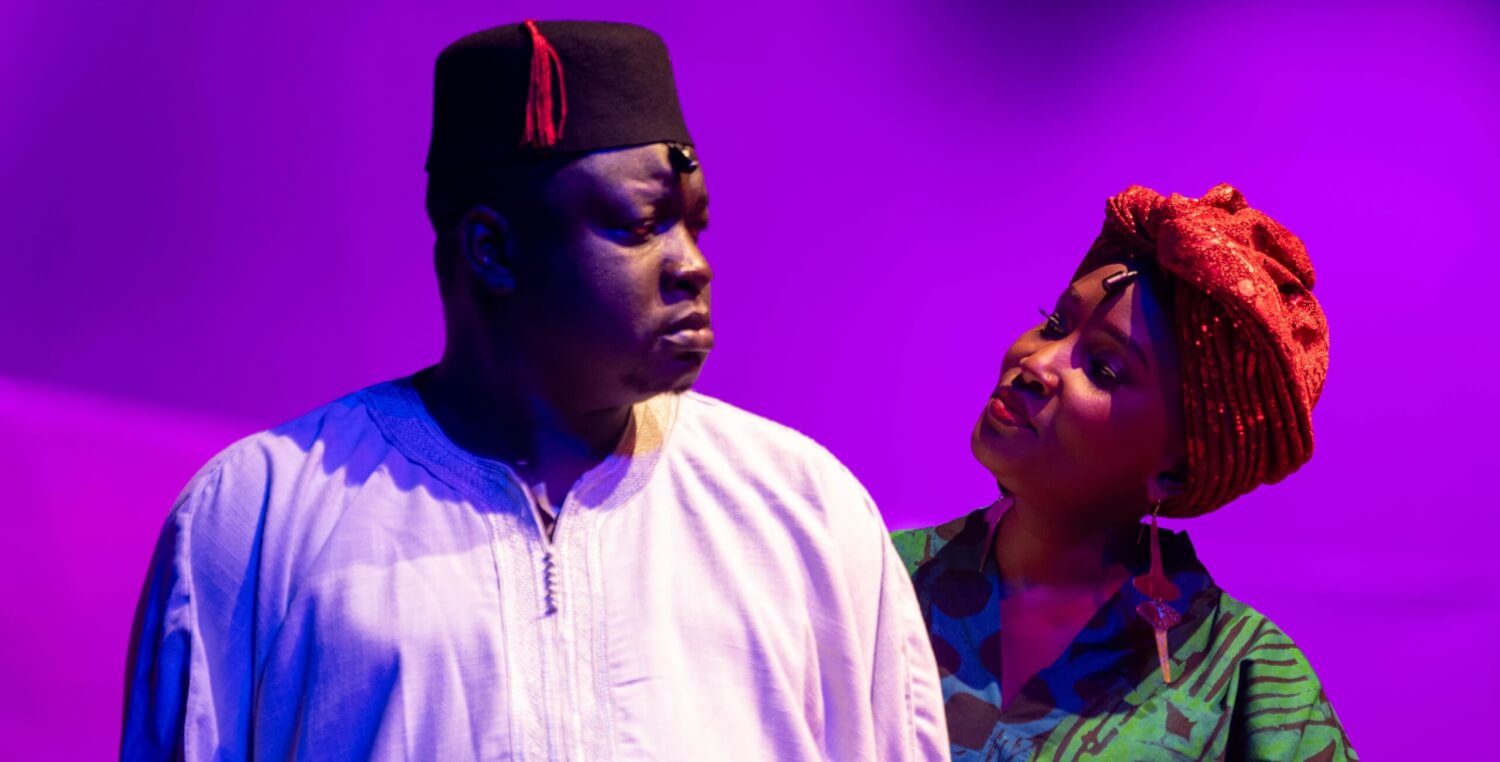
The cast brings exactly that energy. Benson Ojuwa, for instance, is an imposing Mtemi Bokono whose physicality alone deserves all the foot-licking he gets from his cronies. His voice – especially when he occasionally breaks the fourth wall – is a commanding projection that fills the space and wraps itself around the audience. Bilal Wanjau is powerful and charismatic as the cunning Batu.
Gadwill Odhiambo’s Mwelusi is dynamic, with a voice that swells with emotion, matching the tidal pool of his character’s arc. Wanjiku Waweru and Valery Owino, as Tanya and Atega, respectively, are both electric. Cosmas Kirui as Gege is a ball of energy, playing a flute with the same versatility he bounces off dialogue, while Sanchez Ombasa, Ernest Onyango and Ted Munene who the three Askaris are comedic delights.
But despite these strong performances, Kifo Kisimani cannot decide whether it wants to be modern (comment on contemporary events) or remain original. As director, Kigondu chooses to do both, so we watch some scenes where a character’s otherwise magnetic performance is diluted when the (re)writing forces him to add SHA in a line of dialogue. It’s what my friend Gisemba refers to as “a deep need to overexplain and restate the problems Kenya has presently instead of letting the play speak for itself.”
Now, old plays are adapted and modernised all the time, and it works great. We’ve seen it with Shakespeare’s plays, which, throughout the ages, have been adapted to suit particular social or cultural aesthetics. Or simply to make them more accessible to the masses.
However, by design, Kifo Kisimani exists outside time and place, devoid of any specific geographical or temporal reference. Its characters are allegorical figures, each representing a moral or political stance, which, like human nature itself, is immutable. So long as humanity continues to exist, there will never be a time or place where the play’s themes will not resonate. Police brutality and abductions? Land issues and corruption? Public complacency and betrayals? The play, already on its own, comments on today, and therefore the choice to ‘reinstate Kenya’s contemporary problems’, is a drag we could do without.
Because of the play’s deeply philosophical roots, the humour is supposed to stem from the quick-witted dialogue, not physicality or stunts. This works well in the scenes between Mtemi Bokono and his wife, Nyalwe – played by the magnificent Nyawira Alison, who, opposite the volcanic Ojuwa, is like a spotlight, shifting her movement and voice with ease, focusing her attention exactly where it is needed. The two fiery characters head-on are captivating and humorous, their repartee like the ticking hand of a clock or a boxer working away at a bag. This scene is executed perfectly.
However, to present the many subsequent scenes as farce or slapstick, even directing some characters (like Zigu played by Brian Gaitan) in the same manner, was confusing and detracting, contributing to the play’s ridiculously long runtime (four hours is tediously too long).
Given that Gaitan seems an adept physical performer, the choice to direct his performance as slapstick undermines his character’s nuance and pragmatism. As a result, much of what could have been a compelling performance feels forced, even trite. The Zigu-led scene at the well ends up being unnecessarily long and very boring.
But despite the long runtime and inconsistencies, the production is by no means bland. It could have been better, but it was certainly a befitting staging of Kenya’s most popular Kiswahili play. The layered and emotionally charged performances honour Kithaka wa Mberia’s creation and solidify the play’s place as a cultural statement on justice, resistance, and national conscience in today’s Kenya.
EDITOR’S NOTE:
All reporting, interviews, and reviews on Sinema Focus are protected under international copyright law and the Kenya Copyright Act, 2001. No part of this publication may be reproduced, rewritten, republished, or redistributed in any form by media outlets without prior written consent. For reprint or syndication inquiries, contact editorial@sinemafocus.com.
©️ 2026 Sinema Focus / African Film Press. All rights reserved.
Never miss a moment.
Get the latest stories from Sinema Focus delivered straight to your inbox. Subscribe to our newsletter now.