
If cinema has taught us anything, family reunions are a messy affair, full of surface-level pleasantries, deep-rooted secrets, buried resentments, and snowballing revelations of tension and trauma that test bonds to their limits.
If cinema has also taught us anything, gothic horror is a collection of clichés that strike just right at the nerves of an audience. We get a person, a group, or a couple (in this case Uzoamaka Power’s Nikiya and Bucci Franklin’s Luke), bravely and foolishly entering an unknown world. There are people on both sides of good and evil, and ominous warning signs like haunting piano music. There is, of course, a mansion with odd, darkened hallways both vast and suffocating, like a labyrinthine maze.
Stay ahead of Kenya & East Africa’s film and TV.
Get our stories in your inbox — Subscribe to our newsletter now.
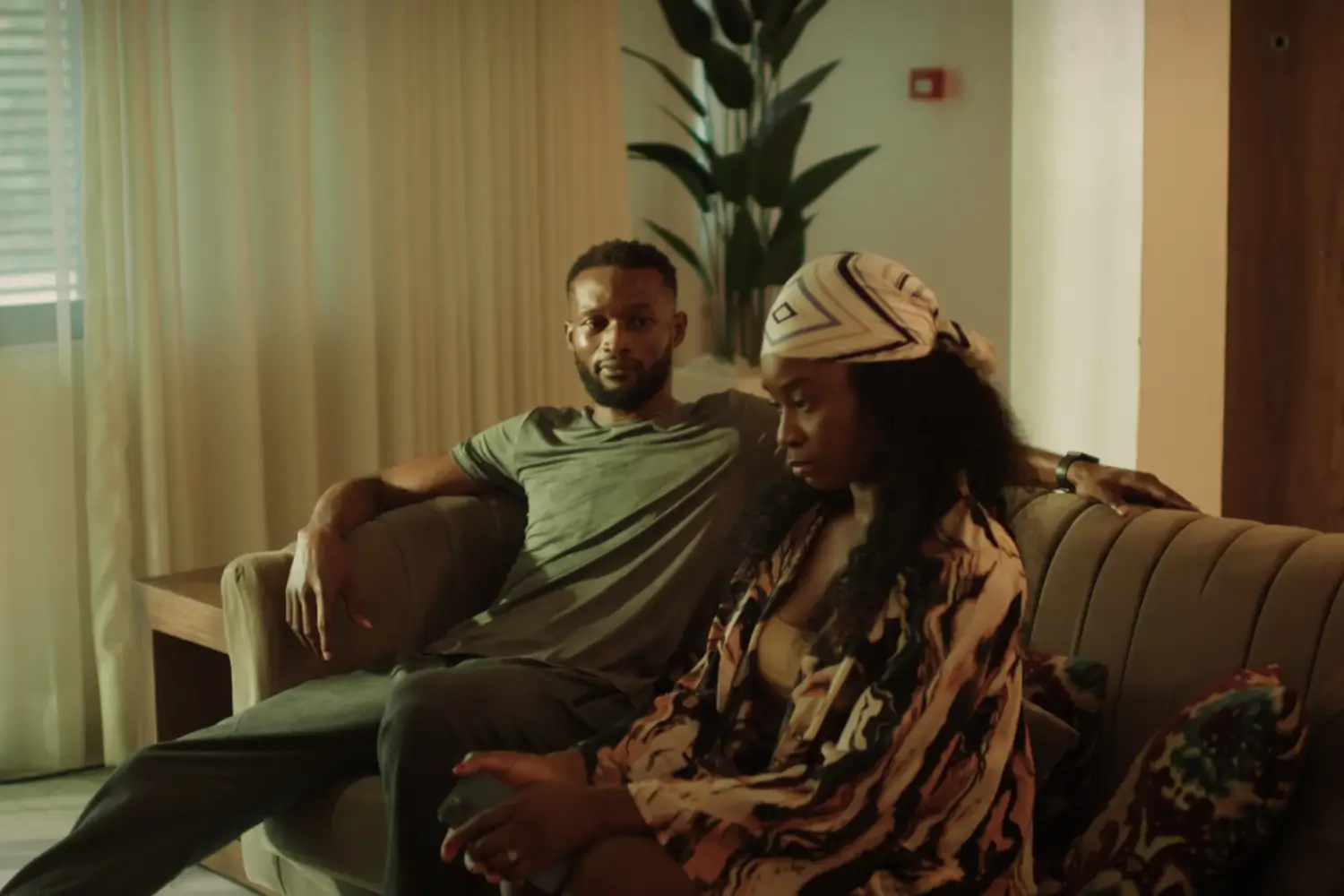
Marry the two, and what emerges is Daniel Oriahi’s Nigerian thriller The Weekend. The premise is fairly simple and almost wholly unoriginal, though exciting nonetheless: a woman forces her fiancé to take her to meet his family at their ancestral village, where mysterious events force them to confront the skeletons buried within the family home.
With three screenwriters on board, it’s easy to see how this narrative stretches in multiple directions. There’s the familiar foreboding of gothic horror, and cliché as it is, it doesn’t really matter because, when done well, conventional thrillers have a way of truly gripping the audience. Then there’s the film’s attempt to examine how families, particularly traditional ones, can become all-consuming, leaving lasting psychological scars on their children.
If not for the unmistakable Nigerian texture, one could easily mistake The Weekend’s metaphors – linking cannibalism to families feeding on their children’s mental health – as a hallmark of A24-style “elevated horror.” Finally, the screenplay layers on garish, gritty splatter-horror tones, leaving as many scars on the audience as terrible parenting does on its protagonists.
While these competing genre impulses don’t quite coalesce, they keep the story moving and engaging. Stylistically, The Weekend measures up beautifully. Oriahi directs with theatrical flair, and his Hitchcockian influences are easy to spot. As one character states, Oriahi is indeed a man (and filmmaker) of substance.
There’s a fascinating precision to the framing. Cinematographer Idhebor Kagho employs telephoto lensing in wide shots like a spider setting a trap. Characters move through expansive spaces, unaware of how constrained they truly are. Frames within frames act like chains and prisons to trap them in the hell that is Luke’s family’s ancestral mansion. It’s within this haunting domestic space that the writing and performances shine, particularly in the awkward exchanges between Nikiya and her fiancé Luke, the returning prodigal son.
Unfortunately, the sound mixing often undermines the writing in these scenes; one can sense the bite in the dialogue, the sharp undercurrents between loving pleasantries. In one particular scene, as Luke reunites with his parents, the pleasantries are moving, but the camera eerily remains at a distance, as it pushes in and dynamics become clear, the sounds fail but the ominous piano score picks up the tension.
As expected of family-reunion films, dinner scenes carry immense weight, yet poor mixing dulls their impact. Despite the sly humor of double-faced relatives, when the film reaches its explosive climax, the performances – particularly from Gloria Anozie-Young and Keppy Ekpenyong-Bassey as the devilish parents – reach a level of ridiculous pantomime.
In contrast, it is the younger actors who truly elevate the film. As the central couple, Uzoamaka Power and Bucci Franklin deliver emotionally rich performances that touch the terrain of prestige drama, the kind “elevated horror” often aspires to. This isn’t to say that regular stylized acting can’t be done brilliantly. As the twisted daughter, switching effortlessly between demure and psychotic, Meg Otanwa delivers a standout performance.
Horror, however, only lingers when the violence lands, and here, Oriahi and editor Ehizoba Chris strike a delicate balance. Borrowing from the grungy texture of torture horror, the blood effects are gruesome and can leave one squeamish. Yet Oriahi and editor Ehizoba Chris know just when to showcase brutality and when to cut away from it for maximum impact.
What’s most impressive is Oriahi’s understanding the lingering pain of past incidences. The film’s tragedy doesn’t make a mockery nor seeks catharsis in destruction. Instead, The Weekend leaves viewers hollowed out as trauma rings across the screen’s solemn final moments. That’s where the film’s craft aligns most powerfully with its message: the mental battle against one’s own nature.
Embracing its mixture of styles and ideas, Oriahi and his team deliver the right kind of thrill for a midnight festival screening and this spooky season.
The Weekend screened at the 2025 NBO Film Festival that ran from 16-26 October.
Check out our full coverage of the 2025 NBO Film Festival here.
EDITOR’S NOTE:
All reporting, interviews, and reviews on Sinema Focus are protected under international copyright law and the Kenya Copyright Act, 2001. No part of this publication may be reproduced, rewritten, republished, or redistributed in any form by media outlets without prior written consent. For reprint or syndication inquiries, contact editorial@sinemafocus.com.
©️ 2026 Sinema Focus / African Film Press. All rights reserved.
Never miss a moment.
Get the latest stories from Sinema Focus delivered straight to your inbox. Subscribe to our newsletter now.