

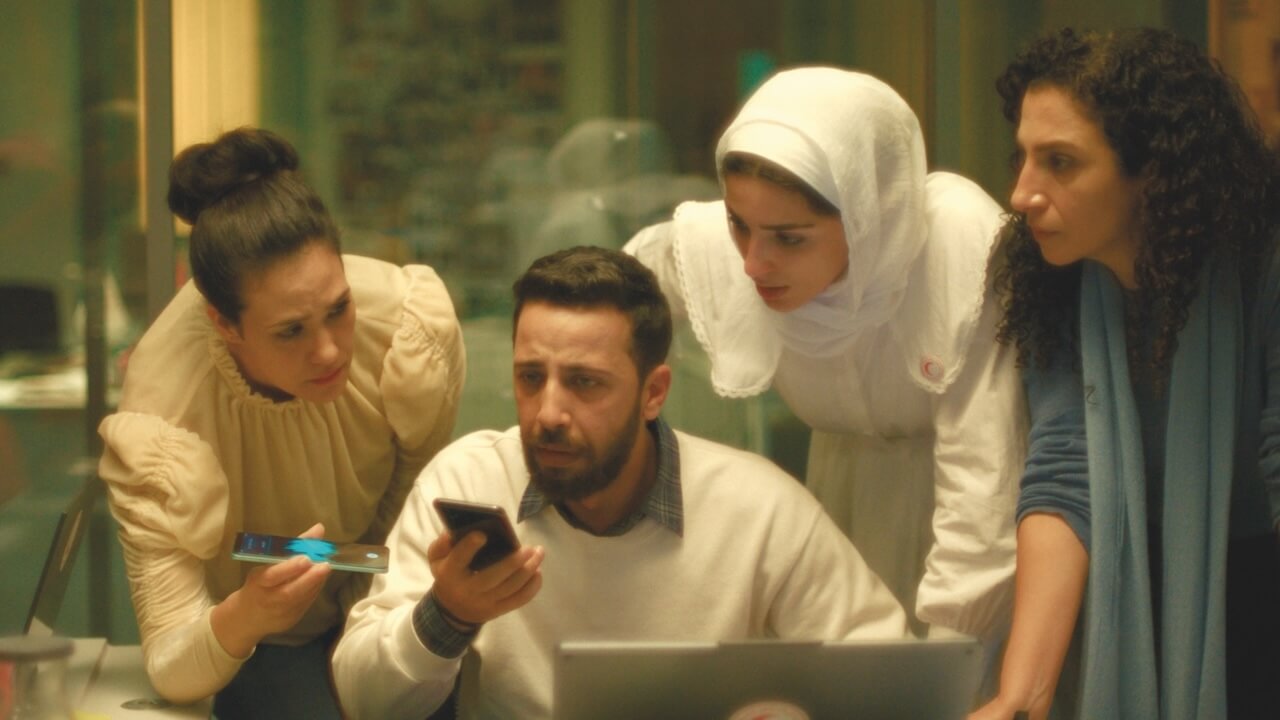
On my bio, it says I believe movies are the most powerful way of shaping perspective. Even though I was completely lucid when I wrote it, a film like The Voice of Hind Rajab comes along and recalibrates what perspective truly means, and how film, as a medium, becomes both its most powerful conduit and, unfortunately, a self-effacing accomplice.
The docudrama, which premiered at the 2025 Venice Film Festival, tells the story of Hind Rajab, a six-year-old Palestinian girl trapped in a car under IDF fire in Gaza for hours in 2024, and the futile efforts to rescue her. It’s also Tunisia’s entry for Best International Feature at the 2026 Oscars, one of Africa’s confirmed submissions so far, alongside Morocco’s Calle Málaga, Egypt’s Happy Birthday, South Africa’s The Heart Is a Muscle, and Senegal’s Demba.
Stay ahead of Kenya & East Africa’s film and TV.
Get our stories in your inbox — Subscribe to our newsletter now.
At a time when headlines rejoice at a reported ceasefire in Gaza, months after the fractures of another “agreed” ceasefire led only to more bloodshed, sieged famine, and a UN Assembly mired in the veined rebukes of suited leaders, The Voice of Hind Rajab stands as perhaps the most brutal but revealing portrait of the inhumanity unfolding in Gaza. It emerges from a world so stripped of its inherited empathy that each viewer becomes, in a sense, complicit. One scene unfolds like a sarcastic riff on the marketed wording and framing of catastrophes, even though well-intentioned, as a means to elicit empathy.
From its opening frame, the film establishes its stark realism. The cinematography unfolds like reconstructed surveillance footage from inside a Red Crescent Society call centre in Ramallah, Palestine. What begins as a mundane evening for the call centre volunteers quickly turns harrowing when one of them, Omar (played by Motaz Malhees), is forced to confront the sudden death of an unnamed girl on the other end of the line. Before grief can even take hold, Omar is introduced to the trembling voice of Hind Rajab, a six-year-old girl, the only survivor in a car surrounded by the bodies of her slain family, as she pleads for help, for company, and for rescue.
If this were fiction, and Hind’s voice were that of a young actress, she would win an Oscar for the emotional weight carried in every stammering breath and the humanity it elicits. If it were fiction, this review would praise the minimalist use of space, the precise blocking, and the razor-sharp editing that turns a single location into a pressure chamber better than David Fincher could dream of. And maybe, if it were fiction, I would call it slightly implausible that a six-year-old could convey such complex emotion with such haunting clarity.
Everything in The Voice of Hind Rajab, not just the voices but the emotional whiplash endured by the cast – recreated beat by beat – is choreographed from lived trauma. That ever-present awareness makes the film emotionally shattering.
Throughout its ninety-minute runtime, we are denied Hind’s point of view. Instead, Kaouther Ben Hania, directing with precision and empathy, keeps the camera fixed on the call centre workers – their twitching hands, darting eyes and frantic resilience as what should have been an eight-minute rescue turns into hours of mounting despair and helplessness. Their efforts constantly frustrated by bureaucratic incompetence, the arduous task of negotiating with an enemy acting in bad faith, and coordinated efforts that endangers both the victims and their rescuers. These characters melt and explode within themselves through hours of unmitigated agitation and anxiety that pull the audience into the visceral hurt of it. The sound design – mixing the static of the phone line, the hum of computers and overlapping archival audio – interposed with the actors’ performances, turns every scene into its own little battlefield.
With a film like The Voice of Hind Rajab, intellectualism almost feels improper. The film is a call to action and unless that call is answered, sitting down to enjoy it feels impossible. Incorporating the actual recordings of Hind Rajab herself, her small voice echoing through the static, surrounded by death and grief, whispering prayers, sharing fleeting meditations of the ocean, the film slowly and constantly breaks the hearts of everyone listening. There is no artifice, no embellishment, no fabricated drama. Everything is unbearably, unrelentingly real.
The film is an uncomfortable but necessary watch. Thousands of children have been killed in a war they cannot even comprehend. At one point, I wondered if, at Hind’s age, I would have even known how to describe a tank shooting at me. Yet beyond its gut-wrenching sadness, The Voice of Hind Rajab reveals the fractured humanity of rescuers and volunteers in Gaza – people who embody the best of what remains, what is still fighting on by picking up the pieces even in the middle of despair. Their frustrated hugs, tears, curses, and fragile hope that can at least comfort us like they did this young girl, simply by being the voice reminding us that there is still someone listening, even if they cannot take away the fear of what comes next.
EDITOR’S NOTE:
All reporting, interviews, and reviews on Sinema Focus are protected under international copyright law and the Kenya Copyright Act, 2001. No part of this publication may be reproduced, rewritten, republished, or redistributed in any form by media outlets without prior written consent. For reprint or syndication inquiries, contact editorial@sinemafocus.com.
©️ 2026 Sinema Focus / African Film Press. All rights reserved.
Never miss a moment.
Get the latest stories from Sinema Focus delivered straight to your inbox. Subscribe to our newsletter now.







nice 0ne