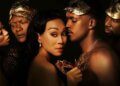


Kings of Jo’Burg returns to Netflix two years after its second season, and by the looks of it, has no intention of slowing down. It remains one of the few South African series – or African for that matter – forging ahead in a streaming landscape that increasingly favours short, limited-run content designed to retain a revolving door of subscribers, even as the global streaming giant scales back on African productions. Clearly, there’s a fanbase behind the longevity of South African shows like this – even one I didn’t particularly enjoy for its first two seasons.
What I remember of those earlier seasons are mostly groans and head-palms at the disjointed stitching of a show that lacked rhythm or direction. Despite its rugged colour grading and stylised action scenes, juxtaposed with the palatial aesthetic of its setting, the narrative felt detached from reason or coherence.
Stay ahead of Kenya & East Africa’s film and TV.
Get our stories in your inbox — Subscribe to our newsletter now.
But stepping into season 3, the first two episodes gave me a glimmer of optimism. The flaws of its predecessors are still present – especially the excessive posturing that drives nearly every confrontation – but beneath it all, Kings of Jo’Burg feels like it’s maturing. The third season boasts arguably the most technically proficient production I’ve seen in an African show. Its visual style, tightly choreographed action, and improved visual effects signal a welcome evolution. The pacing has also slowed enough to allow space for the many criminal factions, a prison subplot, and moments of scattered introspection, making the show more digestible.
Still, despite all the stylised violence and the brooding bravado of its cast, there’s very little in terms of persuasive drama tying the narrative together. The supernatural crime elements offer plenty of visual spectacle but ultimately orbit around without forming a meaningful core. Personal disputes drive much of the plot, yet they rarely carry emotional weight. The show presents a broad spectrum of villainy – both from protagonists and antagonists – but leaves little room for empathy. Characters either operate from selfish motives or make decisions so confounding they defy investment. Even those who exist outside the criminal underworld serve more as a moral compass than fully realised characters.
Kings of Jo’Burg’s biggest weakness remains its overreliance on the supernatural. It strips the story of meaningful stakes. As one character notes, they’re all just running around responding to the whims of spirits whose motives are opaque at best. These mystical forces, portrayed through glowing eyes and dreamlike monologues, are used to explain both internal conflict and external chaos. They serve as idols, threats, and – unfortunately – shields, rendering many scenes devoid of real danger. When death or destruction arrives, it rarely carries weight.
By the time the season comes to a close, this supernatural entanglement between the main characters collides in disproportionate collusions. And with it, the gun trotting crime back and forth between crime organisations and what is the most resourceful fort of plot armour, climax into deaths in the midst of labour contractions. For fans of action, there’s enough firepower to entertain, maximising all the stretches of imagination to galvanise the peak strengths of the show to varying success. But in its end, there is really not much to hold on to.
Between the many expository dialogue updating the audience on the inner thoughts of the writers, there’s never quite enough menace or intrigue to make you root for the protagonists or revel in the collapse of the villains. So much so there is one antagonist who initially seems posed to be a force but then disappears half way through the season as if he’d served his purpose to pad the slow parts of the narrative.
Kings of Jo’Burg has the range to traverse prisons, Johannesburg turf wars, Cape Town drug corridors, mysticism and family dysfunction – but despite the scope, nothing sticks.
I couldn’t stand the first season. It was frustrating, clumsy, and uninspired. Three seasons in, however, the show has made clear strides in cohesion and technical execution. There’s a raw cinematic indulgence in its depiction of violence that, though hollow at the core, is undeniably gripping to watch. The characters remain frustratingly devoid of emotional depth – but perhaps that was never meant to be the draw. And maybe that raises a broader question: do most Kenyan shows, for instance, remain stunted because they rarely get the chance to reach a third season, where visual confidence might finally meet narrative clarity?
But that’s a question for another day. As for Kings of Jo’burg, season 3 is digestible, if forgettable – and considering where it started, that might be the highest compliment I can offer.
Kings of Jo’Burg S3 is streaming on Netlifx.
EDITOR’S NOTE:
All reporting, interviews, and reviews on Sinema Focus are protected under international copyright law and the Kenya Copyright Act, 2001. No part of this publication may be reproduced, rewritten, republished, or redistributed in any form by media outlets without prior written consent. For reprint or syndication inquiries, contact editorial@sinemafocus.com.
©️ 2026 Sinema Focus / African Film Press. All rights reserved.
Never miss a moment.
Get the latest stories from Sinema Focus delivered straight to your inbox. Subscribe to our newsletter now.