

In the cinematic portrayals of the African dream, one that I can only summarize as the dream to leave the continent as soon as possible, the crossing of the Mediterranean is often the closing frame. It’s an image that either elicits the joy of dreams finally within reach or the grief of everything lost to make that journey possible.
Erige Sehiri’s Promised Sky, however, set in Tunisia, unsettles this familiar cartography of migration cinema. Instead, it exposes the hierarchies within Africa itself, where Sub-Saharan migrants seeking safety face the racially charged rejection of northern intermediaries to that dreamy European coastline.
Stay ahead of Kenya & East Africa’s film and TV.
Get our stories in your inbox — Subscribe to our newsletter now.
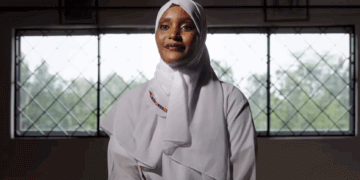
Opening with deliberate silence, the film follows three Ivorian women, and a little girl, sharing a small house on the outskirts of Tunis in search of work and dignity. In each other, they find a fragile form of belonging. Three generations emerge: a matriarch holding together a Christian church that serves as both a spiritual refuge and a source of conflict with the Arab landlords; Naney, a hustler estranged from her daughter and stuck in limbo on her way to Europe; and a university student coming of age under the pressures that crash against her need for freedom.
When a little girl survives a shipwreck and enters their lives, she becomes both their responsibility and their mirror, drifting among them as they latch their longings and aspirations onto her. Over the course of the story, the women’s relationships deepen in both strength and fragility, not through dramatic confrontations but through the quiet rhythms of cohabitation: laughter, fatigue, and the silent anger that gathers as their place in the community becomes increasingly threatened.
Promised Sky is a film that resists spectacle, choosing instead to dwell in the ordinary textures of migrant life, the waiting, the paperwork, the invisible borders shaping every gesture, where conversations often halt midstream when racial tensions burst to the surface. Sehiri, a filmmaker with a background in journalism, spent years researching the routes and realities of Sub-Saharan women moving north. She rounds the film in the understated but carefully articulated emotional sensitivities of her characters. Each woman moves on a different course, pulling away from the others yet they remain in sync, bound by shared rhythm and circumstance.
Much like Sean Baker’s The Florida Project, where the innocence of a child guides the cinematic tensions with a colourful pink hue, Promised Sky unfolds with similar grace. Sehiri’s camera observes rather than dictates, moving with her characters rather than around them, squeezing as much beauty as possible from the mundanity of the everyday. The house becomes a familiar anchor while the world beyond its walls shifts with the women’s experiences. A small, faithful congregation, awkward dormitory rooftop conversations, shared meals, the throbbing lights of a nightclub, and cascading pale hue of morning after, the film is filled with spaces where Sehiri’s empathy lives and where her storytelling feels most piercing.
In an effort to paint a complete portrait of the emotional landscape of these generations of women, the film touches on many threads – racism, faith, motherhood, legality – stripped of an overarching story. It stands at a distance, letting the world happen to these women as naturally as it has clearly happened to so many in real life. At its best, this approach gives Promised Sky a remarkable realism, its characters so well-defined that very little need articulation in their individual conflicts. But stretching itself thin to accommodate all the women flattens some of the film’s emotional energy.
Almost in transit itself, the film picks up and drops its narrative loosely, offering neither sanctuary nor resolution to its characters against the larger sufferings they drift within. What it does offer, however, are moments of pure laughter and tears through the discrimination it ropes them in, recalibrating their world views and their relationships.
By the time Promised Sky ends, abruptly, almost mid-breath, its context couldn’t be clearer. For these women, and the many who live their reality, the struggle carries no promise of resolution. It only shifts the course of their lives and their endurance against it, closing on the image of a deific sky that promises freedom but never quite delivers it.
Promised Sky screened at the 2025 NBO Film Festival that ran from 16-26 October.
Check out our full coverage of the 2025 NBO Film Festival here.
EDITOR’S NOTE:
All reporting, interviews, and reviews on Sinema Focus are protected under international copyright law and the Kenya Copyright Act, 2001. No part of this publication may be reproduced, rewritten, republished, or redistributed in any form by media outlets without prior written consent. For reprint or syndication inquiries, contact editorial@sinemafocus.com.
©️ 2026 Sinema Focus / African Film Press. All rights reserved.
Never miss a moment.
Get the latest stories from Sinema Focus delivered straight to your inbox. Subscribe to our newsletter now.