

Judging from the clunky first scene of Nome, I braced myself for the cynical dread of watching African traditions used as cover for poor storytelling. Granted, carefully woven with the feel, style, and tonal acumen of 1969 colonial Guinea-Bissau, the breadth of scale bringing to life a segment of history almost to photographic accuracy would be excusable even if the voices and narratives of that period were long lost to time. Yet as the scenes build on each other, there was no denying that the steady hands of Sana Na N’Hada have no intention of playing it safe.
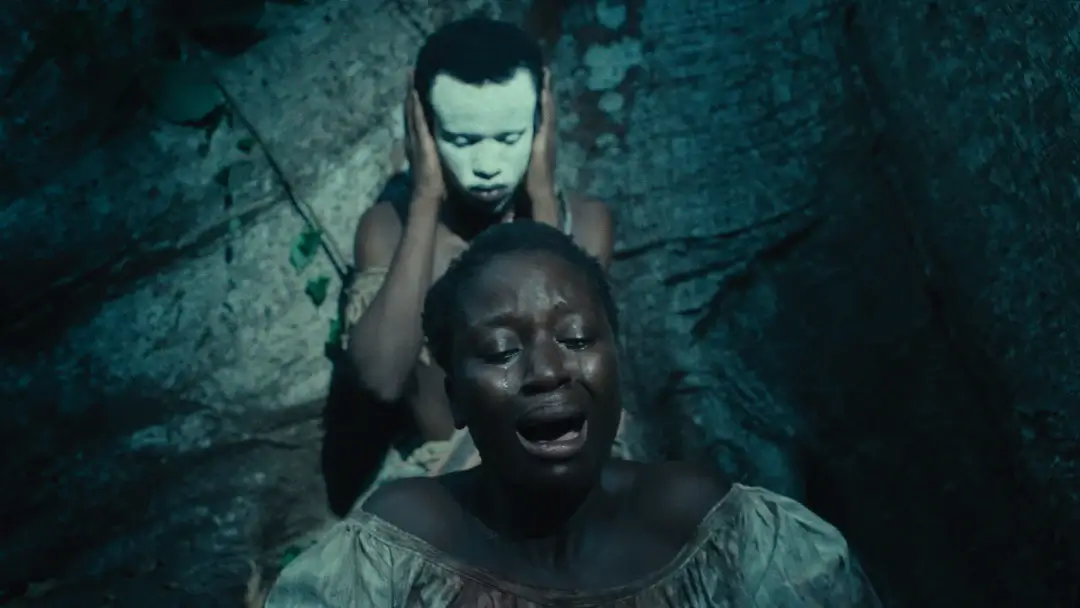
The story opens with the rituals of a communal funeral where a young boy is forced to take over from his late father, both as remembrance and continuity. Where most films might settle for the symbolic promise of this rite, in Nome, the boy is forced into seclusion in the forest with only a spirit for company. There, he’s determined to carry on his father’s legacy by building a musical instrument for his community. Spliced through the first half, his presence captures the mystic soul of the film, as inherited communal duty outweighs individual instincts.
Stay ahead of Kenya & East Africa’s film and TV.
Get our stories in your inbox — Subscribe to our newsletter now.
The more grounded narrative follows two cousins: Nome, a lazy young man living with his mother while the guerrilla war for independence from the Portuguese rages elsewhere, and Nambu, who shares their home. A budding romance between them results in Nambu’s pregnancy. Overcome by cowardice, or guilt, Nome joins the fight while Nambu deals with the pregnancy and glimmers of a better life. What begins as a conventional love story soon branches into far less predictable territory as Nome discovers himself at the heart of the war and Nambu cannot escape its devastation.
Structured around vignettes drawn from historical documentation of the war and those inside it, Nome becomes a relay of stories preserved in the archives of colonial emancipation. The film rarely embellishes the violence of war, yet remains entirely devoted to it, not as a personal epic of a central hero but more in its ideological machinations, a perspective rarely attempted in contemporary cinema. At the same time, its historical portrayals avoid the battle spectacle, focusing instead on individual journeys and metaphysical expeditions the characters undertake as they struggle to grasp the horrors around them. The result is a timeless and masterful work of cinema so achingly familiar and deeply immersive in both past and present.
For all its visual spectacle, much of the film’s strength belongs to writers Virgílio Almeida and Olivier Marboeuf, who resist the temptation to reduce dialogue to clichés that merely stitch images and sound together. Instead, each line carries poetic weight – be it surreal musings or casual banter – grounding characters with surprising depth. The world around them brims with intention and brevity, drawing viewers fully into its rhythm.
The direction and cinematography are the film’s greatest triumphs. Na N’Hada wastes no frame, bringing to life with unrelenting realism, drawings of his own memory. His swirling camera and experimental lenses imbue the mundane with such raw eccentricity, while the meditative pace of each scene is elevated by an absurdly gorgeous score that transports us to another world, even as it mirrors this one. Overtly spiritual, even religious, but never evangelistic, the film anchors us to a ghostly spirit that follows the characters, embodying their connection to something greater than individual struggle. Dialogue and imagery blend nearly flawlessly into a tone that is unforgettable.
In its second half, Nome shifts from depicting the horrors of war to explore the human predicaments that follow it. Almost allegorical of the corruption in the Garden of Eden, the film shows how humanity’s urge to fight and conquer desecrates the natural world. This tension underscores a new nation’s struggle to remain hopeful about the future and the purity of its land, even while acknowledging the weight of its own atrocities. By exposing the enduring corruption that persists despite independence, the spiritual elements take a back seat, leaving viewers with a stark sense of nature’s indifference to humanity.
When the credits begin to role and a note explains that the archival footage was captured by Na N’Hada together with other filmmakers sent to Cuba for training that period, everything that makes Nome works makes sense. These fragments of a reality lost in time, seamlessly contaminating the fictional elements of the film, disturb the rhythm while deepening immersion that could only be consequence of personal motivations beyond simply making a film. And for Nome, this is definitely not just a film.
Nome was one of the 13 African films screened in the inaugural Africa-focused Open Doors section at the 2025 Locarno Film Festival.
EDITOR’S NOTE:
All reporting, interviews, and reviews on Sinema Focus are protected under international copyright law and the Kenya Copyright Act, 2001. No part of this publication may be reproduced, rewritten, republished, or redistributed in any form by media outlets without prior written consent. For reprint or syndication inquiries, contact editorial@sinemafocus.com.
©️ 2026 Sinema Focus / African Film Press. All rights reserved.
Never miss a moment.
Get the latest stories from Sinema Focus delivered straight to your inbox. Subscribe to our newsletter now.