
South Africa usually comes at the forefront of global economic discussions on inequality, with a Gini coefficient as high as 0.67, the highest in the world. It’s a figure that, when put in context, exposes the cracks left by an apartheid regime that segregated its Black and coloured populations from access to the country’s resources. Mother City, a documentary directed by Miki Redelinghuys and Pearlie Joubert, peers into one of apartheid’s most enduring echoes: the scars of spatial inequality now even more pronounced in one of Africa’s most developed cities – Cape Town.
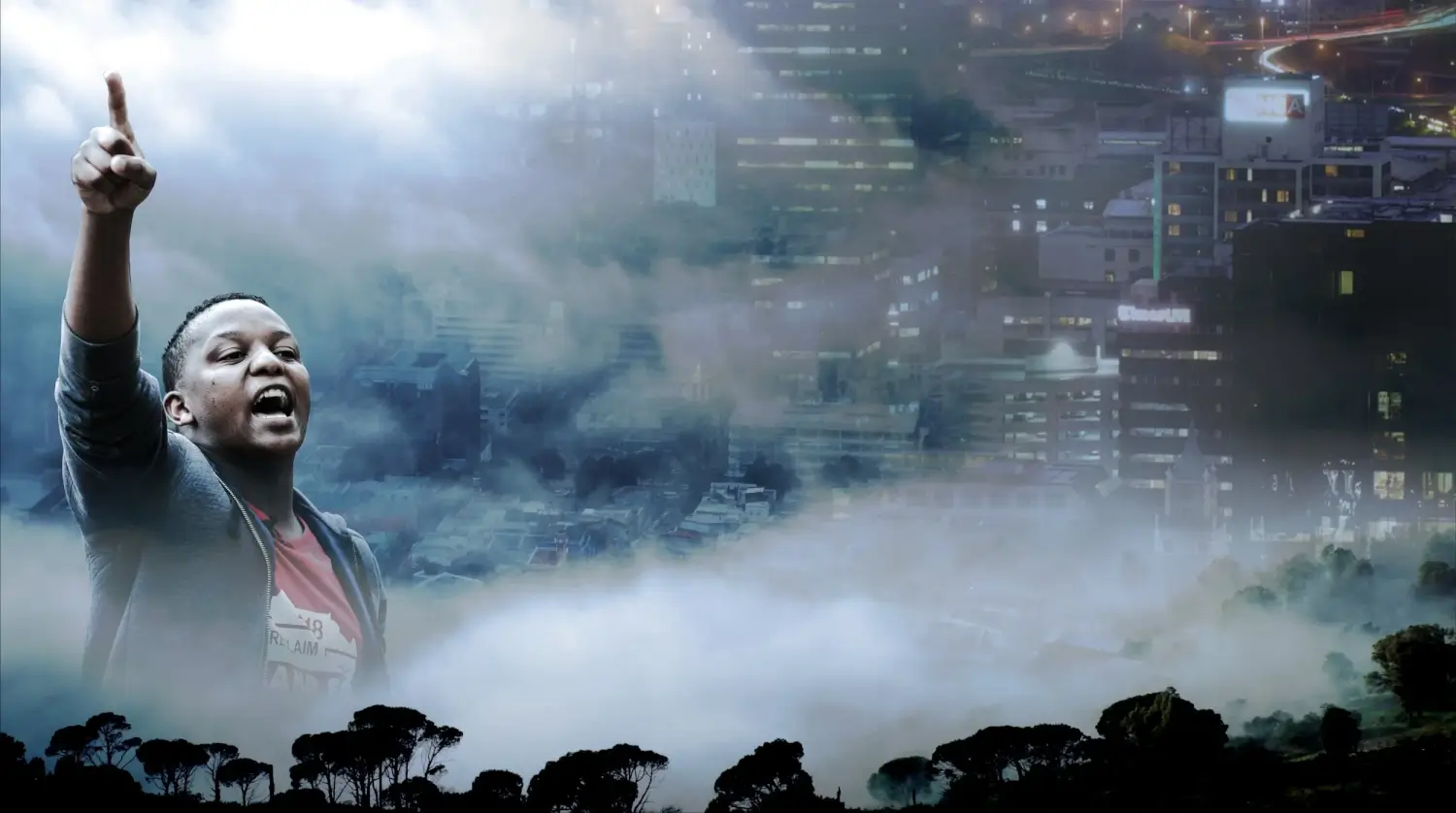
Over six years, the filmmakers follow Reclaim the City, a grassroots activist movement led by the passionate and unflinching Nkosikhona Swartbooi. Known to many as Face, he brings the fight to the city’s political and institutional bureaucracies in a bid to reclaim derelict public buildings and demand affordable housing in a gentrified city that pushes its most disenfranchised citizens to the outskirts in a profit-driven urban plan.
Stay ahead of Kenya & East Africa’s film and TV.
Get our stories in your inbox — Subscribe to our newsletter now.
Cape Town, despite its postcard-perfect beauty often romanticized in films and TV shows, and adored by tourists who flock there every year, is stripped here to its barest form: a city still deeply shaped by colonial and apartheid-era urban planning.
Through Reclaim the City’s occupations of spaces like the old Tafelberg School and Woodstock Hospital, and even a public golf course, the film captures the struggle of a city’s marginalized residents as they halt the sale of public land to profit-driven developers who perpetuate segregation and deepen inequality.
At its strongest, Mother City is a steady portrait of the enduring spirit and solidarity of a marginalized community united through well-organized protest. Through occupations, unrelenting dialogue, and legal challenges, Face and his fellow activists carve out an efficient spearhead for resistance against a city administration that works against them. In transforming abandoned buildings into homes, they redefine their dignity in a city that doesn’t have space for them.
These microcosms of community inside repurposed buildings endear the audience to their fight. Here, they share laughter as they braid hair, celebrating birthdays, memorials, and festivals together, as children and adults alike take up arms in communal organization inside rooms reclaimed from neglect. Around them, the camera doesn’t hide the inconvenienced and often irritated residents of the city, those either too distant from these struggles or too exasperated by the protests.
Their acts of protest, peaceful but loud, grounded in the country’s constitutional framework and driven by an urgent need for visibility, portray a form of dissent that proves both effective and necessary. The filmmakers’ use of intimate handheld cameras, unfiltered sound, and immersive observation, set against a sparse and off-kilter score, mirrors the volatility of their without drawing attention away from it.
At times, however, the editing drifts, expanding into tangential subplots that, while humanizing, bloat parts of the narrative. For instance, as anticipation builds around a landmark court order, the film detours to Barcelona to connect with another urban activist campaign abroad, and later to protests against government evictions during the COVID-19 pandemic. These scenes align with the spirit of Reclaim the City but, at nearly two hours, risk testing the audience’s patience and unevenly settling the film’s climax.
Despite these imperfections, Mother City stands as a vital and deeply affecting work, one that documents, with raw honesty, the lingering legacy of apartheid’s spatial injustices that continue to define South African life. It chronicles the living, breathing chasms of resistance – at times chaotic, but always heartfelt. Its subjects rely on their communal heft to carve out space for themselves, unified and harmonized, led by a figure whose voice cracks with passion and conviction strong enough to move and recruit anyone to his cause.
For Cape Town, this “Mother City” unable to embrace all its children equally, the city is left with questions and anxieties as the political instruments prove deaf, while the judicial, though closest to a sense of justice, is undermined by its appellate structures. Yet the fight of Reclaim the City rages on, from holding officials accountable for corrupt dealings to voicing the cries of a city too slow to act. Mother City brings to the forefront a protest that takes many forms: some defined, some unresolved, but always with these occupiers in mind.
Mother City screened at the 2025 NBO Film Festival that runs until 26 October.
Check out our full coverage of the 2025 NBO Film Festival here.
EDITOR’S NOTE:
All reporting, interviews, and reviews on Sinema Focus are protected under international copyright law and the Kenya Copyright Act, 2001. No part of this publication may be reproduced, rewritten, republished, or redistributed in any form by media outlets without prior written consent. For reprint or syndication inquiries, contact editorial@sinemafocus.com.
©️ 2026 Sinema Focus / African Film Press. All rights reserved.
Never miss a moment.
Get the latest stories from Sinema Focus delivered straight to your inbox. Subscribe to our newsletter now.