
Kikuyu Land is one of those rare but comforting films that, despite drifting between three languages, renders its meaning clear enough that subtitles often feel unnecessary. In the few moments when I do glance down to read the translation, it becomes evidently surreal to see how much is lost, and at times found, between layers of interpretation. That gap between truth and its misconstruction sits at the heart of the documentary’s thematic punches, crafting a moving ode to the people of Kikuyu Land and the spiritual terrain they hold dear, first for the Sundance Film Festival and soon for the world at large.
Following Nairobi journalist and co-director Bea Wangondu, the film interrogates histories, atrocities, and present-day configurations that enable and conspire in land injustices that have kept some of the most fertile parts of the Kenyan highlands away from their rightful owners. This journey moves across the colonial past that uprooted them, through generations of untenable labour conditions, and across oceans to the beneficiaries of the land and labour extracted, all while unfolding against the backdrop of the political consolidation of Kenya’s current president.
Stay ahead of Kenya & East Africa’s film and TV.
Get our stories in your inbox — Subscribe to our newsletter now.
Kikuyu Land bursts across a multitude of interweaving characters and, within these broken-up segmentations, soars and stumbles with the exacting confidence demanded by the gravity of its subject matter as it diffuses across multiple styles and narrative threads. At its core is Wangondu herself, sharing her journalistic eye across the political, economic and social lives of families either barred from land ownership or forced to labour upon it. She meets them with empathy, even as she musters the courage to confront her own family’s role in this history, despite their pleas for discretion.
Wangondu’s decision to weave her own family history – particularly her grandfather’s role as a collaborator – into the broader history of land struggles introduces a dual inquiry that oscillates between personal lineage and the structural violence she is at odds with.
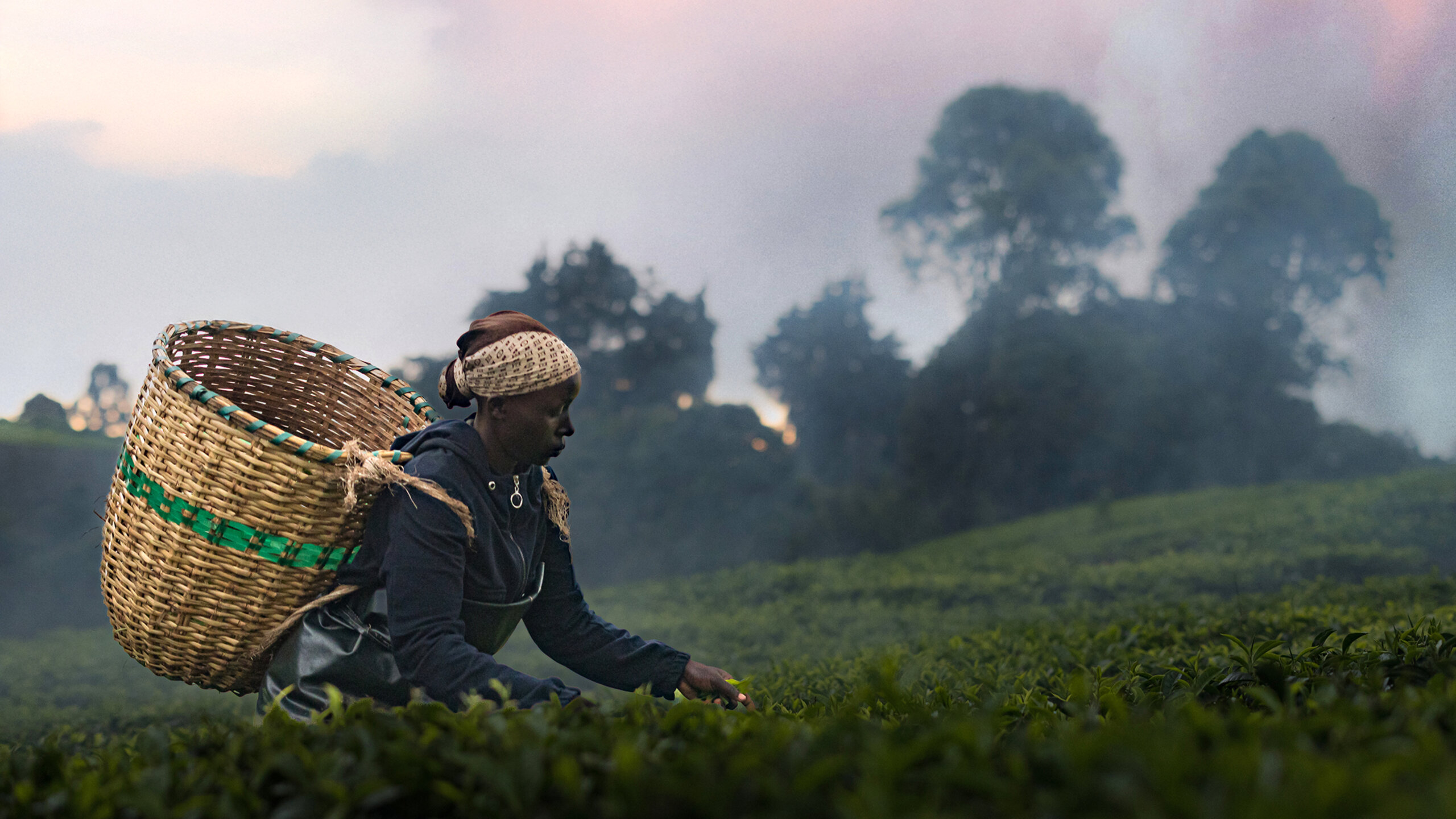
These entwined ideologies and personalities gravitating around the land are aided, if not exemplified, by the cinematography and editing of co-director Andrew H. Brown, which brush the film’s visual and auditory synapses into breathtaking crests. With Kenyan films increasingly freed from any singular visual signature, Kikuyu Land blends colour grades and tonalities into a unique and wondrous style, capturing the slow, earthy gloom of the green rural highlands in contrast with the expedited rhythm of journalistic inquiry. From sweeping drone shots to intimate frame compositions, the imagery, even within a 96-minute runtime, carries generations’ worth of stories, both grand and seemingly inconsequential, handed down to the audience.
Completely enamoured with the personalities in front of the camera, the film spends the limited time it has with each subject in deep reverence, ebbing and flowing seamlessly between them. From a musical engineer leading the charge against generational legal injustices, to the wandering thoughts of a child coming to terms with the systems of labour surrounding him; from the lingering silences that force pain from a grandmother recounting her years under farm managers, to bursts of energy from forces either fighting or defending entrenched systems of oppression, Kikuyu Land never misses a mark in privileging presence with purpose.
In this regard, the film devotes the largest portion of its runtime to wrestling with the portrayal of its antagonistic forces, doing so with a direct intentionality that saddles it with a looming anxiety. This tension steers its virtues and vices with a hypnotic intemperance. Through clipped news articles that chronicle the film’s broader political textures – sometimes through informally sounding audio – and the back-and-forth appeals to uncover the veiled workings of multinational corporations still rooted in the land, the larger questions demanding the most attention, though powerfully illustrated, remain unresolved. Meanwhile, the raw, personalised moments where the film most thrives could have been explored even further.
Perhaps that is simply me being too gluttonous for more of this beautiful film to exist within itself, mostly because of how familiar it feels. By the film’s end, Wangondu reflects on the white lies that bind the stories that inform us, and though they are often sourced from well-intentioned love, she arrives at the conclusion that storytellers are far more important than the stories themselves. In many ways, Kikuyu Land embodies this belief to a fault. Every character – those wearing their lives in deeds, those simply recounting a history, and even those obscured behind pixelated blurs and voice modulators – has their fair moments of impressionability. Together, they coalesce into a profound and poignant meditation on land and its people.
Kikuyu Land had its world premiere at the 2026 Sundance Film Festival, screening in the World Cinema Documentary Competition.
EDITOR’S NOTE:
All reporting, interviews, and reviews on Sinema Focus are protected under international copyright law and the Kenya Copyright Act, 2001. No part of this publication may be reproduced, rewritten, republished, or redistributed in any form by media outlets without prior written consent. For reprint or syndication inquiries, contact editorial@sinemafocus.com.
©️ 2026 Sinema Focus / African Film Press. All rights reserved.
Never miss a moment.
Get the latest stories from Sinema Focus delivered straight to your inbox. Subscribe to our newsletter now.