
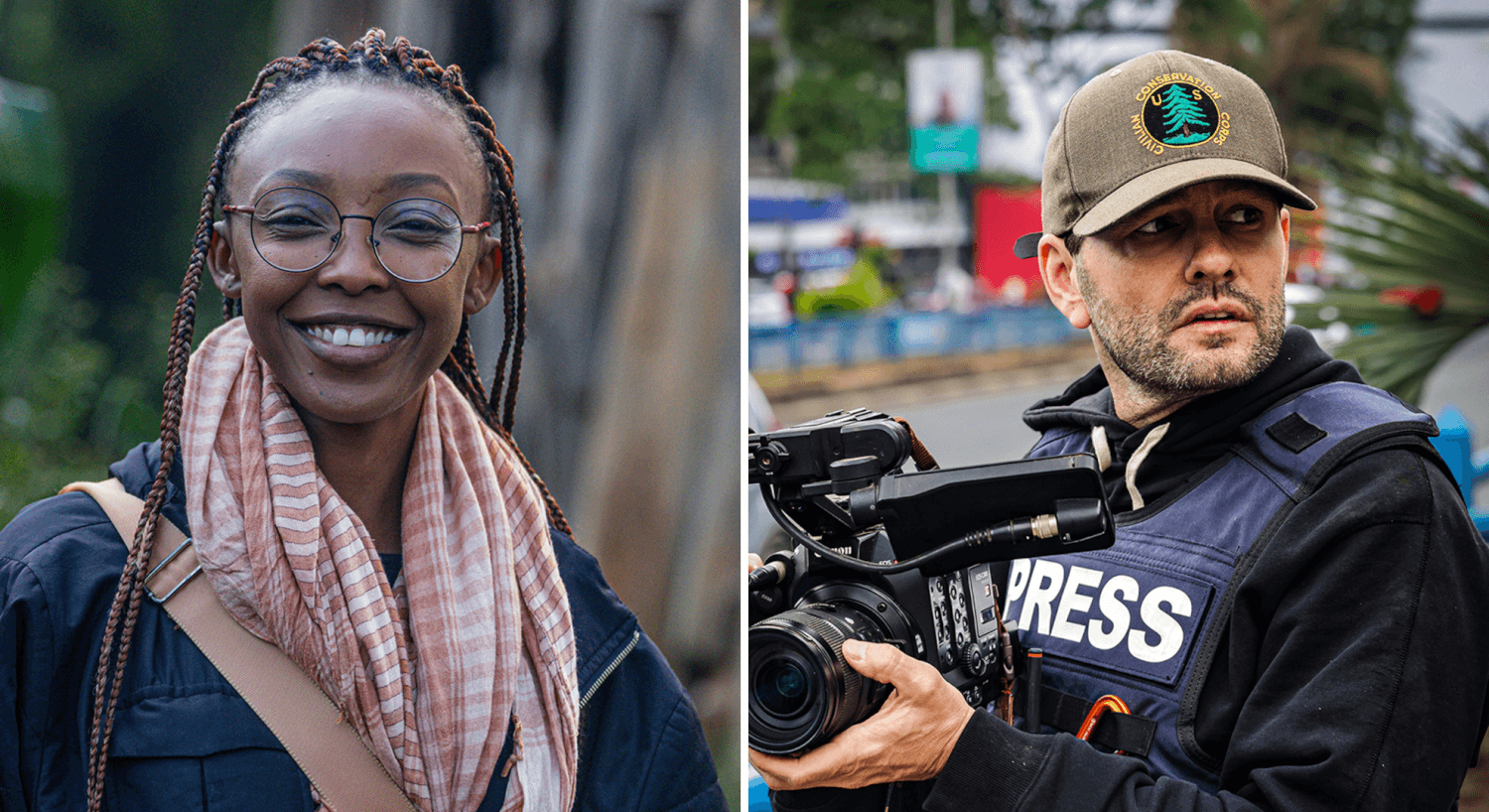
Growing up in Kikuyu country, the echo of land injustice has a way of finding you before you find the language for it. It hums in daily life, in family anecdotes that trail off just when they begin to matter. It is a colonial inheritance, yes, but also a moral riddle passed down across generations, leaving questions on both sides of the divide: for those dispossessed, and for those who quietly benefitted. These unresolved tensions form the bedrock of Kikuyu Land, a Kenyan documentary directed by Bea Wangondu and Andrew H. Brown, and one of three African features that premiered at the 2026 Sundance Film Festival.
Kikuyu Land gathers itself from personal unease, half-asked questions, and the silences that settled into Wangondu as a child. “I was the kind of child who asked too much,” she says, in an interview alongside her co-director Brown, with the wry clarity of someone who learned early what happens to curiosity in systems built for obedience. “And like many children who ask too much, I learned how efficiently curiosity can be dismissed.” In her household, shaped by the logic of Kenya’s 8-4-4 education system, thinking was transactional. You answered correctly. You passed the exam. You advanced. You became respectable. Anything beyond that, anything speculative, disruptive, morally untidy, was unnecessary, even dangerous.
Stay ahead of Kenya & East Africa’s film and TV.
Get our stories in your inbox — Subscribe to our newsletter now.
Yet some questions refuse discipline, and they linger, aging with you. For Wangondu, the most persistent of these centred on her grandfather. Why did he own so much land in a community where most families had so little? It was the one question no one wanted to touch.
When Wangondu later met Brown—the Emmy Award–winning filmmaker who would become her co-director—the conversations they shared about storytelling circled back, inevitably, to this unresolved terrain. Of all the films she could make, this was the only one she could approach without artifice. It was personal enough to demand honesty, and unfinished enough to sustain inquiry. Kikuyu Land emerged as an accumulation of questions finally allowed to breathe, her questions finally being given space to exist.
What the resulting production seems to understand is that land is never just land. While the story begins with the Kikuyu, it does not pretend exclusivity. “This isn’t only a Kikuyu issue,” Wangondu explains. “It’s an African thing, and beyond that, it’s a human thing.” Land, everywhere, functions as memory, telling you where you come from, holding inheritance, heritage, and identity in ways that are both material and mythic. “The only reason we’re speaking about Kikuyu Land,” she adds, “is because this is where I stand. You begin from where you come from. Only then can you reach outward.”
The film moves with a deliberate visual tension, juxtaposing the sweeping openness of Kikuyu country with conversations, some so intimate they feel almost overheard. It is a balance carefully struck, and one that Brown, as a co-director, describes as essential to the film’s grammar. “The landscape there in the Kenyan highlands is beautiful, and it feels sacred at the same time,” he says. “But on the other side of that beauty, there’s a belief that it’s cursed—that it carries wounds, that a lot of bad things have happened on that land.” The history, once learned, alters the view. What initially reads as serenity begins to feel haunted. As beautiful as it is, the land has something to say.
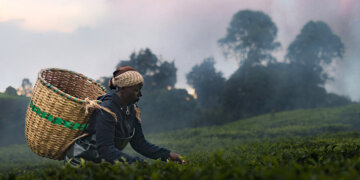
And the story it tells is that in these sweeping landscapes, colonial land dispossession does not feel like a closed chapter but appears ongoing, procedural, and almost administrative. What Kikuyu Land reveals is how the architecture of theft was never dismantled, only renamed. “You see a system being set up almost a hundred years ago,” Wangondu notes. “And you see it still running.” Tea plantations operate today much as they did in the 1930s and 1950s, their rhythms, hierarchies, and cultures barely altered. The British modelled farms as businesses, plantations as corporate enterprises, and what remains now is a continuity of multinational corporations occupying the same terrain, simply under different flags. What looks like modern corporate agriculture is, in fact, an old system wearing contemporary language.
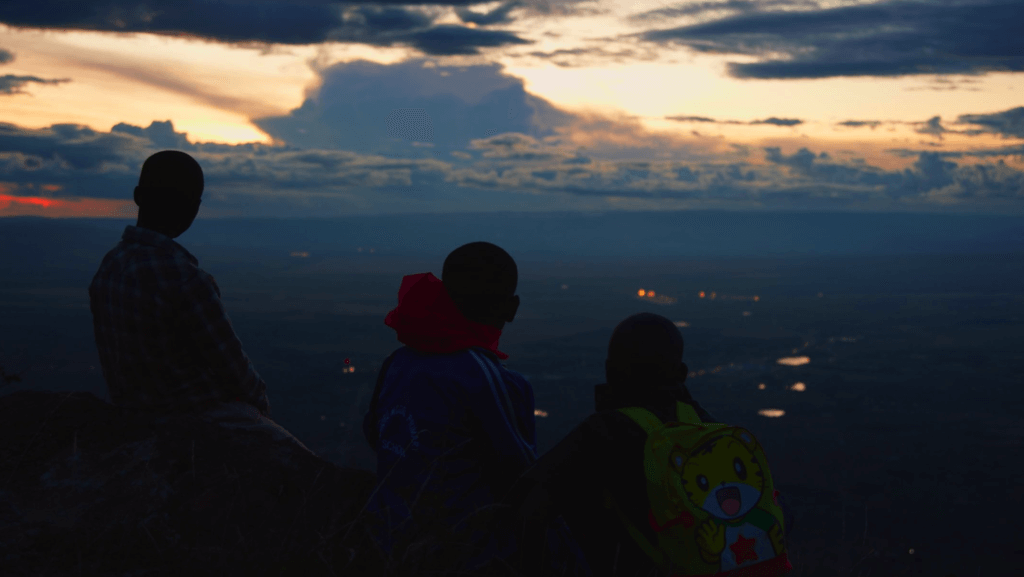
When our conversation turns to reform, an inquiry whether land justice can be achieved without fundamentally rethinking the postcolonial state itself, Wangondu is sceptical, though not cynical. “Unless change comes, things will remain the same,” she says. “And it’s an expensive endeavour to do that.” Kenya, she observes, has spent decades attempting reform, only to circle back to familiar outcomes. The system is already in place. “It’s a chessboard,” she explains—pieces moved, reshuffled, returned to their original positions. Motion without progress. Change without transformation. This recursive stagnation, she suggests, is the very definition of neocolonialism.
Brown, while equally clear-eyed, holds space for the possibility of rupture. Change, he argues, is possible, but only if power chooses accountability over convenience. For multinational corporations to be transparent, for land to be ethically governed, political will must exist. “The governing bodies have to want to serve the people,” he says. “They have to put people above profit.” This is not a Kenyan problem alone. Whether in the United States or Kenya, the pattern repeats, as governments too often align themselves with capital rather than with citizens, extraction rather than care.
Endeavouring to narrate this universal problem has not delivered the filmmakers any easy conclusions about justice. If anything, it has stripped the concept of its abstraction. Justice, as Kikuyu Land understands it, is not a destination waiting patiently at the end of reform, but a contested process. “As it stands, our participants don’t have justice,” Wangondu admits. What the film has offered instead is a kind of collective education about themselves, about the communities they worked with, and about the machinery that governs land, labour, and belonging.
Working closely with families living and labouring within the tea plantations, alongside community organisations and children who have inherited this system without consenting to it, the two filmmakers came to understand how harm persists, and how thoroughly it is normalised. Do they believe justice will arrive? Wangondu hesitates. “That’s a stretch,” she says. The political terrain itself is unstable. Under President William Ruto, land governance has entered another period of disruption: public tensions with the National Land Commission, resignations from within its ranks, mandates challenged and diluted. Change is happening, yes, but not necessarily in ways that clarify paths to restitution. If anything, the reshuffling threatens to further obscure how, or whether, land claimants might ever be heard.
Still, the film does not remain a passive act of witnessing. Through Joseph Njenga—one of the film’s producers, who worked closely with the community—the team was able to facilitate a small but tangible shift, like moving specific families out of the tea plantations and into safer living conditions beyond them. It is a material intervention, but Wangondu is careful not to mistake it for justice. “In terms of justice, I don’t know,” she says. “There hasn’t been any indication that that’s going to happen so far.”
Brown approaches the question from a different angle, less resigned, but no less demanding. “I believe in justice,” he says. “But I believe that for justice to exist, there has to be accountability.” For him, Kikuyu Land functions as a provocation, a call to force accountability where it has long been evaded. Justice, he insists, does not emerge organically, but corporations must be challenged and consumers must ask where their money goes, and under what conditions it circulates. “Without pressure, there’s no incentive,” he says. Justice, then, becomes less a moral guarantee than a political struggle, one that depends on how much discomfort people are willing to generate, how loudly they are willing to insist.
A film like Kikuyu Land is never made in neutral territory. Risk threads through every decision, what can be said, how it can be said, and who might bear the consequences once the camera leaves. For Wangondu, that fear was inseparable from responsibility. “We had to give a lot of respect and handle the stories very delicately,” she says. The lives the film enters are already burdened by precarity, and exposure could not become another form of extraction.
Coming into these spaces, Wangondu was acutely aware of her own positionality. “I was coming from what I now see as a place of privilege,” she reflects, returning to communities within her own culture whose experiences of land dispossession and labour she had not personally lived. That awareness shaped interactions and consent was not assumed but was negotiated, repeatedly.
Brown agrees that transparency had to be established early and sustained throughout. Participants were told clearly what stories the filmmakers hoped to tell, how those stories might be used, and how identities would be protected. At every stage, people were given the option to participate—or not—without persuasion, pressure, or consequence. “We were always coming back to power dynamics,” Brown says, “understanding that we had no business pressuring anyone.” The two filmmakers committed to what Brown calls “moving at the speed of trust,” allowing consent to remain a living conversation rather than a one-time agreement.
The resulting production from these ethical efforts was a film which both of them agree that, if it speaks differently to Kenyan audiences than to international ones, does so because it asks something different of them. For Wangondu, the hope is interrogation. “I want them to interrogate where they come from,” she says—not only in relation to land, but to the wider silences Kenyans have been trained to step around.
She also rejects the idea that younger Kenyans are disengaged from questioning. On the contrary, she points to a politically alert, highly mobilised generation, one that has already demonstrated its willingness to confront power. “We have a very active Gen Z in Kenya,” she says. The protests around the Finance Bill made that unmistakable. And land, she reminds us, was not a footnote to those conversations but was central, as prominent and as urgent as fiscal policy itself.
What she hopes for, then, is engagement in its broadest sense. “Talk about it,” she urges. Let the film spill beyond the screen and into everyday discourse. “Let’s have conversations,” she says. “Let’s indulge them.” Her hope is that Kenyans might care for themselves and their histories with the same intensity they bring to caring for the nation.
Brown approaches the question more cautiously, mindful of his position. “I’m not in a place to challenge Kenyans to do anything,” he says plainly. But he hopes what Kenyan audiences might find instead is recognition—and pride. From his vantage point, Kikuyu Land reveals a people marked not by victimhood, but by endurance. “I see a community that is resolute,” he says. One that has endured extraordinary disruption and yet continues to stand, to organise, to fight for dignity in ways both visible and quiet.
His hope is that the film might offer a mirror. That Kikuyu audiences, in particular, might see how far they have come through honest acknowledgement of survival. And beyond pride, Brown hopes for healing within a community fractured by colonial intrusion, and within households divided by the systems that followed.
Kikuyu Land had its world premiere at the 2026 Sundance Film Festival, screening in the World Cinema Documentary Competition. The film now heads to the 2026 Copenhagen International Documentary Festival (CPH:DOX) where it will premiere in competition. CPH:DOX runs from 11-22 March.
EDITOR’S NOTE:
All reporting, interviews, and reviews on Sinema Focus are protected under international copyright law and the Kenya Copyright Act, 2001. No part of this publication may be reproduced, rewritten, republished, or redistributed in any form by media outlets without prior written consent. For reprint or syndication inquiries, contact editorial@sinemafocus.com.
©️ 2026 Sinema Focus / African Film Press. All rights reserved.
Never miss a moment.
Get the latest stories from Sinema Focus delivered straight to your inbox. Subscribe to our newsletter now.