
An eye trained to see and analyse a work of art is doomed to encounter difficulties when it meets a religious object. Conventional forms of expression (non-liturgical) operate under established rules that may be malleable but are otherwise immutable. The same cannot be said for liturgical art. Watching a liturgical play, especially, it becomes difficult to establish whether the production is doing something ingenious or simply curating a sermon for its audience.
For Chemichemi Players’ Valentine’s special, It Takes Two, director Julisa Rowe is having too much fun exploring the realms of possibilities for liturgical theatre, and in the process, might have just stumbled onto something special.
Stay ahead of Kenya & East Africa’s film and TV.
Get our stories in your inbox — Subscribe to our newsletter now.
The premise is deceptively simple: a tender, rhythmic ‘time-lapse’ of a marital lifetime. We follow a couple, John and Mary, from the heady glow of early vows to the quiet endurance of decades shared. The fabric of this story is crafted on a bucketload of biting humour, drama, music, and poetic narrations. Now, given this premise, most directors would opt for the same direction: a dynamic, elaborate set that evolves with the narrative. They would be gunning for a spectacle, even casting some of the most charismatic actors. In It Takes Two, Rowe chooses a refreshingly novel direction, and yet the simplest one.
At its core, liturgical drama is fundamentally different from liturgical service. For one, in a liturgical dramatic performance, there is a clear division between performers and spectators, while in a liturgical service, everyone participates in the action.
But what happens when you blur the line between service and drama? When you deliver a sermon while also providing artistic entertainment? You get It Takes Two, a clever hybrid stripped down to the basics so it entertains without being a spectacle, and preaches to its audience without slipping religious didactism. What unfolds on stage is not the spectacle of grand romance, nor the melodrama of betrayal and collapse, but something far rarer in contemporary theatre: an honest excavation of partnership as lived experience.
It Takes Two sidesteps clichés to reveal the texture of real partnership, its laughter and its stumbles, its harmonies and its friction. In doing so, the play poses universal questions: Is love enough? Are marriages simply a series of shattered illusions? What do you do when love fails?
Performance and relationship dynamics take prominence over the mono-lit, stripped-down stage featuring only two chairs and a small table. But the barrenness of the stage is a ruse because there’s really no stage since there’s no division between performers and spectators. The play is both a liturgical service and a drama, served in a chef-esque fashion (the set-proscenium is designed as a high-end restaurant), with the performance unfolding between meals.
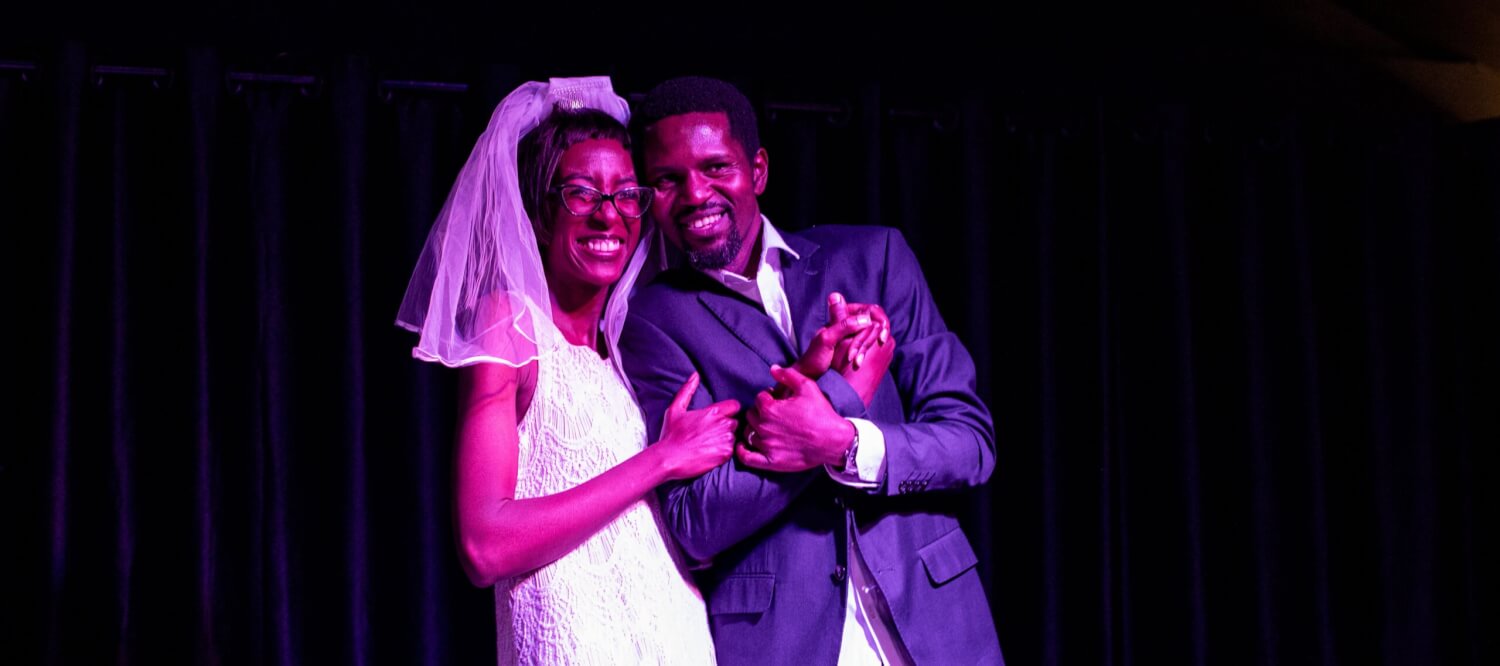
The cast is the real-life couple Justin Mirichii (Shimoni) and Sakina Mirichii, with Benjamin Webi bridging the drama with service through soulful music, poetic soliloquy and direct audience engagement. Both Justin and Sakina display comfort, chemistry and awareness only possible with a real partner. There is an ease in the way they occupy space together that grounds the play’s emotional arc. In the early scenes, their energy crackles with the buoyancy of possibility. Movements are quick, laughter is unrestrained, and their bodies lean instinctively toward each other. As the years pass, that physical vocabulary evolves. The space between them occasionally widens; gestures become more deliberate; affection becomes less flamboyant but no less real.
The writing understands that most marriages do not fracture in a single dramatic explosion but are tested by accumulations. There are no villains and victims here, no exaggerated moral failings. Instead, the friction arises from the ordinary weight of adulthood.
The integration of liturgical service and drama reminds us that this is not a singular story but a shared one. The music and narrations, soulful and reflective, punctuate emotional peaks without overwhelming them, and guide the audience through transitions in time and tone. There’s plenty of humour, sharp and situational, but it never trivialises the stakes because they are relatable and true.
While the production cannot escape narrative beats (early bliss, midlife strain, reflective resolution), it more than makes up for the lack of suspense or surprise with emotional sincerity. Instead of a climactic ending, we get a sensation, a recognition of our shared humanity. In a theatrical landscape often dominated by spectacle and high-concept experimentation, It Takes Two feels almost radical in its gentleness.
EDITOR’S NOTE:
All reporting, interviews, and reviews on Sinema Focus are protected under international copyright law and the Kenya Copyright Act, 2001. No part of this publication may be reproduced, rewritten, republished, or redistributed in any form by media outlets without prior written consent. For reprint or syndication inquiries, contact editorial@sinemafocus.com.
©️ 2026 Sinema Focus / African Film Press. All rights reserved.
Never miss a moment.
Get the latest stories from Sinema Focus delivered straight to your inbox. Subscribe to our newsletter now.