
How does one go about assessing a film that feels incomplete? Not just one with elements in need of polishing, but one constructed such that the narrative has missing pieces, both intentionally and unintentionally.
Hollow, a psychological thriller directed by Allan Bosire, sits in that 40 minutes long sweet spot where it feels too short, and yet not long enough to be a feature. If one examines its narrative ambitions, it feels like a film attempting to be the latter while retaining an air of mystery so that the horror lands only in its final few minutes. This is a film clearly crafted to tantalize, a concept piece setting up something bigger without delivering the promise of a complete experience on its own.
Stay ahead of Kenya & East Africa’s film and TV.
Get our stories in your inbox — Subscribe to our newsletter now.
There’s no doubt there’s intent to its vagueness; Hollow derives its best moments of tension by holding back, yet there is still an overt desire to scare the viewer. This treatment, along with continuity mistakes, cutting mishaps and even a boom microphone visible on screen, reveal a film still unfinished. It’s clear that given more time, the filmmakers had a lot more to explore, especially concerning the central couple.
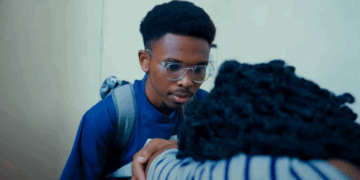
Opening with a quote about the ordinary beauty of forever love, the film immediately sets an air of tension. A picture of a happy couple gives way to tragedy: a miscarriage that scars their lives and relationship, though naturally her more than him. The trauma lingers even as time pushes them forward to a new house.
The writing leans into classic horror tropes: the foreboding house, creepy voices of a child, a woman battling physical and mental trauma, and a husband attempting his best to assuage them but limited in empathy. Even elements of craft seem familiar: shots captured at odd angles, the camera holding a beat longer, and a soundscape full of cliché effects and haunting music.
Everything is in place for thrills, and Hollow delivers some, especially when it corners the couple into exposing the gaping wounds in their relationship. Yet these moments never coalesce into something wholly immersive. The film builds tension but doesn’t quite find the space to pay it off.
There are clear hints to what Hollow could have been, especially in how it uses horror as an allegory for trauma and deterioration of disconnected marriages. Unfortunately, all of this remains surface level, and dialogue simply explains the tension instead of playing with it. Subtext is all but missing in conversations rushing through the plot. While the film never really charts unfamiliar territory, even a typical horror of this kind would carry substance if it had time to let the world and its characters breathe.
The rawness of the craft doesn’t help. Due to its unpolished quality, it becomes difficult to tell what aspects are deliberate and what are simple mistakes. The editing, for example, features snippets where extra frames linger between cuts, creating a jarring distraction. The sound, while effective, is often poorly mixed, breaking immersion rather than enhancing it.
Yet visually, the rawness produces shots and sequences that truly heighten the scares. In one sequence, the camera remains fixed on the husband asleep at a lower angle, capturing his lack of awareness. Around him, his wife, deep in her trauma, glides across the room as the lights play tricks on the viewer. The eeriness is immediately undercut by the standard horror tropes of banging doors and ghostly voices.
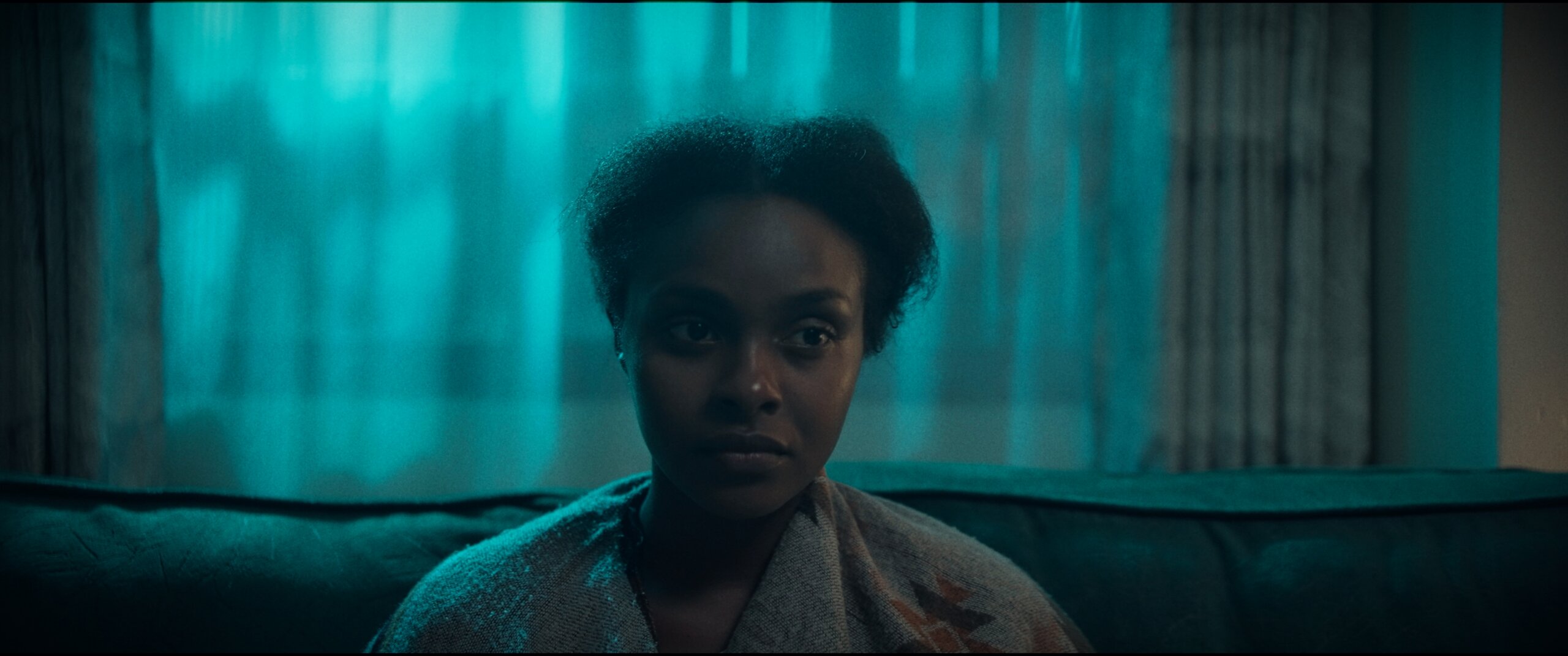
Hollow’s greatest strength is its use of colour, a craft element often ignored by even experienced filmmakers. The screen is almost always bathed in an emerald green hue, especially its night scenes, with set design that hits the eye boldly, and lighting that creates an unsettling atmosphere. This aspect truly carries the film.
Unfortunately, overall, good parts follow average ones; it is as if the viewer is witness to the filmmakers finding their narrative core and voice in real time.
As someone who studies and dissects films, it begs the question of what the film could have been had it been a feature film. For one, the protagonists would have a lot more to work with
While Joan Kenduywa is serviceable as the troubled woman slowly losing her mind, it’s the type of role we’ve seen done a dozen times, and so there’s nothing extraordinary in her performance.
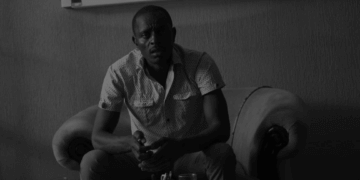
Neville Misati, however, takes an intriguing effortless approach to his role. He understands the sort of charming “nice guy” the film slots him into. There’s a misguided tenderness to the role; he tries hard or so it seems, but cannot muster the heart to truly help to his wife.
Misati plays his character with a relaxed energy that betrays his unwittingly cruel lack of understanding. He nails this aspect of the typical man unwilling to face the discomfort, and desperate to move on because he’s not the one in pain.
That theme sits heavy at the centre of the screenplay, how people in relationships approach their spouse’s trauma and how empathy become lacking over time. It’s why Hollow opens with the twisted quote about the normalcy in forever. The film attempts to tell the audience how this makes people take their relationships and partners for granted, yet ironically it doesn’t explore this enough, taking the viewer’s experience for granted. This is best exemplified by the cheap jump scare in the final shot, as if the filmmakers felt compelled to deliver on the horror premise rather than address the true depth of their themes.
Ambiguity in itself isn’t a bad thing, some of cinema’s greatest final shots often leave us suspended in uncertainty, but here it feels abrupt rather than intentional. Hollow ultimately feels like a film both physically and spiritually incomplete.
EDITOR’S NOTE:
All reporting, interviews, and reviews on Sinema Focus are protected under international copyright law and the Kenya Copyright Act, 2001. No part of this publication may be reproduced, rewritten, republished, or redistributed in any form by media outlets without prior written consent. For reprint or syndication inquiries, contact editorial@sinemafocus.com.
©️ 2026 Sinema Focus / African Film Press. All rights reserved.
Never miss a moment.
Get the latest stories from Sinema Focus delivered straight to your inbox. Subscribe to our newsletter now.