


In the corridors of film labs and festival residencies, cinema continues to find refuge. In these spaces, stories once confined by borders and budgets begin to breathe, sharpen their voice, and dream beyond the margins.
The Locarno Film Festival’s Open Doors program – founded in 2003 to support filmmakers from regions where independent cinema faces challenges – is one such initiative. In 2024, it announced a four-year focus on African cinema for its 2025 to 2028 cycle, supporting filmmakers from 42 African countries through co-production opportunities, producer training, and director development initiatives.
Stay ahead of Kenya & East Africa’s film and TV.
Get our stories in your inbox — Subscribe to our newsletter now.
Among those selected for the inaugural Africa cohort is Kenyan filmmaker June Wairegi, one of six participating prodcuers in the Open Doors Producers program. The others include Rwanda’s Yannick Mizero Kabano, Angola’s Kamy Lara, Zimbabwe’s Kudi Maradzika, Burkina Faso’s Moustapha Sawadogo, and Ethiopia’s Leul Shoaferaw.
When I sat down with Wairegi for this interview, I couldn’t help but wonder whether our conversation would unravel more than just her personal journey. Perhaps, too, it would offer a glimpse into how this new Open Doors cycle signals a pivotal moment for African film industries and their role in shaping global independent cinema.
This selection is not just a career milestone for Wairegi, it’s a shift in how she imagined her role within the broader cinematic ecosystem. “Of course, receiving the news was incredibly exciting,” she says. “But to be honest, I didn’t fully understand what it would entail at first. This time, I wasn’t going into a program with a project as I have done before. I was going in with a company. That alone was a learning curve.”
The company is Giza Visuals, a film production house based in Nairobi which she co–founded with director Omar Hamza. Wairegi describes it as far more than a production entity – it’s the creative engine powering much of the momentum she’s now experiencing.
“At Locarno, the producers’ track is really about developing your production company,” she explains. “It gives African producers a platform to present their companies for potential local and international collaborations. So it’s not just about the film you’re working on, it’s about your whole blueprint – how you position yourself, how you market, and what kind of stories are in your slate.”
To qualify for the program, applicants were required to submit an introduction video, a pitch deck and a specific project. For Giza, this project was Manjano – a film in development for two years, with significant progress made during their time at the Red Sea Film Festival in 2024.
Wairegi describes Giza as “very story-first and proudly African,” driven by passion, independence, and audience orientation. “We’re deeply passionate about stories, especially ones that reflect our experiences and cultures,” she says.
Their most recent feature, Sayari, a romantic comedy, also took two years to make. Earlier scripts were in development even longer, reflecting the team’s long-view approach. But what truly distinguishes Giza is its orientation toward the audience.
“Some filmmakers say, ‘I’m not making this for the audience.’ But then, who are you making it for?” asks Wairegi. “We make films for people. We want to hear laughter in the theatres. We want our stories to be felt.”
This thinking led to the creation of Rafu, Giza’s own TVOD platform that allows audiences to directly purchase and stream their independent films at a cost of Ksh 300 or $2.
“People always ask, ‘Where can we watch your films?’ Sometimes the cinema run is over. And Netflix hasn’t picked it up. So we created a direct channel to the audience.” Wairegi says.
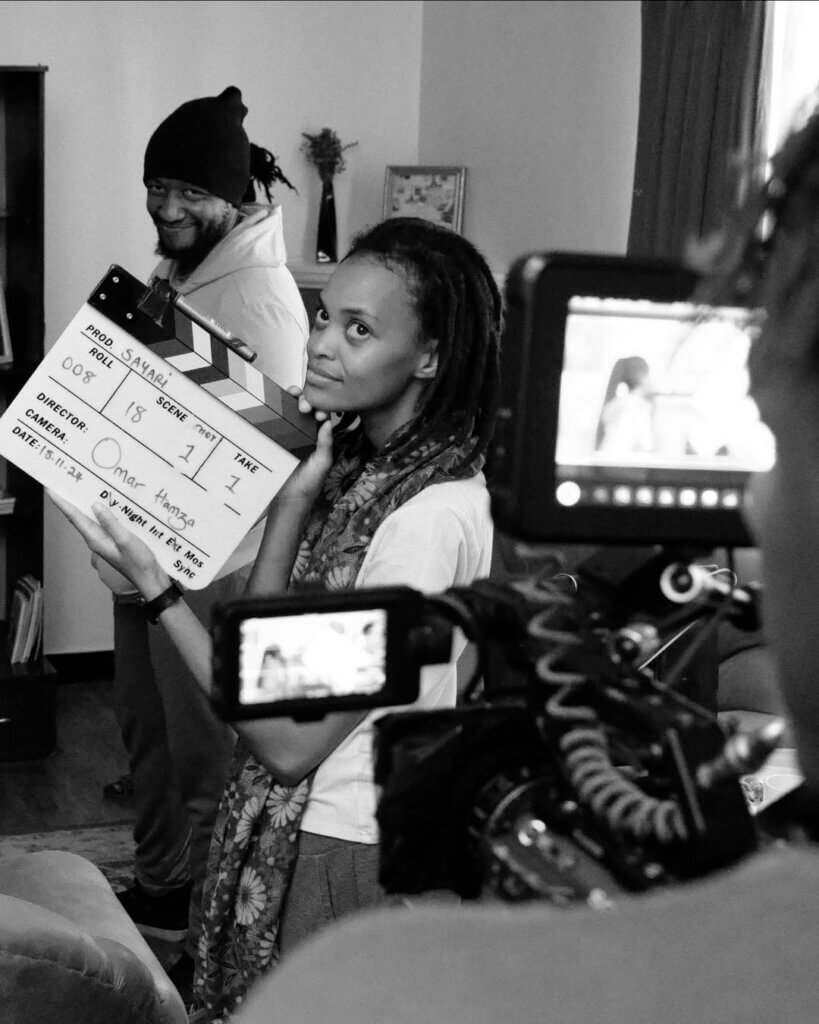
Starting out as a writer, Wairegi became a producer out of necessity. “I’m a much faster writer than I am a producer,” she admits. “But the first real challenge I faced, which actually led me to co-found Giza, was realizing no one was going to produce the stories I wrote.”
No longer creating in the background, this shift exposed her to the many hurdles of independent filmmaking on the continent, most common being financing.
“Our earliest projects were made with immense sacrifice,” she says. “Everyone on set gave more than just their time, people compromised on everything, even the basics like meals. It’s the belief in the story that’s what carried us through.”
Distribution remains an even more entrenched systemic challenge. In Kenya, cinemas continue to be dominated by Hollywood titles, leaving little room for homegrown stories to thrive. Local films are often seen as commercially unviable, a perception that trickles down into every stage of the distribution chain, from programming decisions to audience turnout.
For Wairegi, this isn’t just about access, it’s also about perception. The label of “local film” still carries a condescension, a quiet suggestion that the work is somehow lesser. And over time, audiences have internalised that narrative.
The result is a kind of creative confinement, where filmmakers are boxed into a national identity that feels more like a constraint than a celebration. “Kenyan filmmaker” becomes a label loaded with assumptions. For Wairegi, and with opportunities like Locarno Open Doors, the work ahead lies not just in making films, but in reclaiming the freedom to tell them without these limitations.
More than ever, she’s determined to make films that transcend boundaries and resonate across Africa and beyond. It’s her way of pushing back. “We’re not just Kenyan filmmakers. We’re filmmakers, period,” she says. “And we’ve seen audiences from all over respond to our stories at festivals. It’s about finding new ways to bridge that gap between our films and the people they’re meant for.”
Since its founding in 2018, Giza’s slate has grown steadily. They’ve produced Africa Magic Viewers’ Choice Awards (AMVCA) nominated titles Rishai (2021), a dramedy about a soft-hearted gangster who tries to save a suicidal woman and Gacal (2023), a romance thriller where a jealous husband kidnaps his wife’s lover’s brother. In their most recent offering Sayari, released in April 2025, the quiet life of a struggling BnB manager is disrupted by a runaway groom. They’ve also produced shorts like Itifaki, Jarr, Ndoto and Sukari which was nominated for Best Short Film at the 2025 AMVCA.
Wairegi describes Manjano, their new film in development through Locarno, as the perfect example of where they’re headed.
Written and directed by Omar Hamza and produced by Wairegi, Manjano is Giza’s most ambitious project yet. It’s a $400,000 romance-action film about a young man who recruits a team of misfits to pull off a heist to fund his elopement with a girl promised to another.
“This isn’t just a genre exercise, it’s a statement,” Wairegi says.
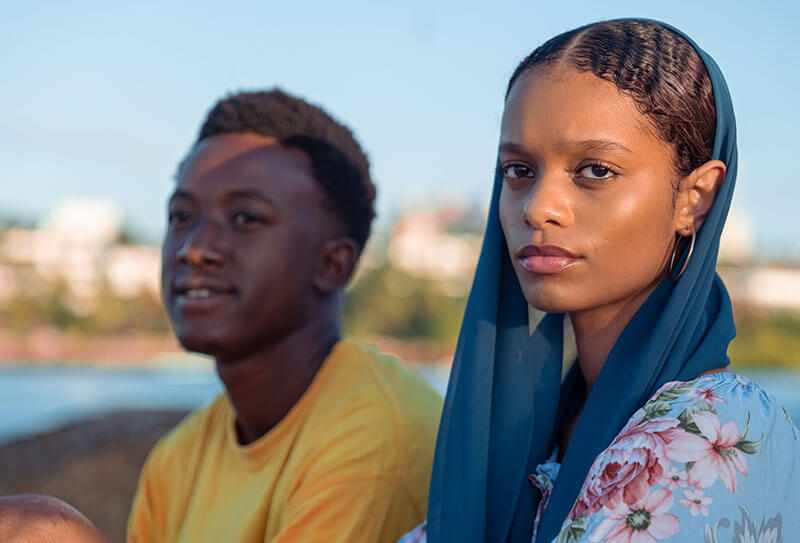
Manjano is a bold proof of concept– Giza’s attempt to show the world that African films can, in fact, be profitable. Too often, she notes, internationally co-produced African films screen almost exclusively at global festivals. And if at all they return home, its sometimes for limited impact screenings rather than wide releases, locking out mainstream local audiences. It’s become something of an industry inside joke: if your film is backed by European funding, chances are people back home might never get to see it.
“The films that do get seen locally often play at niche venues like Unseen Nairobi” says Wairegi. “And even then, it’s mostly a very specific audience attending.”
This tension between local relevance and international validation remains a sore point across the continent, one that has sometimes defined the kinds of stories we get to tell. Instead of exporting only pain, Wairegi hopes to inspire a gentler revolution – one stitched in light, laughter, and the ordinary African days. Giza’s tagline reads: “A Kenyan film production house telling stories that excite, move and linger.”
Her vision echoes Wanuri Kahiu’s Afrobubblegum philosophy which challenges Africa’s stereotypical grim narrative, instead, choosing to represent the continent in a positive light by finding more joy in its diverse creativity.
“It’s important for us to prove that African stories don’t need to be sad to be taken seriously,” Wairegi says. “We don’t always need to centre war, genocide, early marriage. Those are valid stories, but where is the Kenyan joy? Where’s the colour? Where are the non-agenda films that simply exist and entertain?”
Programs like Open Doors, while monumental for African independent producers like her, still reflect a global imbalance. Wairegi admits that a kind of creative co-dependence has taken root and become the norm. “Many filmmakers only produce short films when grants from institutions like DocuBox come through,” she says. “And without open calls from platforms like Sundance or Hot Docs, progress stalls. And unless you’re tapped into a Showmax series, a MultiChoice commission, or a Netflix production, the road ahead often feels frustratingly unclear.”
In this uncertain ecosystem, the lifeblood of many African filmmakers often comes from outside, and that reliance can be both enabling and limiting. This model tends to position African filmmakers as recipients, not partners, making space for tokenism to creep in. But when approached wisely, Wairegi believes international co-productions offer a critical opportunity for producers to reassert agency.
“To be honest, if you don’t have a clear vision going into a program like this (Locarno Open Doors), you can very easily be swayed,” she says. “If all you bring is an idea, a single script you’re desperate to get made, you risk becoming just another name in a long line of pitches.”
Instead, she’s taking more than just a project to Locarno – “a system, an actual illustration of how we’ve already made money in Kenya. That’s far more interesting to an investor than just a script.”
She praises Open Doors as a welcome shift. “It’s the first program I’ve been part of that actually nurtures independence. It’s not just about plugging into an existing system. It’s about learning how to function beyond it.”
Wairegi says Kenyan filmmakers, and African filmmakers at large, must start thinking differently about foreign co-productions and partnerships so that it’s not just about passive participation or one-sided expectations.
“Outside of Africa, people approach film as business. If someone helps you get funding, they’re taking a percentage,” she says. “They’re not doing it out of goodwill, they’re doing business. So you, too, have to ask: How am I making this profitable for myself?”
With Open Doors fast approaching (the program is slated to run from 7 – 12th August 2025), Wairegi is focused and ready. What excites her most isn’t just the exposure but the depth of connections being cultivated.
One of the first steps in the program is an in-depth, two-hour one-on-one conversation focused entirely on the filmmaker, their vision, ambitions, and personal journey. “It’s a very tailored program,” she says. “They really try to understand your specific goals so they can match you with the right people.”
That personalised matchmaking matters deeply. “It’s not just about funding or co-productions, it’s also about finding people who see the story, audience, and purpose the same way you do.”
As her career continues to gain momentum, Wairegi’s advice to emerging African producers like herself is firm: “Don’t wait for anyone to rescue you. If you want to make a film, then make the film. But more importantly, have a vision. This is a shaky business. It will sway you in every direction. And it will discourage you at every step, especially if you’re not grounded in something of your own. You’ll face rejection after rejection – I know I did. Before I got into Locarno, there were so many ‘nos.’”
EDITOR’S NOTE:
All reporting, interviews, and reviews on Sinema Focus are protected under international copyright law and the Kenya Copyright Act, 2001. No part of this publication may be reproduced, rewritten, republished, or redistributed in any form by media outlets without prior written consent. For reprint or syndication inquiries, contact editorial@sinemafocus.com.
©️ 2026 Sinema Focus / African Film Press. All rights reserved.
Never miss a moment.
Get the latest stories from Sinema Focus delivered straight to your inbox. Subscribe to our newsletter now.








Way to go team Africa 🇰🇪