

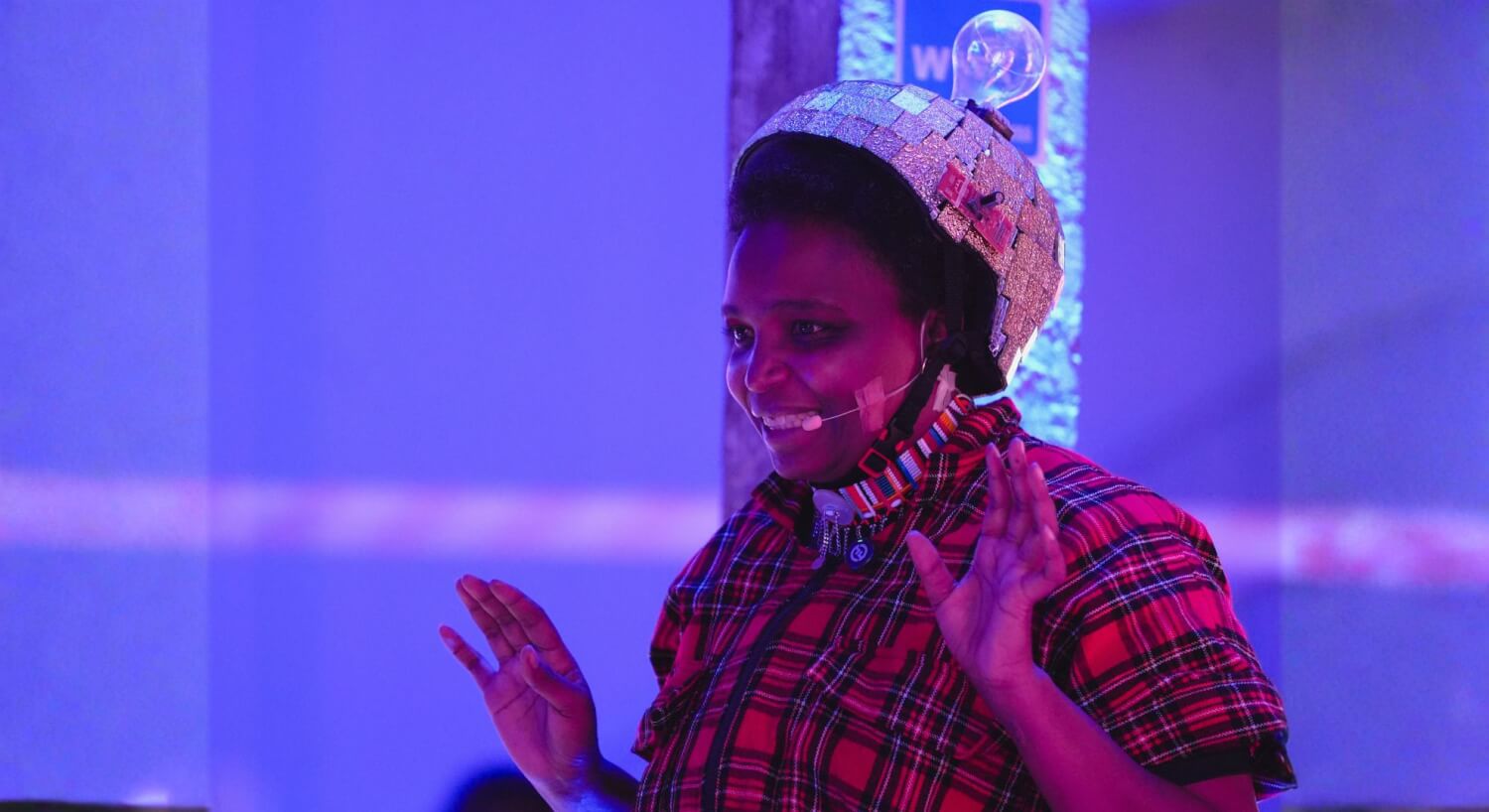
Some dystopian art struggles to pass the ‘suspension of disbelief’ test because of the existential question it poses: what if your worst fears about the future came true? And when you’re staring down your own worst nightmare, disbelief is the last thing you can suspend.
2057: Dystopia, an immersive one-woman play starring Njeri wa Gakuo, drops us into a world that, though futuristic, feels remarkably similar to today, except that some of our fears have come true. A malevolent AI is in charge (there’s even a robot robber). Society is collapsing. Environmental degradation is at its worst; giant data centres (each consuming more than 450 gallons of water) have sucked the earth dry, the little remaining water is poisonous, and the air “kunanuka heartbreak”.
Stay ahead of Kenya & East Africa’s film and TV.
Get our stories in your inbox — Subscribe to our newsletter now.
2057: Dystopia is an ambitious and experimental work, not just in its content but also in its form, fusing AI, audience interaction, archival memory, and live solo performance. Given its esoteric nature, my only concern watching the play at Shah Houses, on Saturday, 22 November, was whether this kind of layered, experimental theatre would be accessible and resonant with broader Kenyan audiences. I guess time will tell.
The play imagines a future where AI governs memory and identity; access to basic resources, like water, is controlled; and personal autonomy is threatened by data-driven power structures. Between the acts, a voice prompts the audience to make choices, and our decisions influence how the narrative unfolds; basically, what memories are lost and what is restored. In a futuristic world where personal autonomy is almost nonexistent, the play, involving the audience in its progression, is a reminder of the power that lies in our agency, and the dire consequences that await should we lose that power.
The Shah Houses on this particular day is a storyboard of what I imagine is ChatGPT’s idea of Afrofuturism: portraits depicting lean, tall, dark, Maasai-esque men posing against backgrounds that vary from futuristic Nairobi skyline to colorful, abstract, retro futuristic patterns adorn the pillars. We will see the dynamic versions of the same abstract retro futuristic patterns on the six digital screens that surround the stage, or the boxing-ring-like central space separated from the audience by duct tape. While the play is supposed to be an immersive performance with the audience as an active participant in the unfolding of the story, this stage design, with a marked stage-proscenium separation, signifies no such intent. For most of the performance, the audience feels more like spectators than active participants.
From a stage washed in hypersensory lighting, Gakuo becomes a grandmother reconstructed from fragments of stored memory. She’s trying to recover the memories of the world she once knew, a Kenya that was “vibrant, chaotic, and alive” but which has since been reshaped by algorithmic order. The play does not require Gakuo to wear multiple characters simultaneously, but that doesn’t make her performance any less complex. She must oscillate between memories, events, and timelines – an exercise akin to sorting through a bag full of things (the opening act is her literally sorting through a bag). Her solo performance favours a kind of channeling over full characterisation, encouraging the audience to accompany her in this journey of futuristic imagination. And for a play that demands quite a lot of physical and emotional engagement, Gakuo works overtime to elevate these moments.
The play, written and directed by Thayù Kilili, begins as a nostalgic recount of a good old, perfect world when life was rich and colorful, and the waters had crocodiles, Naivasha was a flower paradise, and AI was a benevolent helper. The act then zeroes in on the populace’s complacency in the face of AI’s evolution from innovation to domination.
Though set in the future, the play is really a dress down on today’s Kenyan middle class and their preoccupation with indulgent lifestyles, from internet subscriptions to gym memberships to yoga classes. It’s here that Thayù’s writing soars the highest. They manage to strike the perfect balance of acerbic and witty, offering a theatrical experience that’s both thought-provoking and entertaining. Their writing reminds me of French playwright Jean-Pierre Martinez, whose dystopian plays are celebrated for their skillful combination of the grim realities of dystopian societies with elements of satire and wit. 2057: Dystopia could be one of the more daring and conceptually rich theatre pieces ever to be staged in Kenya, and I can’t wait to see where theatre goes from here.
EDITOR’S NOTE:
All reporting, interviews, and reviews on Sinema Focus are protected under international copyright law and the Kenya Copyright Act, 2001. No part of this publication may be reproduced, rewritten, republished, or redistributed in any form by media outlets without prior written consent. For reprint or syndication inquiries, contact editorial@sinemafocus.com.
©️ 2026 Sinema Focus / African Film Press. All rights reserved.
Never miss a moment.
Get the latest stories from Sinema Focus delivered straight to your inbox. Subscribe to our newsletter now.