
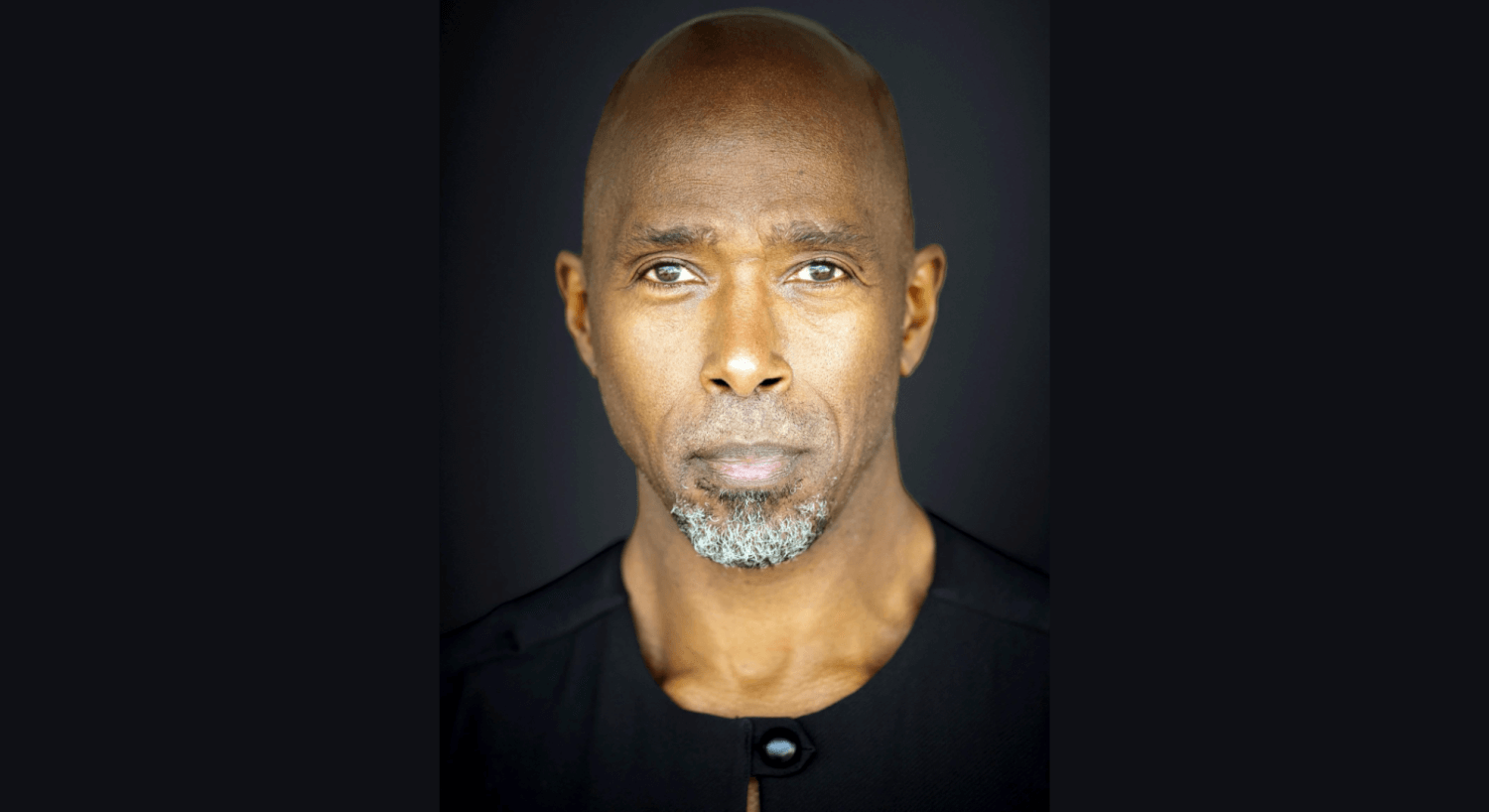
Ntare Guma Mbaho Mwine’s story is one born on American soil but of Ugandan ancestry. Across stage to screen, photography to documentary, his gaze has always turned homeward, towards Uganda.
Mwine was recently in Kenya for the screening of his documentary Memories of Love Returned, first at the newly launched Kilifi Creek Festival where it won the Visionary Award and Special Jury Mention, then at the 2025 NBO Film Festival. A playwright, photographer, documentarian, and Hollywood actor, known for his roles in shows like The Chi, The Lincoln Lawyer and Dexter: Resurrection, Mwine directs the documentary two decades in the making.
Stay ahead of Kenya & East Africa’s film and TV.
Get our stories in your inbox — Subscribe to our newsletter now.
As expected, just like he is onscreen, Mwine is magnetic in person, the sort of figure who turns a film event into a small constellation around him. The NBO Film Festival is no different, and getting him alone for a conversation takes a kind of patience. And when you finally do, there is an almost involuntary urge not to start with small talk but to acknowledge the depth of the artistry before you, the only honest way to do so being to try and understand it.
My instinct is to first try to get closer to what animates his work, not the filmography or the résumé, but the pulse beneath it, the sensibility that keeps an artist returning to the page, the lens, the stage. And so, to begin our interview, I ask Mwine to locate himself in that interior landscape; to tell me not who he has been, but who he is. How would he describe himself, not by credits or genres but by sensibility? His answer is disarmingly modest until you realise how exact it is. “I would describe myself simply as a Ugandan, an artist, and a photographer,” he says, his phrasing stripped of pretense, it almost feels like a rebuke to the industry’s usual self-mythologizing.
Uganda seems to sit at the heart of the art he makes, and not merely as a setting or a subject, but an identity he has never shied from. A first-generation Ugandan-American, Mwine carries a dual inheritance that stretches across continents. That duality, between where one is born and where one belongs, has shaped the kinds of stories he tells, and how he tells them.
But talk to Mwine long enough, and you realise every road seems to lead back to Uganda. “For me, when I look back at life in Uganda, it has always been deeply inspiring. From my family to my friends, to simply walking the streets and hearing the local music. I feel more alive there than I do anywhere else,” he says. “That’s what inspired me to create my play Biro, my photography work, and now this documentary, Memories of Love Returned, along with some short films I have made. All of them, in one way or another, have been inspired by something in Uganda.”
The play he mentions, Biro, is a solo piece which he premiered at Uganda’s National Theatre in 2003, that confronted the wounds of HIV, war, and migration, all bound to Uganda’s history. With the play, Mwine navigated the responsibility of telling an African story from a diasporic vantage point, translating a country’s memory and ache for audiences who stood both inside and outside its history. Beyond its Ugandan debut, Biro later staged at the Joseph Papp Public Theatre in New York, as well as across cities such as Los Angeles, Seattle, London, and several African cities. In 2004, Mwine performed the work before multiple African heads of state.
And just like Biro, the transcendence of his other artistic imaginations has been witnessed, as his photographic work as well has travelled far, exhibited at the United Nations, the Latino Art Museum, and other spaces across the world.
I ask him what it feels like, when his work moves farther than the people and places it depicts; when Uganda, refracted through his lens, finds itself explored oceans away, a question to which he weighs what art owes to both maker and audience. “Sometimes you create something for yourself, trying to tell the most compelling or interesting thing, and people take from it what they want. It is hard for me to dictate what everyone should take away. Each project is different. But I do hope people take away the importance of preserving our memories, especially memories of love, and find a way to share them, not keep them locked up,” he says.
Preserving memory lies at the heart of his latest work Memories of Love Returned. The documentary began with an accidental encounter. On a trip to Uganda in 2002, Mwine stumbled upon a rural studio photographer named Kibaate Aloysius Ssalongo, when his car broke down in the small town of Mbirizi. Over decades, Kibaate had quietly amassed a vast visual archive, thousands of portraits capturing the everyday dignity and beauty of his community. Moved by both the scope and intimacy of the work, Mwine helped Kibaate preserve his collection. Two decades later, following Kibaate’s death, he returned to organise a public exhibition of the images.
The revelation of Kibaate as an unheralded artistic genius might have been enough story. Yet the exhibition opened more layers: such as Kibaate’s tangled legacy as the father of a prodigious number of children by several surviving mothers, Mwine’s own health and family journey, and even Kibaate’s early documentation of Uganda’s LGBTQ community.
When I ask what it is about these images, about the stubbornness of photography as a vessel for memory, that made him embark on making Memories of Love Returned, Mwine’s has a reverent answer.
“Memories are captured in many different ways,” he says. “And one of the most potent ways is through photography. What is so incredible about Kibaate’s work is how it has lasted over five decades, because it is physical, something you can touch, you can pass on. The very paper he printed on has survived half a century.”
He pauses, then gestures at my phone. “But now we have everything here. In fifty years, will your phone even be around? No, it’ll be obsolete. And the information will be gone too.” There’s a trace of unease in his voice. “I often wonder whether what we’re recording now, our present, will exist fifty years from now. We don’t keep our own materials anymore. We store them on Instagram, on other platforms. And if those disappear, so do we. We have backed ourselves up on the cloud,” he says, with a faint, rueful smile. “And the cloud will evaporate.”
The chosen title, Memories of Love Returned, is a phrase that sounds like a benediction, the kind of title that could sit on an old vinyl sleeve or a half-forgotten letter, the words trembling with a desire to make the past answer back. What, I wonder, does return mean to him?
“I think it’s self-explanatory, really,” he says. “It is about memories of love that sometimes you don’t share.” There is a pause, almost imperceptible, before he continues. “We all have those, right? Loves we hold quietly, maybe forever. This is about returning them, reciprocating them, letting them breathe again.”
I ask how the documentary form enables this; the act of returning love, of reanimating memory, and what it means, as a Black man, to use that medium to project African stories to the world.
“The documentary form is unfiltered, really. You can look at fictional stories, they’re always filtered somehow. But a documentary is an unfiltered look into our stories coming from the continent. And that is what makes it worth celebrating.”
As an actor, across his screen work – whether as the traumatized Ronnie Davis in The Chi, the overtly optimistic Blessing Kamara in Dexter: Resurrection, or the no nonsense Detective Raymond Griggs in The Lincoln Lawyer – Mwine has inhabited men whose lives seem to either splinter or shine under the weight of their worlds. How does he approach embodying such men, these men whose lives so often mirror the social fractures, or harmony, of the places they inhabit?
“Each role is different,” he says “So the approach changes every time. Some characters feel close to you, you don’t have to do much work to connect. Others require deep research and effort to understand.” He pauses, reflective now. “Each project is unique in how you find your way into the character and the world they live in.” He refuses to mystify the craft, yet has an acknowledgment of the deep empathy it demands.
Having worked across continents and mediums, Mwine has seen storytelling in all its forms, from the solitary pulse of theatre to the collaborative sprawl of cinema. So it is right to ask how he sees the current state of African film, particularly its documentary turn, and what responsibilities or opportunities lie before the new generation of filmmakers.
“That’s what is so incredible about initiatives such as the NBO Film Festival,” he says. “It’s celebrating African stories from across the continent and even the diaspora. A few years ago, this didn’t exist, and now, here we are.”
He looks around, as if gesturing to the very energy of Nairobi. “It is a very exciting time,” he continues. “We are creating our own space and sharing our own stories, and that is only going to continue. You see it here in Kenya, and in Uganda, filmmakers doing incredible work. I hope I get to work with them one day.”
As our conversation winds down, Mwine gives a few hints of what is next for him – projects that stretch, once again, across borders. “I just shot something with C.J. ‘Fiery’ Obasi, the Nigerian filmmaker,” he says. “We worked together recently, and we are hoping to keep building on that.” He mentions others, too, “Loukman Ali, I am a huge fan of his. And here too, I’m trying to meet filmmakers to collaborate with. Everywhere I go,” he says with a grin, “I’m on the hunt.”
Memories of Love Returned is screening at Unseen Cinema until 30 November.
Check out our full coverage of the 2025 NBO Film Festival here.
EDITOR’S NOTE:
All reporting, interviews, and reviews on Sinema Focus are protected under international copyright law and the Kenya Copyright Act, 2001. No part of this publication may be reproduced, rewritten, republished, or redistributed in any form by media outlets without prior written consent. For reprint or syndication inquiries, contact editorial@sinemafocus.com.
©️ 2026 Sinema Focus / African Film Press. All rights reserved.
Never miss a moment.
Get the latest stories from Sinema Focus delivered straight to your inbox. Subscribe to our newsletter now.