
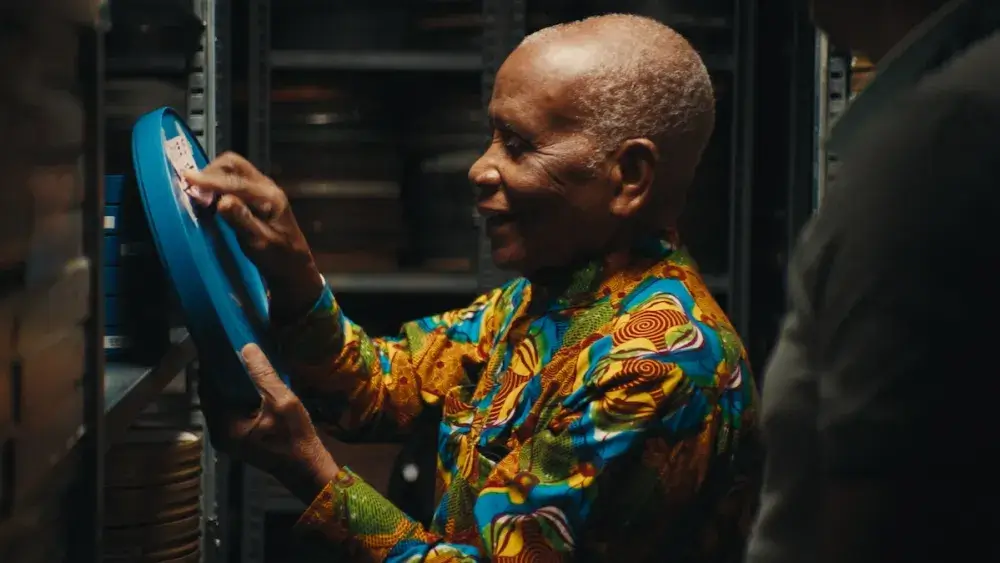
Veteran Ghanaian filmmaker Chris Hesse, once a cameraman for Ghana’s first president, Kwame Nkrumah, has seen history become. He’s a man whose lenses captured every knot and unfurling of the string of time as a people became a nation. Then, he watched the flames turn to ashes, the same history he dedicated his life to documenting.
In The Eyes of Ghana, Hesse emerges as the most youthful and wilful 90-year-old I’ve ever seen. His memory is razor-sharp, his wit quick, and his charm radiates through the screen.
Stay ahead of Kenya & East Africa’s film and TV.
Get our stories in your inbox — Subscribe to our newsletter now.
Directed by Ben Proudfoot, and produced by Higher Ground Productions (the company founded by Barack and Michelle Obama, who appear briefly to express their admiration for Nkrumah), The Eyes of Ghana is a 2025 feature documentary about Hesse – a Ghanaian filmmaker and documentarian racing against time and his fading eyesight to preserve a vast archive of film footage documenting Ghana’s early years of independence.
When two-time Oscar-winning Proudfoot frames Hesse in an extreme close-up for the film’s opening shot, his glaucoma-ridden eyes and weathered face reveal a man who has given everything to history. There’s little left in him to give, except the desire to restore what was lost and pass his story to the next generation of chroniclers. “Just because you don’t know the story doesn’t mean it never took place,” he says.
Proudfoot is as interested in profiling Hesse as he is in using him as a gateway into Ghana’s cinematic and political history. He interweaves Hesse’s story with Nkrumah’s vision of pan-Africanism and the role of film in Ghana’s decolonisation. Yet when it comes to Nkrumah’s contentious legacy, the director plays it safe, acknowledging its complexity while leaning more toward tribute than critique. The documentary raises questions about the political power of film, colonial archives and what’s lost but doesn’t fully interrogate them.
Like all veterans who’ve earned their dues, Hesse casts one last look at history, tracing his steps back in time. “At the age of 90, I’m at the evening of my life,” he says. With talking-head interviews framed in picturesque Academy-ratio closeups and meticulously chosen archival footage, Proudfoot paints a portrait worthy of Hesse’s stature in cinematic history.
Watching The Eyes of Ghana, one can only appreciate the historical significance and the momentous weight that the making of this film carries: a tricenarian documentarian paying homage to a nonagenarian on the other side of the camera. Two generations on the furthest edges of time coming together – the past, present, and future colliding into each other.
We also meet Edmond Addo, a cinephile in his 70s who speaks of cinema with stars in his eyes. Once a projectionist at The Rex Cinema, a dreamy movie theatre in Accra during Nkrumah’s era, Addo is frozen in the past, clinging to the dusty ruins of what The Rex once was. That is, until history is restored and generations collide: Addo, Hesse, and Anita Afonu – a young Ghanaian filmmaker and Hesse’s protégé – watch as The Rex Cinema is renewed. It is, as Addo says, “a dream for the eyes.”
The film’s structure is loosely chronological, but Proudfoot favours thematic sequencing over a strict timeline. Hesse’s reflections bleed into national history; one anecdote about a shoot leads to a meditation on colonialism, racism, or film censorship. The editing mimics memory itself; associative, impressionistic, looping back to certain sounds or images, for instance, the frequent use of Nkurumah’s voice-overs.
Rather than dictating emotion, Kris Bowers’ music echoes it, swelling only when the imagery needs propulsion, then fading into near silence during reflective moments. In sequences showing archival footage of Ghana’s early post-independence era, Bowers weaves in highlife rhythms, anchoring the film culturally and temporally.
The Eyes of Ghana traces the pulse and growing pains of a nation. Ghana breaks free from Britain under Nkrumah’s unrelenting vision, the air thick with the promise of a liberated Africa. As the young nation shakes off the colonial yoke, Nkrumah dares to dream beyond borders, calling for a united Africa – an ambition, as Hesse’s reels show, too vast for one man to lead. Then comes the coup that does more than unseat a president; it attempts to erase some parts of history and rewrite the rest.
In Hesse’s telling, the new regime not only silenced Nkrumah’s voice but destroyed the very material that had captured a people learning how to live in freedom. History was killed, but not entirely. With a wily twinkle, Hesse recalls: “What they didn’t know was that the negatives were in London.”
After the coup and the ensuing distortion of history, two narratives emerge: one of a power-hungry Nkrumah, drunk on authority, becoming the imperialist he once fought; the other of a visionary leader betrayed by a CIA-backed coup. Hesse, like his preserved reels, refuses to take sides. Whether Nkrumah was a dictator or a dreamer, Hesse neither denies nor affirms, he simply speaks fondly of the man who inspired his life’s work. As Hesse tells an inquisitive student, the camera holds no opinion; it doesn’t judge. Once the camera starts rolling, it simply records life as it happens.
I left The Eyes of Ghana with a newfound appreciation for documentary filmmaking, and its power to hold a mirror to history as it is, not as we’d prefer to remember it.
The Eyes of Ghana screened at the 2025 NBO Film Festival that ran from 16-26 October.
Check out our full coverage of the 2025 NBO Film Festival here.
EDITOR’S NOTE:
All reporting, interviews, and reviews on Sinema Focus are protected under international copyright law and the Kenya Copyright Act, 2001. No part of this publication may be reproduced, rewritten, republished, or redistributed in any form by media outlets without prior written consent. For reprint or syndication inquiries, contact editorial@sinemafocus.com.
©️ 2026 Sinema Focus / African Film Press. All rights reserved.
Never miss a moment.
Get the latest stories from Sinema Focus delivered straight to your inbox. Subscribe to our newsletter now.