
When the Cannes Film Festival came into view this year, I was eager to hear about the films that would define 2025, those that I should be looking forward to – the best of the best. Outside of big names like Ari Aster’s Eddington and Wes Anderson’s The Phoenician Scheme, there were remarkable offerings from across the globe, from China’s Resurrection to Iran’s It Was Just an Accident, and Norway’s Sentimental Value. It was in those same discussions that I first heard of Nigeria’s My Father’s Shadow, a film holding its own among the year’s most talked-about titles.
The year has since found me repeatedly checking MUBI to see if it might appear, only to be pleasantly surprised when it was announced as part of the lineup at the 2025 NBO Film Festival.
Stay ahead of Kenya & East Africa’s film and TV.
Get our stories in your inbox — Subscribe to our newsletter now.
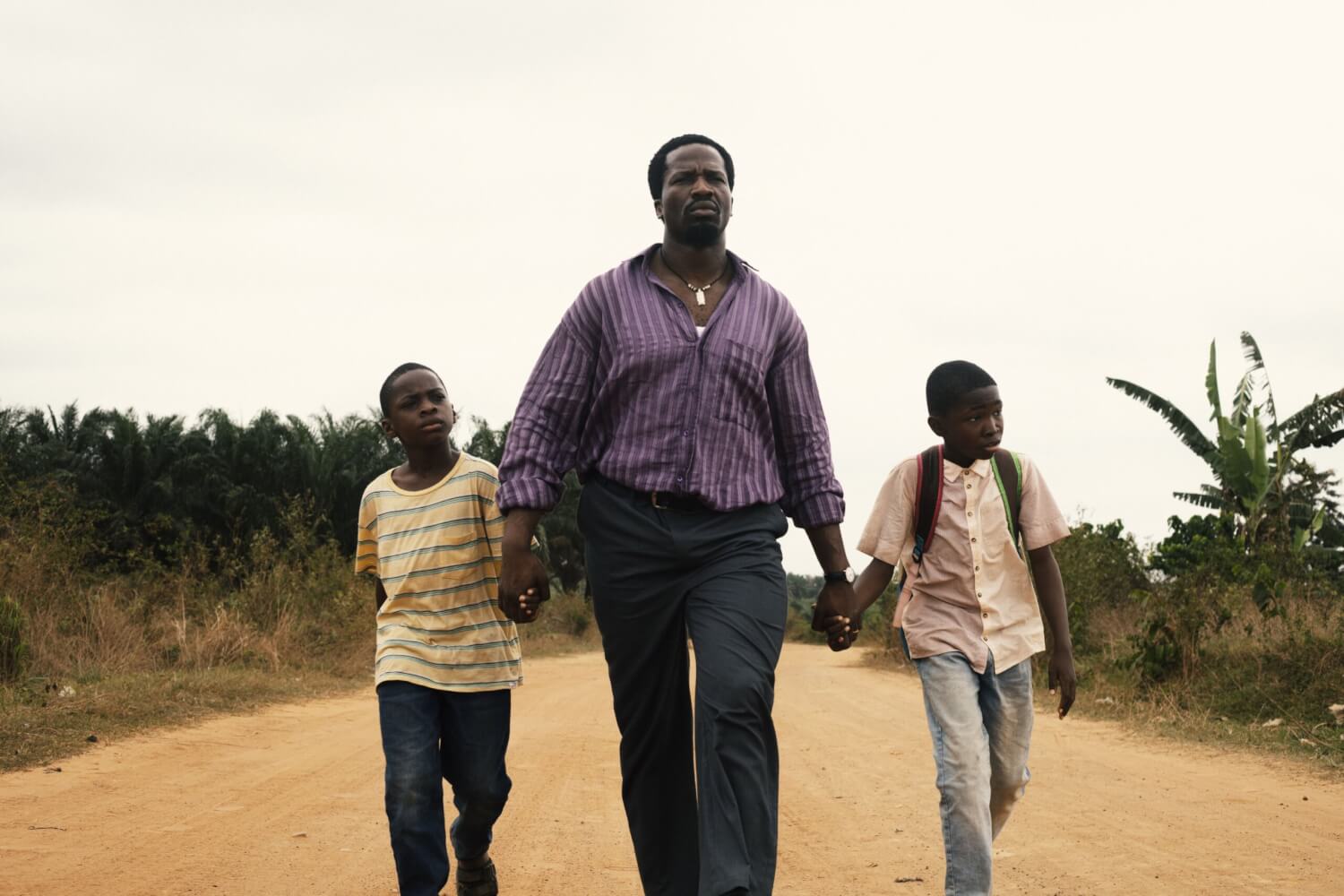
Set in 1993 Nigeria, My Father’s Shadow, directed by Akinola Davies Jr., captures the faint, trembling heartbeat of a country on the verge of something greater than itself, be it democracy, collapse, or rebirth, yet suspended in the day-to-day mundanity of its people, except in bursts of impassioned pronouncements. It is a deeply personal film, told through the eyes of two young brothers, Akin and Remi, who accompany their father, Folarin, on what should be a simple trip from their village to Lagos. But as the day stretches into a near-spiritual odyssey, the journey unfolds into something tortuous in its simplicity: a portrait of a beloved father that extends into the anxious soul of a nation struggling under the weight of its unfulfilled promise.
Davies, who co-wrote the script with his brother Wale Davies, revisits his childhood with the looseness and mystery of memory, where normality often overlaps with restive images of apprehension. The day unfolds in fragments: a stalled bus, a missing paycheck, soldiers on alert, the radio crackling with static, newspapers fluttering with election updates. Through these half-remembered textures, the film finds its impressionable truth through the reactions and conditions of its characters, between dream and documentary. Its tactile realism is undercut by an ever-present sense of the surreal, dissolving between the unaltered and the recollected.
The father, Folarin, played with stunning emotional complexity by Ṣọpẹ́ Dìrísù (Gangs of London), is a man caught between tenderness and exhaustion. Introduced with the gushing wave of an unlikely presence, his young sons see him as a giant, a provider, a protector, an assured voice. Yet the camera treats him like a ghost, already half gone from their lives and, for most of the film, lost inside his own thoughts. Floating between prophecy and confession, this father, endeared by all who know him, slowly breaks into pieces, comforting his sons on the reasons he hasn’t been present in their lives and almost preparing them for even more absence: “The memories that cause you pain when someone leaves are the same ones that will comfort you later.”
Visually, the film is an elegy. Jermaine Canute Edwards’ cinematography breathes in the lived, aging colours and chaos of Lagos without ever exoticizing it. Every frame holds both the warmth of nostalgia and the ache of distance; yet walking amongst the residency, the past doesn’t seem that much different from the present. From the quiet melancholy of an ominous conversation in an abandoned amusement park to the fleeting joy of a seaside swim interrupted by a washed-up whale, My Father’s Shadow balances the sacred and the mundane with rare sensitivity, allowing the heaviness of the narrative to blend with the pace of a child’s attention. The score, alternating between ethereal highs and rumbling lows, deepens that trance-like atmosphere, dosing the film with a feeling of watching life unfold through memory’s fog.
Yet beneath its lyrical softness lie the political wounds of a nation. Davies doesn’t merely reconstruct the boys’ view of their father, he maps that intimate absence onto that of Nigeria itself, seemingly fatherless, suspended between the hope of democracy and the inevitability of betrayal. The turmoil of the 1993 elections exists at the film’s edges: soldiers, headlines, and uneasy conversations hint at the instability of a nation and a family alike. In both, deep unconditional love exists, persisting despite being constantly tested by systems that make meaningful presence almost impossible.
By the time My Father’s Shadow ends, the breadcrumbs it leaves in its wake come to an abrupt but expected conclusion. Across its runtime, Davies builds something that feels both as grand as a national tribute and as intimate as a eulogy, historically dense yet deeply entrenched in personal memory. Serving as a meditative trance on fatherhood, memory, and the aching persistence of love in the face of political and capitalistic disillusionment, this quiet, understated film lingers like unresolved grief, haunting at the back of the mind yet fulfilled and warm.
Akinola Davies Jr., in his feature debut, delivers what feels like a reclamation: bold and unflinching, a cinematic séance between generations, a love letter to Lagos, and a mourning song for what Nigeria could have been. In this film, he captures African grace in its brightest light, neither hiding its fragility, comradeship, pain, nor joys while remaining profoundly familiar across every corner of sub-Saharan Africa.
My Father’s Shadow screened at the 2025 NBO Film Festival that ran from 16-26 October.
Check out our full coverage of the 2025 NBO Film Festival here.
EDITOR’S NOTE:
All reporting, interviews, and reviews on Sinema Focus are protected under international copyright law and the Kenya Copyright Act, 2001. No part of this publication may be reproduced, rewritten, republished, or redistributed in any form by media outlets without prior written consent. For reprint or syndication inquiries, contact editorial@sinemafocus.com.
©️ 2026 Sinema Focus / African Film Press. All rights reserved.
Never miss a moment.
Get the latest stories from Sinema Focus delivered straight to your inbox. Subscribe to our newsletter now.