
Netflix’s latest South African series arrives with familiar faces from past local hits, including Ama Qamata and Natasha Thahane from Blood & Water and Bonko Khoza, who delivered a haunting turn in Showmax’s Red Ink. As the streamer continues refining its South African pipeline, Marked, a heist thriller, enters with a familiar formula: fast-paced dramatic escalation grounded in a gritty, morally complex crime setting. Though drastically different in premise from its predecessors, this blueprint, which has struggled to produce any quality in Kenya, seems to be faring much better in South Africa, with high production values often filling in the gaps left by uneven storytelling.
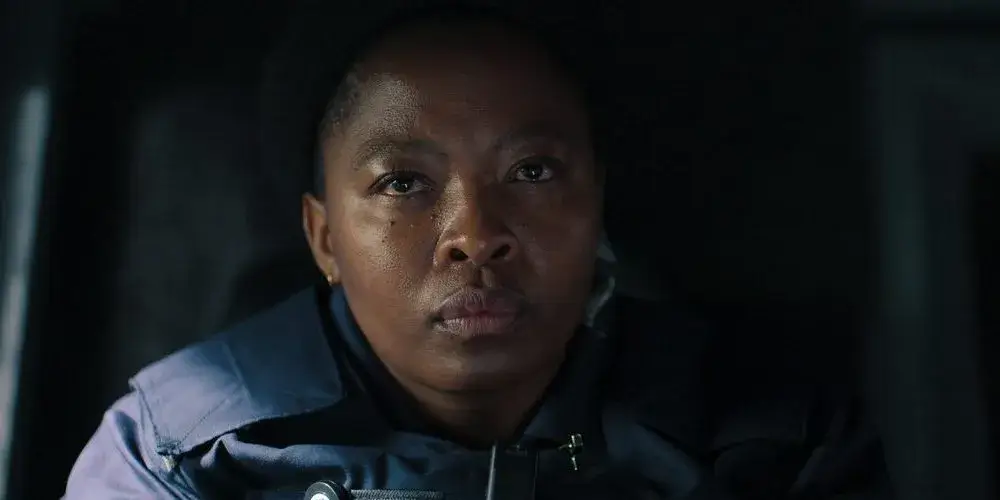
Created by Akin Omotoso, Sydney Dire, and Steven Pillemer, Marked follows Babalwa – played with remarkable conviction by Lerato Mvelase (Justice Served) – a devout Christian mother grappling with her daughter Palesa’s (Qamata) terminal diagnosis. Once a disgraced cop, now the most trusted driver in a cash-in-transit firm, Babalwa wrestles with the cruel inequalities of a system that offers her daughter an early death, and her waning morality as she spirals into the criminal underbelly.
Stay ahead of Kenya & East Africa’s film and TV.
Get our stories in your inbox — Subscribe to our newsletter now.
Mvelase guides the emotional arc of the series almost entirely through her expressions. She carries the intensity of a character whose convictions are slowly worn down by grief, economic precarity and maternal instinct through a narrative shifting quite hurriedly as it builds on underdeveloped elements, betting firmly on the rising tension of her character’s moral degradation. Where international Netflix counterparts like Better Call Saul or Ozark take multiple seasons to unpack such transformation, Marked doesn’t have such luxury of space. Instead, it chooses to ram through seasons’ worth of character change within scenes, let alone episodes.
The show’s branching storylines are either rushed through or summarized in brief dialogues at a pace that undercuts any nuance or gravity, creating an imbalance between the accelerating timeline and the emotional heft of events.
With villains wearing their villainy on their faces to save time from expositions, and side characters that offer little more than filler scenes and light moments of comedic relief, Marked shows little interest in developing the supporting cast beyond their distilled simplicity. From a devout husband losing his wife yet never fighting for or against her, to a recovering alcoholic detective who can barely offer three episodes worth of resistance before he succumbs to his demons, the characters around Babalwa serve mainly as placeholders for a narrative that rarely has time to breathe.
Still, the first half of the show has its moments, introducing a well-constructed world of rationale juggling between its bipolar themes, faith clashing with fatalism, and survival strategies taking precedence over ideals. It also clearly benefits from the cinematic polish of a Netflix production with strong visuals, confident direction, and an evocative score. But as the episodes progress, there is a drop-off in holding together these worlds. The rudimental elements that drive the show – the depths of a mother’s love, the hold of religious devotion, and the action promised in criminal wars at the heel of investigating police – serve great performances and land well in isolation. Yet when stacked together, they often jostle for dominance instead of blending into a unified emotional narrative.
The final episodes play out like a badly crafted Ocean’s 11 caricature, relying on the blatant incompetence of a crew of misfits whose presence in the story is never convincingly justified. Their clumsily executed plan, whether undermined by the sheer idiocy of its sequencing or by the even greater ineptitude of the show’s antagonistic elements, peters out by the end. Neither the heist sequences, which should invigorate even the dullest of setups, nor the intended thematic payoffs ever build anything worth the excitement as the final credits roll up.
Ultimately, Marked, like Kenya’s Faithless, is a series with a premise that promises more than it could deliver. Taking one or more women from the peace of church routine into the criminal world intrigues as a concept, but the follow-through is a slow and strenuous process of world-building that these shows, either by choice or streaming limitations, simply have no patience to do right. For Marked, what remains is a performance-driven thriller that showcases the potential of South African talent and production but stumbles greatly under the weight of its own ambition.
Marked S1 is streaming on Netflix.
EDITOR’S NOTE:
All reporting, interviews, and reviews on Sinema Focus are protected under international copyright law and the Kenya Copyright Act, 2001. No part of this publication may be reproduced, rewritten, republished, or redistributed in any form by media outlets without prior written consent. For reprint or syndication inquiries, contact editorial@sinemafocus.com.
©️ 2026 Sinema Focus / African Film Press. All rights reserved.
Never miss a moment.
Get the latest stories from Sinema Focus delivered straight to your inbox. Subscribe to our newsletter now.