
At the heart of The Shadow Scholars lies a stark contradiction: the academic futures of some of the world’s most privileged students are being secured by anonymous intellectuals halfway across the world – many of them Kenyan – whose own aspirations remain indefinitely deferred. Directed by Eloïse King and executive produced by Steve McQueen, the documentary examines the billion-dollar ghostwriting industry that flourishes in the shadows of global academia, where an estimated 50,000 Kenyans earn a living writing academic papers for students in elite Western institutions.
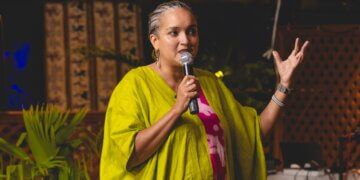
The film follows Oxford professor Patricia Kingori – the youngest Black woman to achieve that honour at the institution – as she embarks on a deeply personal and professional inquiry into the ethics of academic outsourcing. As her journey takes her from the cloisters of Oxford to the buzzing backrooms of Nairobi, Kingori uncovers a network of Kenyan writers completing essays, theses, and even dissertations for students in elite institutions in the UK, US and Canada. These are not mere cheats on the margins, they are deeply embedded players in a system that has monetized education at the expense of learning.
Stay ahead of Kenya & East Africa’s film and TV.
Get our stories in your inbox — Subscribe to our newsletter now.
While The Shadow Scholars presents this ecosystem with care and detail, the film’s most powerful implication remains largely unspoken: that the very institutions tasked with upholding educational integrity have quietly adapted to a market logic that allows them to look the other way. Kingori’s investigation is thoughtful and compelling, but the documentary avoids pressing the universities themselves – those who accredit degrees built on ghostwritten work – about their role in perpetuating the system. It raises questions but rarely confronts power.
Here in Kenya, we’ve spoken about this before with the infamous KSCE examinations and the enormous leakages that paved the way, year after year, for under-qualified students to secure top spots in coveted universities. And while students are sometimes penalised, the sources of the leaks and the powerful figures who enable them are rarely held accountable. It’s a case of institutionalised corruption embedded in the very systems meant to uphold merit.
What’s striking is how The Shadow Scholars treats this labor as both invisible and indispensable. Without ghostwriters, many students in elite institutions wouldn’t graduate at all. And yet, universities continue to focus scrutiny on the students or writers rather than interrogating their own outdated assessment systems. The real scandal isn’t just that students cheat – it’s that institutions in the Global North profit from a broken model while outsourcing the consequences to the Global South. In doing so, they preserve the illusion of academic excellence while exporting the intellectual labor needed to maintain it. This is the quiet machinery of modern colonialism – clean, credentialed and conveniently offshore.
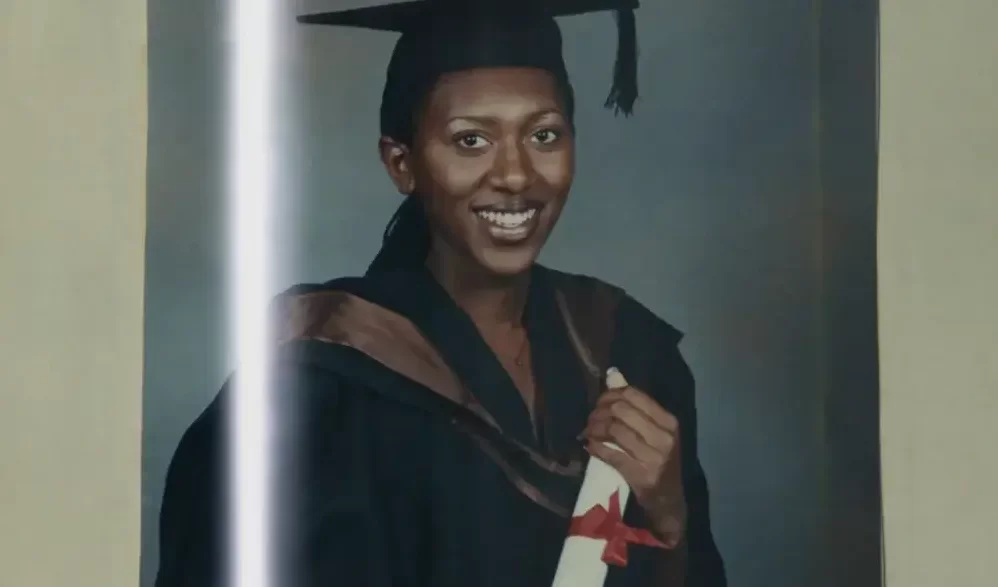
One of the film’s most resonant threads is the quiet dignity of those working behind the scenes. Mercy, a seasoned academic writer and single mother, recounts completing two Master’s-level dissertations in one night, work that would typically take a student a week. Her skill is undeniable, but the film lingers on the irony; despite having mastered the language and logic of academic excellence, she remains excluded from its rewards. There is a deeper story here, about African brilliance being systemically undervalued and exploited, and The Shadow Scholars gestures toward it without fully digging in.
The same can be said of its treatment of artificial intelligence. The documentary briefly acknowledges how tools like ChatGPT are displacing human ghostwriters but fails to explore the bitter irony that Kenyan workers were among those who helped train these very models, often for less than a dollar an hour. Now, many are losing their ghostwriting gigs to the very systems they helped build. It’s a sharp metaphor for the extractive logic of the global tech and education industries, but one the film doesn’t fully chase down.
Still, there’s a quiet rage underneath the film’s calm surface, a sense that something foundational is being eroded. The Shadow Scholars gestures toward the erosion of educational value, the moral ambiguity of outsourcing learning, and the brutal clarity of global inequality. But it ultimately resists discomfort. For a film about fraud, it feels oddly polite.
And yet, the story it tells is urgent. It exposes a system where education is no longer a noble pursuit, but a service to be bought and sold, where Kenyan intellectual labour props up Western success, often invisibly. The phrase “African solutions to Western problems” rings throughout, not as pride, but as indictment. The question isn’t just who gets the degree but who does the work, and at what cost because when knowledge becomes a commodity in the global marketplace, the cost isn’t just academic – it’s economic, cultural and profoundly human.
The Shadow Scholars had its African premiere at the 2025 Encounters South Africa International Documentary Festival, and is now headed to the 2025 BlackStar Film Festival that runs from 31 July to 3 August. For its Kenyan premiere, The Shadow Scholars screened at the 2025 NBO Film Festival that ran from 16-26 October.
EDITOR’S NOTE:
All reporting, interviews, and reviews on Sinema Focus are protected under international copyright law and the Kenya Copyright Act, 2001. No part of this publication may be reproduced, rewritten, republished, or redistributed in any form by media outlets without prior written consent. For reprint or syndication inquiries, contact editorial@sinemafocus.com.
©️ 2026 Sinema Focus / African Film Press. All rights reserved.
Never miss a moment.
Get the latest stories from Sinema Focus delivered straight to your inbox. Subscribe to our newsletter now.