

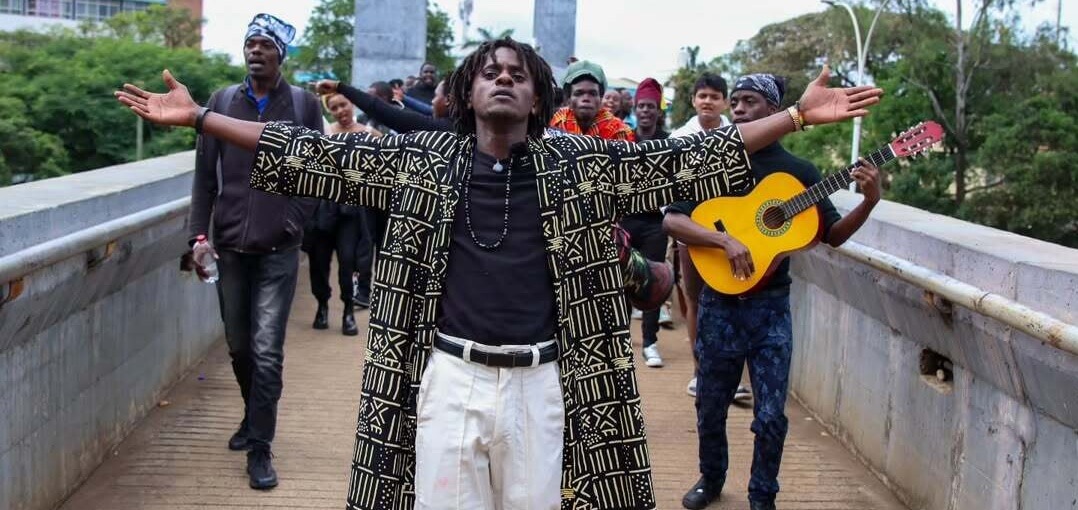
On 16 November 2025, on a memorably sunny yet cold Sunday morning, I scuttled through the empty, uncharacteristically quiet streets of Nairobi on my way to the Kenya National Theatre (KNT). It was there, I had been told, that an audacious experiment in theatre – Story za Thuita – would begin.
Outside the KNT building, a buzzing crowd of about fifty had already gathered – one that would quadruple as the day progressed. Soon, Thuita Mwangi, the solo star of the show, lean and exuberant, emerged from the tent wearing a patterned ankara kimono over a plain black t-shirt and beige pants. And to complete this ensemble was a long, dark, beaded necklace and several bracelets. He cut the image of a postmodern African revolutionary, if you ever met one.
Stay ahead of Kenya & East Africa’s film and TV.
Get our stories in your inbox — Subscribe to our newsletter now.
When a theatrical performer is challenged to captivate an audience without the aid of dynamic lighting, elaborate sets, or charismatic co-performers to bounce off, I imagine you would have to be Thuita Mwangi to pull it off. To be Thuita Mwangi is to be an irrepressible, chaotic surge of effervescence that leaves everyone else in the vicinity slightly winded. For Thuita Mwangi to pull off enthralling performances on the unforgiving, unpredictable Nairobi streets, he must be ‘always on’. And he is always ‘on’.
“I remember being very young, around 6, at a funeral back in the village with my family,” Thuita says. “And I remember reaching for the mic, looking out at all the sad people, and doing imitations of popular shows back then, like Tausi, and dissing my cousins, and the entire crowd just bursting into laughter.”
When I first saw Thuita in early 2025, he was on stage in The Trial of Dedan Kimathi, a Nairobi Performing Arts production, where he stole the show as the loose-limbed, loose-lipped wisecracker. But as he tells me during this interview, he never became a star; he was born one. “I’ve been an artist for as long as I can remember.” Thuita was born thirty years ago in Nairobi, at Pumwani Hospital, only four kilometres from the CBD. It’s only right, poetic even, that this kid who grew in Eastlands should make the city his greatest muse.
Story za Thuita is an intimate, living portrait of thespian Thuita and his (radical) return to the rawest form of performance: storytelling in the open streets of Nairobi. Here, he transforms the city’s streets into spontaneous stages where theatre meets the people, and the city, with its monuments and ancient buildings, is animated into century-spanning, sometimes rib-cracking, other times sombre stories. Moving from street to street – accompanied by an ensemble of pantomists, dancers, narrators, and singers – Thuita delivers stories drawn from recorded history, passed down memory, imagination and the rhythms of the city. “We’re the custodians of culture, heritage and memory,” he says.

According to theatre historians, street theatre was already a major component of urban life in the 1500s London, and played a key role in the French Revolution of 1789 to 1799. But its modern form, as we know it today, would be born on the streets during the Russian Revolution in 1917. The eminent personality of street theatre in India, Safdar Hashmi, wrote in his article, The First Ten Years of Street Theatre: October 1978- October 1988: “Street theatre as it is known today can trace its direct lineage no further than the years immediately after the Russian Revolution of 1917…This was a beginning of a new type of agitprop theatre performed on the streets, at factory gates, markets, dockyards, playgrounds, barnyards, and so on.”
Street theatre adopted its political stature from its inception. It emerged as a politically sharp sensitization tool for the working class. In India, a paradigm shift from proscenium theatre to street theatre was initiated by the anti-fascist movement of the Communist Party of India. In China, the Communist Party used street theatre to mobilise the workers and the peasants against the elite post-imperial warlords.
It was in 2023 when Thuita first considered staging a performance on the streets of Nairobi. But first, he needed a little guiding prod, which would come in the form of an initiative he calls a ‘mitosis’ challenge. The mitosis challenge, Thuita explains, is a platform created by acclaimed writer and theatre maker Ogutu Muraya to challenge budding young artists to grow and monetise their craft. Muraya gave him five thousand Kenyan shillings and challenged him to conceptualise and execute an artistic performance that would quadruple the money. “The idea I came up with became Story za Thuita,” he says.
Thuita’s gift of gab is a given, but his voice shakes and his words falter just slightly when he speaks about Muraya, whom he calls “his greatest inspiration and North Star.” “It was Ogutu Muraya who pushed me to become the storyteller I am today.” But even before he met Muraya, Thuita knew he would do something “crazy” on the streets of Nairobi.
Why Nairobi? “I love this city, I was born here, I grew up here,” Thuita says. “Nairobi is a story in itself. You go to KNT, travel back a few decades in history, and you meet the white World War II veterans escaping their PTSD with plays staged within these very theatrical walls. McCmillan Library has an elaborate story that involves a former US president. Norfolk hotel, Kipande House…Everything you see in this city holds a deep, intricate story that ripples through time.”
We speak over the phone, but Thuita’s passion is unencumbered by distance when he talks about Nairobi’s absence from the global tourism hub conversation, and his desire to leverage Story za Thuita to reposition the city as a regional tourist destination of note. “Cairo is on the map, Kigali Rwanda, Addis Ababa…and yet Nairobi is missing in this conversation,” he says.
Story za Thuita was born out of necessity, rebellion, and artistic curiosity. “Something was missing in Kenya’s theatre-sphere. Something experimental, something out of the box. Like every true artist, I love experimenting,” he says. Before Thuita, Kenyans had never experienced street theatre on this scale. Story za Thuita had to exist because it needed to, because the people needed to understand the historical roots of the city they call home.
There was also a dose of artistic curiosity fueling the furnace. “I just wanted to see if I could do it, and what that would look like,” Thuita reveals. “I was curious to see how people would react when we tell them about the dark colonial past of Nairobi, and why the city is the way it is today.”
When I mention my praise of the performance’s final scene at the Dedan Kimathi monument, where Thuita and his supporting ensemble reenact the arrest and murder of Dedan Kimathi, he says: “I had always wanted to stand before the Dedan Kimathi monument and shout, ‘Do you know who this man is? Do you understand the momentous significance of this statue?’”
Story za Thuita doesn’t pull punches when it comes to commenting on Kenya’s current political climate. “When I spoke about the Mau Mau and the colonial systems that shaped Nairobi, I was subtly drawing a comparison with the present to show the audience how little has truly changed over the years,” he says. “In many ways, our nation is still not free. We only got new masters.”
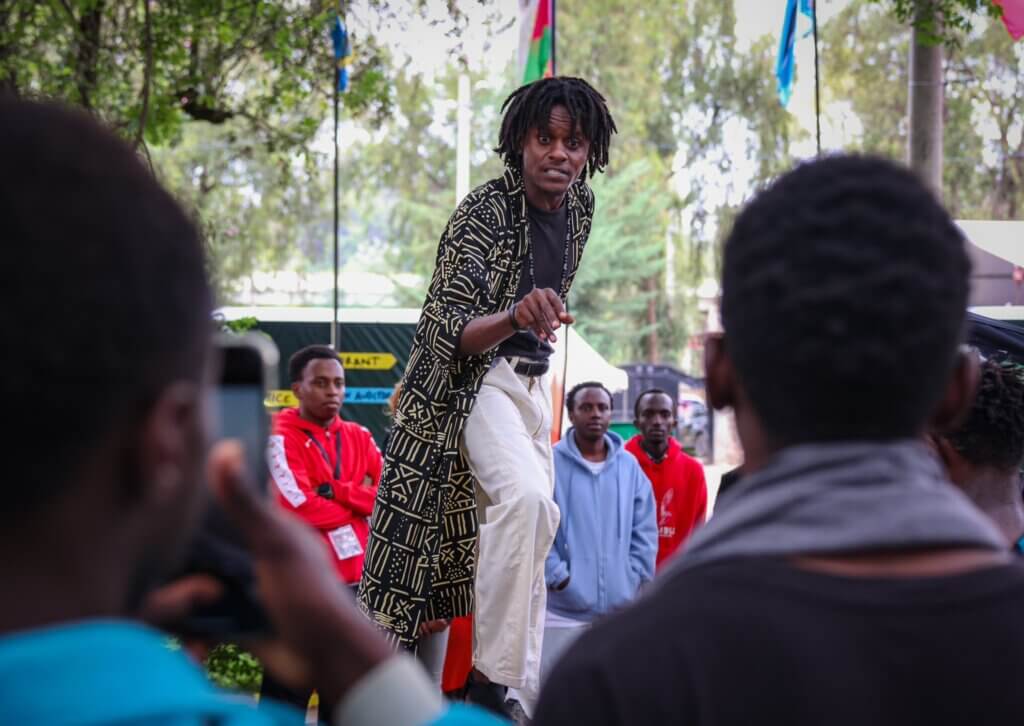
Story za Thuita is as much an artistic experiment as it is a political statement. It is a search for theatre stripped of walls, tickets, and formalities, where performance becomes immersive, democratic, and alive in the unpredictable energy of the streets. “I wanted to tell the historical stories of Nairobi, and I knew the theatrical walls just wouldn’t do. I had to package it as a narrative and take it to the streets – like a tour guide.” Thuita holds a Management in Tourism degree from Kenyatta University, and he indeed handles his street performances like a masterful tour guide – if tour guides were visceral, charismatic stage magnets.
The very idea of abandoning the proscenium for the streets is an act of rebellion. And all rebellion is political. Story za Thuita carries a radical political impulse. It reclaims theatre from elite cultural spaces and returns it to the public, to the streets where ordinary Nairobians who might not have access to the lofty theatres live and work. It challenges the class barriers that often define theatre culture, rejecting ticketed auditoriums and institutional stages in favour of a democratic artform accessible to anyone willing to pause and listen.
In this sense, Story za Thuita becomes a form of cultural resistance, insisting on visibility for the common mwananchi while reclaiming public space as a site for imagination, dialogue and expression in a city increasingly shaped by commerce and exclusion. Beneath its playful immediacy lies a political belief that theatre can still function as a civic act: a way of meeting the public, sharing experience, and briefly reshaping the social life of a city constantly yearning. And Thuita Mwangi, the man behind it all, is just getting started. His next show, in collaboration with Sanara Kenya, will be announced soon.
Looking for more theatre? See our roundup of Kenyan Theatre Shows to See in 2026 (So Far). You can also find this year’s film and TV releases in our What to Watch guide.
EDITOR’S NOTE:
All reporting, interviews, and reviews on Sinema Focus are protected under international copyright law and the Kenya Copyright Act, 2001. No part of this publication may be reproduced, rewritten, republished, or redistributed in any form by media outlets without prior written consent. For reprint or syndication inquiries, contact editorial@sinemafocus.com.
©️ 2026 Sinema Focus / African Film Press. All rights reserved.
Never miss a moment.
Get the latest stories from Sinema Focus delivered straight to your inbox. Subscribe to our newsletter now.