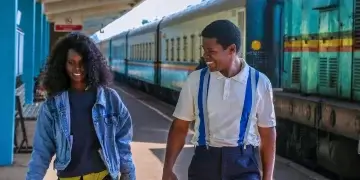


For a creative widely recognised for his striking cinematic shots, Ugandan filmmaker Loukman Ali now finds himself enjoying writing more than what he has most often been praised for: cinematography. It is a change that feels less like a rejection of the visual than a settling into something quieter and more deliberate.
Ali had a relatively quiet 2025, at least on the surface. But behind the scenes, he has been working on his next feature, Cakewalk, currently in development – though he insists this is still a working title during this interview. The conversation moves easily between process and doubt, his evolving approach, past work and unfinished ideas.
Stay ahead of Kenya & East Africa’s film and TV.
Get our stories in your inbox — Subscribe to our newsletter now.
Cakewalk is a story about a struggling filmmaker who is kidnapped by his ex-girlfriend and taken on a wild drug ride. “I think I have something better written down somewhere,” he says of the logline.
Ali considers Cakewalk his second chance to correct the mistakes he made in The Girl in the Yellow Jumper. Both films are road trip films, as he describes them. “I’m kind of trying to go with the same formula but do a version that I’m happy with, because I was never happy with The Girl in the Yellow Jumper,” he says.
Ali has always approached filmmaking from a visual standpoint, creating storyboards and working backwards from image to narrative. But he’s evolving, now focusing on the writing as the lead in his creative process, and Cakewalk is a manifestation of that.
“Lately, I’ve noticed I’m more interested in the script and in the characters,” says Ali. He’s enjoying the process of writing more than production itself, describing it as both “therapeutic and difficult.”
“Anytime I feel a certain way, I just get into this bubble and start writing,” he says. He recalls deleting the first 30 pages of a 111-page script after receiving notes from a Hollywood script editor, and finding pleasure in rebuilding it. “It was such a good feeling having to figure out a way to fix all those problems that I’d created by deleting pretty much the entire first act.”
Ali adds that writing is also where the industry’s biggest issues lie. “The stories are nice but the way they’re presented, the screenplays are just not there yet.”
Having focused on visuals in the past, he now finds that aspect comes naturally. “I don’t overthink it. By the time I have a script that makes sense, everything else feels obvious and just falls into place.”
He’s having a lot of fun building characters and chaos from very simple ideas. “I try to throw as many misfortunes at the characters as fast as possible,” he says.
Writing Cakewalk began as a stream of consciousness, and after page 30, he started thinking more about it. By page 60, he had learnt to build a more complex and interesting world for his characters or “make the characters’ lives miserable” as he calls it. “At this stage, I’ve learnt more about the characters. There’s a whole lot of discovery,” he says.
Ali’s writing process also involves thinking about how to bring his “crazy” ideas to life. “I have to start thinking about how to shoot all these things in Uganda and how possible they are.” There’s a lot of action in Cakewalk. “I start thinking, how will this be shot?” But he also doesn’t allow the pressure or limitations of what’s possible define his work. “When I’m writing, I don’t care how I’m going to do them. Of course, there’s a limit and even if I don’t care, I’m writing the script and the scenes within reason.”
As far as genres go, Ali describes Cakewalk as more of a thriller than an action film. “It does have a couple of action sequences, but I wouldn’t classify it as action. That said, I’m sure people will still call it an action film because the lines are a bit blurred.”
Across many film industries, directors are known to collaborate repeatedly with the same actors, building creative partnerships that audiences have come to celebrate. From Martin Scorsese and Leonardo DiCaprio or Robert De Niro to Christopher Nolan and Cillian Murphy, Ryan Coogler and Michael B. Jordan to Jordan Peele and Daniel Kaluuya. For Ali, that kind of collaboration began with his 2020 film The Girl in the Yellow Jumper and Michael Wawuyo Jr., who he’s now worked with across seven projects. Cakewalk might be their eighth collaboration, going by the teasers Ali shared on Instagram in August 2025. Michael Wawuyo Sr. has also featured in two of Ali’s films alongside his son.
Casting the same actors is part of Ali’s filmmaking process, a way to capture his vision more effectively, particularly given his precise approach to writing and storyboardin
“When we get to the table read, most of the work is already done,” he says. “Once on set, I’m usually working closely with the DP on technical aspects, not explaining to actors how to act. That’s why I use same actors, I don’t want to be an acting coach. My role is to guide performance in terms of emotional points; what’s happening inside, what they’re trying to achieve, not how to act. If someone can’t do it, I’ll find someone else who can.”
It’s a very deliberate process for him, one that he admits may make him lose promising actors but he insists he doesn’t have the resources or time to teach actors on set. “I just don’t have the budget to take chances or try things. Sometimes I have to shoot for a day and it costs like 20 million. If I can’t finish it, I have to pay extra the next day,” he says. “That’s why sometimes I write for a specific actor. I have to work with people who I know will deliver, people who will not disappear because they’re tired or not feeling it. There are a lot of things to consider.”
Over the course of his career, Ali has crafted a name for himself as one of the most distinctive filmmakers to come out of Uganda in recent years. One might even label him as part of a growing wave of genre filmmakers in Africa. His first feature The Girl in the Yellow Jumper was the first Ugandan title on Netflix, and was soon followed by Katera of the Punishment Island, part of Netflix and UNESCO’s short films anthology African Folktales Reimagined. His growing reputation also put him on the path to direct and serve as cinematographer on the Nigerian feature Brotherhood, produced by Jade Osiberu for Amazon Prime Video.
Ali exited Brotherhood in the final stages of production due to differences with the producer. “This was my first time working in Nigeria, the pressure and temperament were so different,” he says. “There might have been a lack of understanding on my side of exactly how things work there. On the producer’s side, there might have been a lack of patience or an understanding that I’m from a different background where things are done differently.”
He frames the experience less as conflict and more as miscommunication and cultural differences in how people work and communicate across borders. “We later came to an understanding,” he adds. “In hindsight, now that I know a couple of things better, my collaborations with West Africans are a bit smoother.”
In Uganda, Ali approaches collaborations with great caution. “We always say things like ‘let’s collaborate, let’s collaborate’ but collaboration in Uganda often has no direction.” For him, many things have to align for it to work, a convergence of skills rather than collaboration for the sake of it. “What you need is someone good at this, someone good at that, coming together to do something better than all of us put together,” he says. “But there’s always this feeling like we’re coming together because that is what is expected.”
He identifies audio engineer and composer Andrew Ahuura as one of his long-time collaborators. “Whoever I’m collaborating with has to share a vision. They have to see what I’m trying to achieve and help me achieve it, work with me on that, and not try to impose their own vision on me, because that’s probably not going to work,” he says.
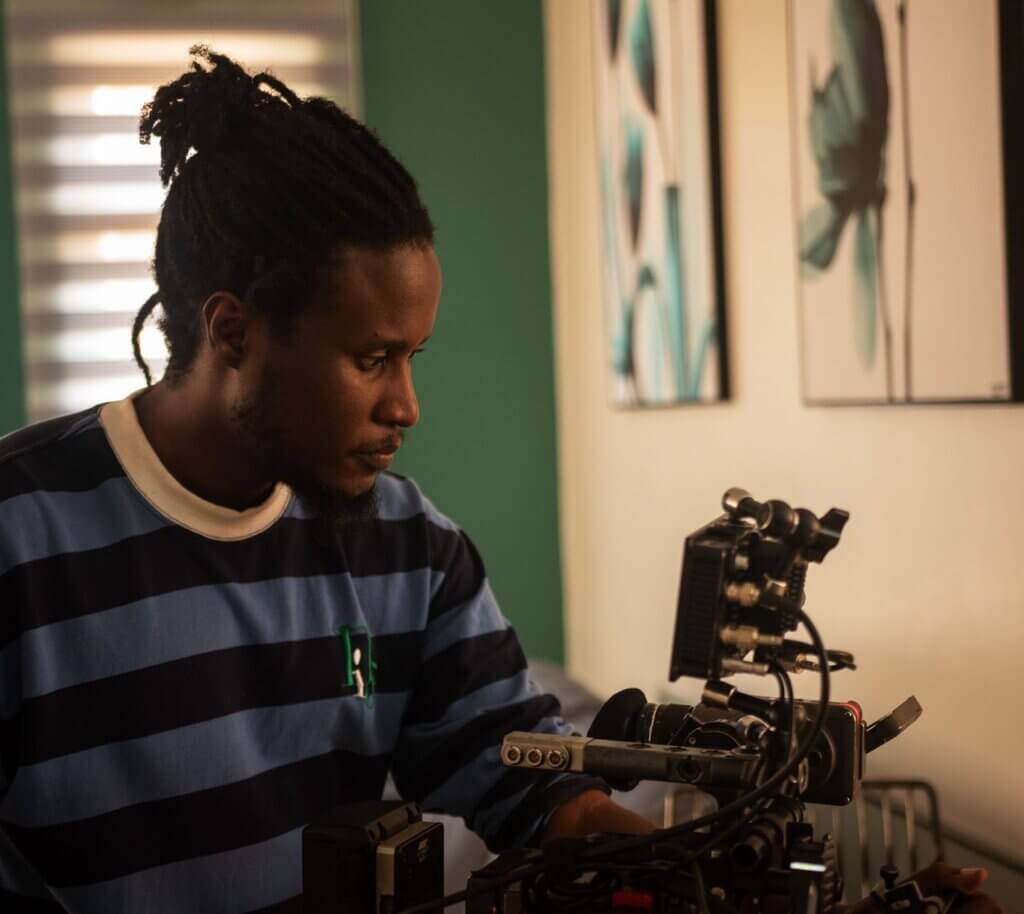
Ali has cultivated a recognisable visual identity and recurring motifs across his films. For instance, The Girl in the Yellow Jumper and Sixteen Rounds each feature a character in a gas mask, while Cakewalk and The Girl in the Yellow Jumper also share structural similarities – both unfold as road trip stories. Revenge is also a common theme across his work. “I guess I fantasise so much about people not getting away with stuff,” he says. Yet he still feels he’s only beginning to come into his own style.
“I feel like I’m starting to come into my own and become more confident in my stuff, especially in my recent work, the things that I’m writing and creating now,” he says. “I think I will have my kind of style in my future work.”
But he’s not worried that his films may begin to look the same, seeing it instead as part of a longer process of self-discovery rather than creative stagnation.
“I don’t believe having a style is boring or predictable,” he says. He compares it to attending a Lucky Dube concert: “You know what to expect; that’s what you paid for.”
For Ali, familiarity is not a flaw but a feature. “People say they don’t want predictability, but human beings like familiar things,” he adds. “I have a couple of stories that are kind of similar, but then again, most stories are similar. We just change the setting and present something in a way that hasn’t been seen before, and that’s a new film.”
Rather than agonising about predictability, what matters more to Ali is that his work is, above all, entertaining.
He believes that not attending a traditional Ugandan film school helped him avoid a didactic approach common in much African cinema – films shaped by documentary or PSA traditions that insist on moral instruction. “The films we grew up with were about entertainment so I’ve been trying to emulate that,” he says. But he’s quick to clarify the balance he tries to strike. “It’s not just about a film being entertaining, but entertainment that also has something to say.”
As a storyteller who’s mostly worked in films, would he seek to capture this entertainment in TV shows? It’s something he wouldn’t jump into happily, especially if it involves long-running episodes such as the telenovelas that have gained popularity on local M-Net channels across East, West and Southern Africa. “I would do it for money, but I wouldn’t be happy,” he says. He doesn’t, however, mind short-format series. “TV shows that are like regular human-being episodes. Yeah, like the normal episodes we see on TV, not 3,000 episodes, that’s too much. I’m more interested in doing miniseries, like the ones on Showmax or Netflix.”
Cakewalk, which Ali hopes will release in 2026, comes six years after The Girl in the Yellow Jumper. In between, he has directed a number of short films that came with far greater consistency, something he says was driven by learning rather than urgency. “I was trying to educate myself on some parts of production,” he explains.
Now that his focus has shifted almost entirely to writing, he places no pressure on output. “I’ll make films when I am able to, whether that’s in the four or five years, whatever happens, happens,” he says.
EDITOR’S NOTE:
All reporting, interviews, and reviews on Sinema Focus are protected under international copyright law and the Kenya Copyright Act, 2001. No part of this publication may be reproduced, rewritten, republished, or redistributed in any form by media outlets without prior written consent. For reprint or syndication inquiries, contact editorial@sinemafocus.com.
©️ 2026 Sinema Focus / African Film Press. All rights reserved.
Never miss a moment.
Get the latest stories from Sinema Focus delivered straight to your inbox. Subscribe to our newsletter now.